

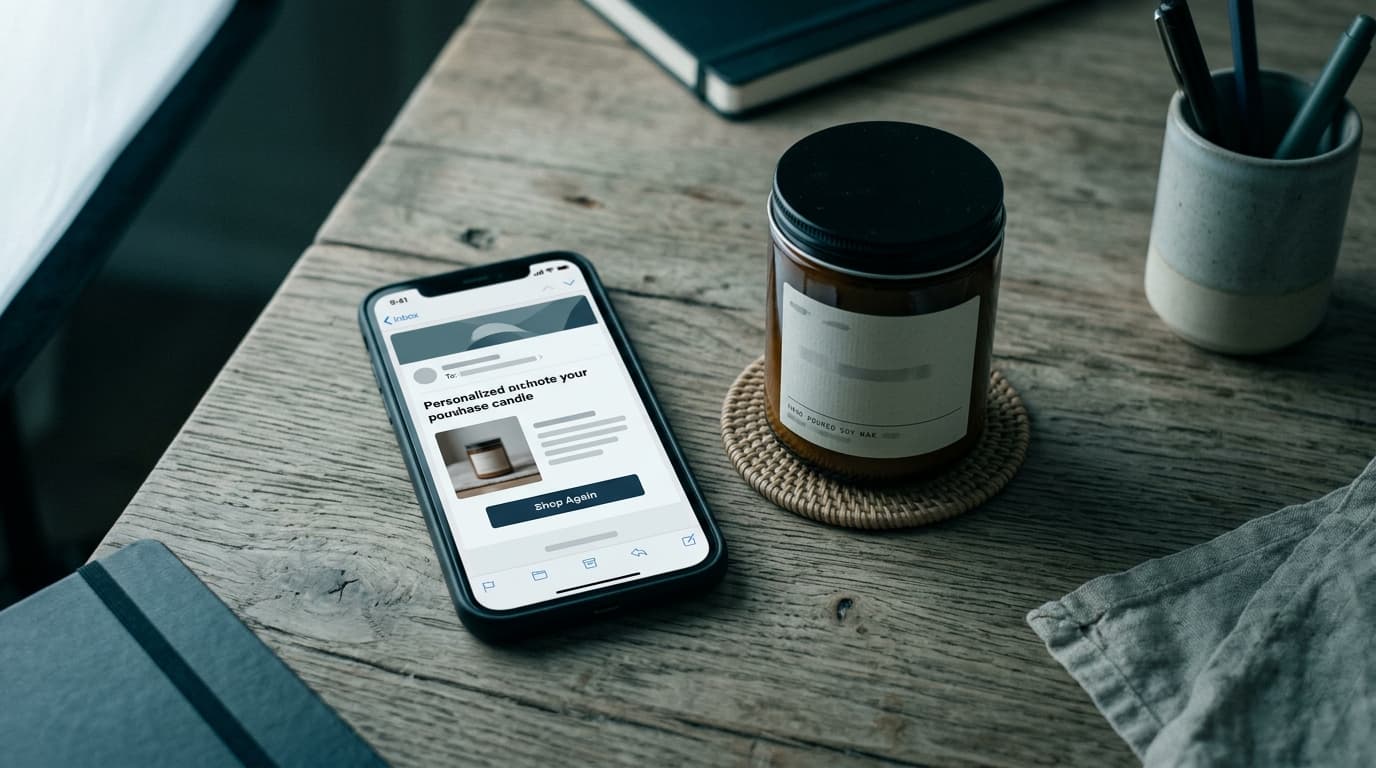
A post-purchase email sequence is the series of automated emails a customer receives after buying from your store, designed to turn a one-time transaction into a long-term relationship. Most eCommerce stores get this wrong. They mistake the default Shopify order confirmation for a strategy. It is not.
The common wisdom is that once the credit card is charged, the hard part is over. The sale is won. In reality, the most vulnerable moment in the customer relationship is the space between clicking “buy” and the product arriving. This is where retention is either earned or lost. A good post-purchase sequence does more than confirm an order; it eliminates buyer’s remorse, builds anticipation, and lays the groundwork for the second purchase.
The Failure Mode: Confusing Transactional Emails for a Relationship
The mistake to avoid: trusting that your eCommerce platform's default notifications will handle customer retention. They will not. Those emails are transactional receipts; they confirm an action. They are not designed to build a relationship. The typical failure pattern is a loud silence. A customer buys, gets an automated receipt, gets a shipping notification, and then… nothing. They are dropped back into the generic marketing pool, receiving the same newsletters as someone who has never purchased. This teaches the customer that they are a transaction, not a member.
The result is a leaky bucket. You spend heavily on acquisition to get a customer, only to lose them to neglect. The invisible substrate of the customer journey is ignored; the relationship withers before it begins.
The Anatomy of a Sequence That Actually Works
A successful post-purchase flow is a conversation that unfolds over the first 30 days. It has a clear narrative arc, moving from reassurance to education to the next logical purchase. In our experience building these for clients, a six-part sequence is the most effective starting point. It can be adapted for different product types, but the psychological progression is canonical.
Email 1: Reinforce the Decision Immediately (Sent: 0-1 hours after purchase)
This is not just another order confirmation. While it includes the necessary details (order number, items, shipping address), its primary job is to fight off buyer's remorse. The customer just gave you their money; your first communication back needs to make them feel brilliant for doing so.
- What it includes: A warm, genuine thank you. A picture of the founder or team. A reminder of your brand’s mission or what makes your product special. A link to your help center or FAQ.
- What it does: It replaces the cold, robotic confirmation with a human welcome. It shifts the feeling from "I just spent money" to "I just joined something."
Email 2: Build Anticipation, Don't Just Send a Tracking Link (Sent: When order ships)
Your platform sends a shipping notification automatically. Your job is to make it better. The default version is purely functional. A strategic shipping email builds excitement for the product's arrival. This is low-hanging fruit - the open rates on these emails are astronomically high.
- What it includes: The tracking number, of course. But also, content that helps the customer prepare. If they bought a skincare product, link to a "How to Prep Your Skin" guide. If they bought a coffee maker, send your favorite recipe.
- What it does: It uses the moment of highest anticipation to provide value and deepen the brand connection before the box even lands.
Email 3: The Arrival Check-In (Sent: 2-3 days after delivery)
This email has one job: to make sure everything went smoothly. It is a customer service email, not a sales email. Sending this proactively shows you care about the customer's experience, not just their wallet. It also helps you catch and resolve issues before they become negative reviews.
- What it includes: A simple, direct question: "How is everything?" or "Did your order arrive safely?" Provide direct links or contact info for support.
- The mistake to avoid: Do not ask for a review here. It’s too soon. They haven’t even had a chance to properly use the product yet. Asking now feels grasping and transactional.
Email 4: Unlock the Full Product Value (Sent: 7 days after delivery)
The customer has the product. Now, help them get the most out of it. This email establishes your authority and demonstrates that your commitment extends beyond the sale. This is where you create power users.
- What it includes: Pro-tips, care instructions, a video tutorial, or user-generated content showing how other customers use the product.
- What it does: It reduces the chance of misuse or disappointment and makes the customer feel like an insider. This is how you build topical authority in your customer's inbox.
Email 5: The Smart Review Request (Sent: 14-21 days after delivery)
Now you can ask for the review. The customer has received the product, confirmed it's what they wanted, and learned how to use it properly. They are at peak satisfaction. A request for a review now feels earned, not demanded.
- What it includes: A direct, simple request. Make it as frictionless as possible by linking directly to the product page's review section. Briefly explain why reviews are important (e.g., "it helps other customers like you make the right choice").
- Honest tradeoff framing: You can incentivize reviews with a small discount, but be transparent about it. The honest version is slower but builds more credible social proof; incentivizing too heavily can look like you're buying reviews and attract lower-quality feedback.
Email 6: The Relevant Next Step (Sent: 25-30 days after delivery)
This is the first time you explicitly ask for another sale. After a month of providing value, you've earned the right. The key is to make the offer feel like a logical next step, not a random promotion. This requires segmentation.
- What it includes: A cross-sell of a complementary product (the conditioner that goes with the shampoo they bought) or a restock reminder for consumable goods.
- What breaks: Sending a generic "10% off everything" coupon. It ignores their purchase history and signals you don't actually know who they are. The offer should demonstrate you were paying attention.
Alright. Coffee's ready. Let's talk about why this actually drives revenue.
Running a sequence like this isn't just about making customers feel good. It is a direct lever on Customer Lifetime Value (LTV). The entire goal is to decrease the time between first and second purchase and increase the overall repeat purchase rate. In practice, stores with no post-purchase strategy see repeat rates in the single digits. Implementing a basic sequence often doubles that. A properly segmented, value-driven sequence can push it even higher.
This isn't a "set it and forget it" machine. You have to watch the metrics. Are open rates high but click-through rates low on your education email? The content is probably wrong. Is no one using the discount code in your cross-sell email? The offer is likely irrelevant to the first purchase. The sequence is a system; each email is a gear that has to mesh with the others.
The Concrete Handoff
Your work starts with an audit. Map your current customer experience from the moment they click "Complete Order" to 30 days later. Open a spreadsheet and list every single communication they receive from you. Note the sender, the subject line, and the core message. You will likely find large, silent gaps. Your first task is to build the email that fills the biggest and most damaging gap - which is almost always the value-add email between product arrival and the review request. Start there. That single email can be the difference between a one-time buyer and a repeat customer.
Post-Purchase Email Sequences: How to Turn First-Time Buyers FAQ
How many emails should be in a post-purchase sequence?
A good starting point is 5-6 emails sent over the first 30-45 days. This allows you to cover the key touchpoints - confirmation, education, a review request, and a cross-sell - without overwhelming the customer. The exact number depends on your product's complexity and usage lifecycle.
When is the best time to ask for a product review?
The best time to ask for a review is after the customer has had enough time to actually experience the value of the product. For most physical goods, this is 14-21 days after delivery. Asking too early feels premature and can lead to lower-quality reviews.
Should I offer a discount in my post-purchase emails?
Yes, but strategically. Avoid offering a discount in the first few emails. The initial focus should be on value and reassurance. The best place for a discount is in the final email of the initial sequence (around day 30) as an incentive for a second purchase, ideally tied to a product that complements their first order.