

Post-Purchase Email Flows: How to Drive Repeat Revenue and LTV on Shopify
Post-purchase email flows are automated sequences triggered after a customer completes a transaction - and they consistently outperform promotional campaigns, generating 2–5× higher open rates and significantly more repeat purchases than standard broadcast emails. For Shopify merchants, a well-architected post-purchase flow is the single highest-ROI lever for increasing customer lifetime value (LTV).
Most stores nail the acquisition side and then go silent. That silence is expensive. Acquiring a new customer costs 5–7× more than retaining an existing one, which means every dollar you don't spend nurturing past buyers is a dollar working against your margins. Here's how to build post-purchase flows that turn one-time buyers into loyal customers - with specific sequences, timing, and tactics that work in 2027.
Why Post-Purchase Flows Matter More Than Ever
Shopify's merchant base has grown intensely competitive. Ad costs on Meta and Google have climbed steadily, squeezing return on ad spend (ROAS) across most niches. The stores that win aren't necessarily spending more on acquisition - they're extracting more value from customers they already have.
A customer who buys twice is roughly 9× more likely to buy a third time. That behavioral shift from first to second purchase is the most important conversion event in e-commerce, and post-purchase email is your primary tool for making it happen.
The 5 Core Post-Purchase Email Sequences
1. Order Confirmation + Brand Welcome (Day 0–1)
The order confirmation email has the highest open rate of any message you'll send - often above 70%. Most stores treat it as a transactional receipt and nothing more. That's a missed opportunity. Layer in a brief brand story, set expectations for delivery, and introduce one complementary product category. Keep the upsell soft here; the primary job is to reinforce the buyer's decision and reduce post-purchase anxiety.
2. Shipping and Delivery Updates (Day 1–5)
Shipping notification emails see open rates of 50–65%. Use them strategically. Go beyond the tracking number - include tips for using the product, link to a how-to video, or tease what's in your catalog that pairs well with what they just bought. Shopify integrates directly with tools like Klaviyo and Postscript, letting you trigger these based on fulfillment events automatically.
3. Product Education and Onboarding (Day 3–7)
Once the package has arrived, send a dedicated email focused entirely on helping the customer get maximum value from their purchase. This is especially powerful for consumables, supplements, skincare, and any product with a learning curve. Include usage instructions, video content, user-generated results, and a direct path to your support team. Customers who feel successful with a product come back to buy more of it.
4. Review Request + Social Proof (Day 7–14)
Timing matters here. Send a review request too early and the customer hasn't had time to form an opinion. Send it too late and the excitement has faded. Day 10–12 after delivery is the sweet spot for most physical product categories. Use a tool like Okendo, Junip, or Yotpo (all with native Shopify integrations) to collect structured reviews. Incentivize with a small discount on a future order - this bridges directly into your repeat-purchase objective.
5. Replenishment or Cross-Sell Sequence (Day 14–45)
This is where LTV is won or lost. Build logic based on product type: consumables get a replenishment reminder calibrated to average usage cycles (a 30-day supply gets a nudge at Day 22–25); non-consumables get a cross-sell based on purchase history and catalog affinity. Klaviyo's predictive analytics and Shopify's purchase data combine to make this segmentation highly precise in 2027.
Post-Purchase Flow Comparison: Basic vs. Optimized
Element Basic Flow Optimized Flow Emails in sequence 1–2 (confirmation only) 5–8 across 45 days Personalization First name, order number Product-specific content, predicted next purchase Segmentation All buyers in one flow Split by product category, AOV, and new vs. returning Review collection None or generic Timed, incentivized, platform-integrated Cross-sell logic Static featured products Dynamic recommendations based on purchase history Avg. repeat purchase rate 12–18% 28–40% (varies by niche)Segmentation: The Variable That Separates Good Flows From Great Ones
A single post-purchase flow for all buyers is better than nothing. But segmented flows are where the real revenue lives. At minimum, split your sequences by:
- First-time vs. returning buyers- returning customers need less brand education and more product discovery
- Product category- a skincare buyer and a supplement buyer have completely different usage cycles and cross-sell affinities
- Order value tier- high-AOV buyers often respond better to premium upsells and loyalty program pitches
- Acquisition source- paid social buyers sometimes need more trust-building than organic or referral buyers
Shopify's customer data platform capabilities, combined with Klaviyo's conditional splits, make this kind of segmentation accessible without a dedicated developer. Set it up once and let it compound.
Timing and Frequency: Rules of Thumb
Over-emailing post-purchase is a real risk. Here's a clean framework:
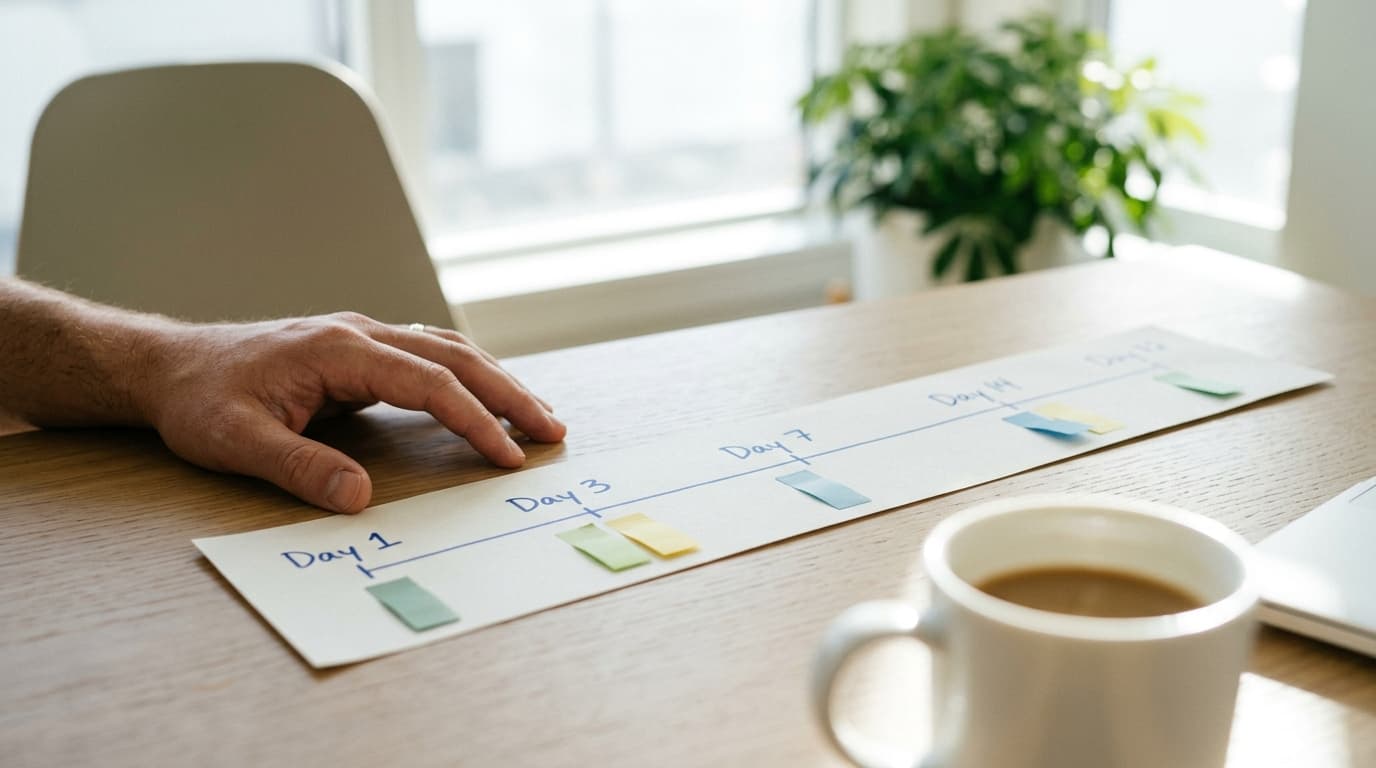
- Day 0: Order confirmation (immediate)
- Day 2: Shipping update with brand content layered in
- Day 5: Delivery confirmation + product onboarding
- Day 10: Review request with small incentive
- Day 21: Cross-sell or replenishment email
- Day 35–45: Win-back trigger if no second purchase has occurred
Six emails over 45 days is not aggressive - it's a relationship. Monitor unsubscribe rates at each step. If Day 5 is spiking unsubscribes, the content isn't delivering enough value. Adjust the offer or the copy before blaming the timing.
Metrics to Track for Post-Purchase Flow Health
Don't optimize blindly. These are the KPIs that actually matter:
- Repeat purchase rate (RPR): percentage of customers who buy again within 90 days - your north-star LTV metric
- Flow-attributed revenue: total revenue directly credited to post-purchase sequence emails in your ESP
- Time to second purchase: the faster this shortens, the healthier your flow is
- Review conversion rate: percentage of review-request recipients who submit a review
- Unsubscribe rate per email: anything above 0.5% on a single email warrants immediate investigation
Toolstack for Shopify Post-Purchase Flows in 2027
The most widely used and proven combination for Shopify post-purchase automation includes Klaviyo for email and SMS automation, Okendo or Junip for review collection, Rebuy or CartHook for post-purchase upsell pages (pre-email), and Gorgias for support integration. All four connect natively to Shopify without custom development.
If you're earlier stage and want a simpler setup, Shopify Email paired with Shopify Flow handles basic post-purchase sequences directly inside the admin - no third-party ESP required to get started.
The LTV Compounding Effect
Here's the math that makes this worth prioritizing: if your average order value is $65 and your current repeat purchase rate is 18%, lifting that rate to 30% through an optimized post-purchase flow doesn't just add one extra order per customer. It shifts those customers into higher loyalty tiers, increases their AOV over time, and dramatically reduces your effective customer acquisition cost (eCAC) because retained customers also refer others.
A 12-percentage-point increase in RPR for a store doing 1,000 orders per month equals 120 additional orders - at zero acquisition cost. At $65 AOV, that's $7,800 per month in pure retained revenue, or $93,600 annually, from flow optimization alone.
Build the sequences, segment them thoughtfully, and review the metrics quarterly. Post-purchase email is not a set-and-forget system - it's a living asset that compounds in value as your catalog and customer base grow.
What is a post-purchase email flow?
A post-purchase email flow is an automated sequence of emails triggered after a customer completes a purchase. It typically spans 30–45 days and includes order confirmations, shipping updates, product education, review requests, and cross-sell or replenishment offers - all designed to increase repeat purchase rates and customer lifetime value.
How many emails should a Shopify post-purchase flow contain?
An optimized post-purchase flow contains 5–8 emails spread across 45 days. The sequence starts with an immediate order confirmation and ends with a cross-sell or win-back trigger around Day 35–45. Fewer than 3 emails leaves significant revenue on the table; more than 8 within 30 days risks unsubscribe spikes.
What's the best tool for post-purchase email automation on Shopify?
Klaviyo is the most widely adopted email automation platform for Shopify in 2027, offering native integration, predictive LTV analytics, and deep segmentation. For simpler setups, Shopify Email combined with Shopify Flow provides a no-cost starting point directly inside the Shopify admin.
When should I send a review request email after purchase?
Send the review request 10–12 days after confirmed delivery. This window gives customers enough time to use the product and form an opinion while the purchase is still fresh. Pairing the request with a small discount on a future order increases response rates and directly supports your repeat-purchase goal.
How do I measure whether my post-purchase flow is working?
Track four core metrics: repeat purchase rate (RPR) within 90 days, flow-attributed revenue reported in your email platform, time to second purchase, and unsubscribe rate per email. A healthy flow improves RPR by 10–20 percentage points versus no flow and keeps per-email unsubscribe rates below 0.3–0.5%.