
When AI recommends a business like yours, is your site even readable?
Free AI Visibility Check. ChatGPT, Claude, and Perplexity are answering the searches that used to go to Google - and they can only cite sites they can actually understand. Scan yours free to see which AI-readiness signals you have, and which you're missing.
Free · no signup · scores the 15 signals AI uses to find you · ~20 seconds. We save the URL and score to improve the tool and may follow up - see our privacy policy.
Free checkup
How does your site compare to ours? Run a live PageSpeed audit.
Real Google PageSpeed Insights. See your performance, accessibility, best-practices, and SEO scores in about 20 seconds.
Audited at 1digitalagency.com · Desktop strategy
01 / What the sweep reads
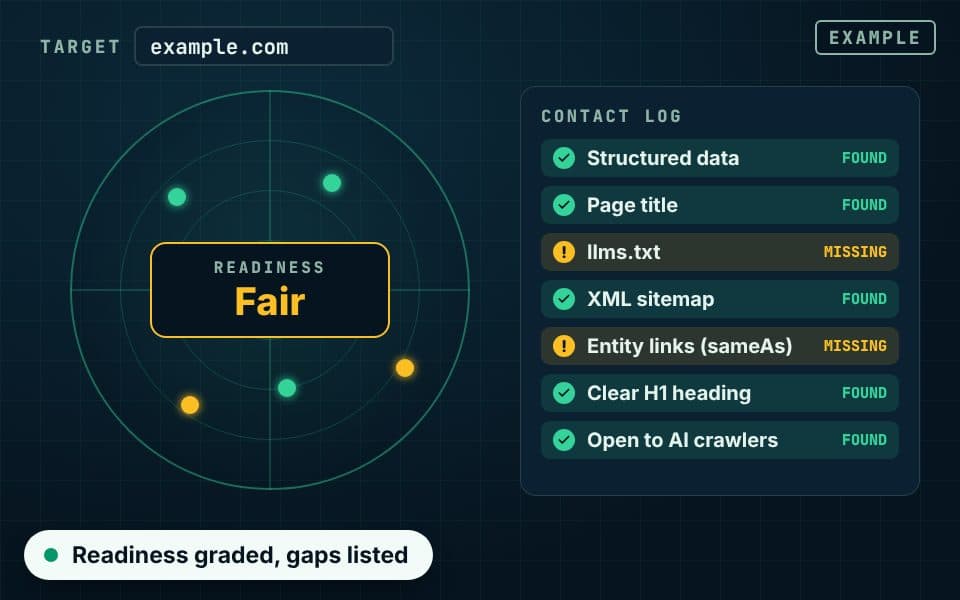
15 signals, plotted on three rings
Each contact on the scope is one check. The inner ring is the page itself, the middle ring is what machines parse, and the outer ring is whether crawlers can get in at all.
Inner ring
Page basics
- Page titlePresent and sized to describe the page.
- Meta descriptionA clean summary AI can quote.
- Clear H1 headingOne heading that states the main topic.
- Logical subheadingsH2 sections AI can extract.
- Mobile viewportMobile-first crawlers render the page right.
Middle ring
Machine-readable
- Structured data (schema.org)JSON-LD that says what your business is.
- Entity links (sameAs)Ties your brand to profiles AI can cross-reference.
- Open Graph tagsClean previews when a page is shared or summarized.
- Canonical URLOne true URL, no duplicate confusion.
- Image alt textMultimodal AI can read your visuals.
Outer ring
Crawler access
- Open to AI crawlersrobots.txt lets AI bots reach your content.
- llms.txt (AI crawler guide)A curated guide to what matters.
- XML sitemapA full map so deep pages get found.
- Readable content without JavaScriptReal text in the raw HTML.
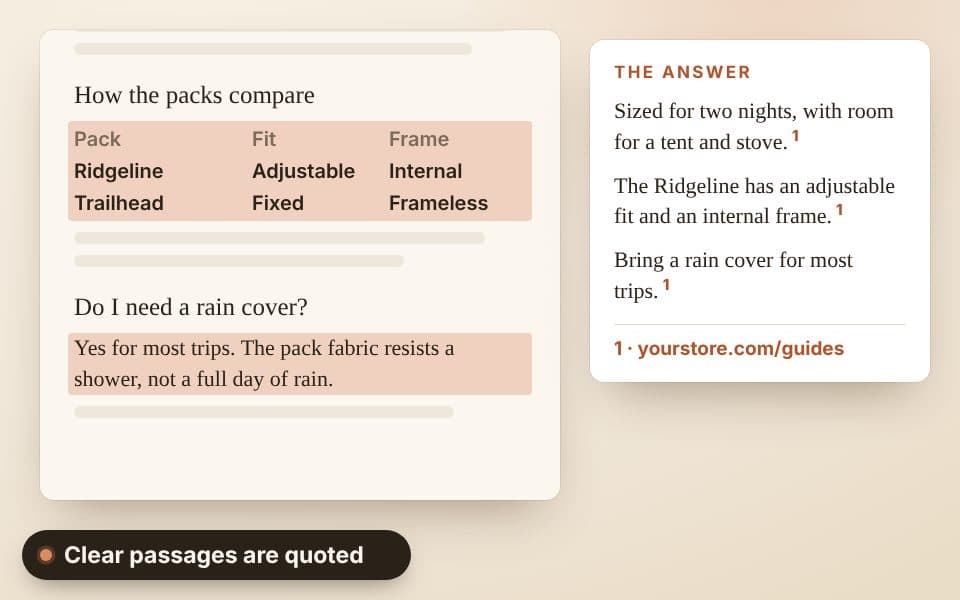
- Answer-ready structureQ&A that AI can lift as a direct answer.
What this checks (and what it doesn't)
This scan reads your public page, llms.txt, sitemap, and robots rules to grade the technical signals AI assistants use to find and cite a business - structured data, metadata, crawlability, and more.
It's an honest readiness score, not a guarantee of any specific AI result or proof that AI cites you by name - that's what our AEO Audit measures.
02 / How a sweep works
We read your site the way an AI crawler does
- Step 01Enter a URLType any public page into the scope. The sweep takes about 20 seconds.
- Step 02We read what a crawler readsYour public page, llms.txt, sitemap, and robots rules, the same files AI crawlers fetch.
- Step 03Each signal is gradedEvery check reads pass, warning, or fail, and the page gets an overall grade from Poor to Excellent.
- Step 04A speed scan followsOnce the AI check is done, a PageSpeed scan of the same URL runs further down the page.
03 / Readable, then cited
Being readable is step one. Being named is step two.
This free check
Can AI read your site?
A readiness score for one page and its crawler files, right now.
AI Visibility by Found in AI
Is it changing over time?
Asks ChatGPT, Claude, Perplexity, Gemini and Google AI Overviews your customers' questions on a schedule and shows whether each answer names you. How tracking works
04 / From gaps to fixes
Every amber contact comes with a fix
Your results explain why each missing signal matters. When you want them closed, a senior strategist turns the gaps into a prioritized roadmap.
- llms.txt (AI crawler guide)We draft and maintain a /llms.txt so AI assistants index the right pages.
- Entity links (sameAs)We add sameAs links (social, Wikidata, directories) so AI resolves you to a single, verified entity.
- Image alt textWe write descriptive alt text on every image so multimodal AI can read your visuals.
- Structured data (schema.org)We build Organization, LocalBusiness, and page-level schema so AI reads your entity, not its guesswork.
In depthWhat a pass and a miss look like, signal by signal
Page basics
- Page title
- Pass: Present and sized to describe the page.
- Miss: Missing or empty, the single most important on-page signal.
- Meta description
- Pass: A clean summary AI can quote.
- Miss: Missing, so AI has to invent a summary of your page.
- Clear H1 heading
- Pass: One heading that states the main topic.
- Miss: No H1, or several that blur the main topic.
- Logical subheadings
- Pass: H2 sections AI can extract.
- Miss: No H2s, so AI can't tell where one topic ends.
- Mobile viewport
- Pass: Mobile-first crawlers render the page right.
- Miss: No viewport tag, so mobile-first crawlers may render it wrong.
Machine-readable
- Structured data (schema.org)
- Pass: JSON-LD that says what your business is.
- Miss: No JSON-LD, so AI has to guess what your business is.
- Entity links (sameAs)
- Pass: Ties your brand to profiles AI can cross-reference.
- Miss: Nothing connects your brand to its profiles across the web.
- Open Graph tags
- Pass: Clean previews when a page is shared or summarized.
- Miss: Missing, so AI and social tools fall back to raw, messy text.
- Canonical URL
- Pass: One true URL, no duplicate confusion.
- Miss: No canonical tag, so duplicate URLs can split your visibility.
- Image alt text
- Pass: Multimodal AI can read your visuals.
- Miss: Images without alt text are invisible to multimodal AI.
Crawler access
- Open to AI crawlers
- Pass: robots.txt lets AI bots reach your content.
- Miss: robots.txt blocks crawlers, or opts out named AI bots like GPTBot.
- llms.txt (AI crawler guide)
- Pass: A curated guide to what matters.
- Miss: No /llms.txt, so AI crawlers get no curated guide.
- XML sitemap
- Pass: A full map so deep pages get found.
- Miss: No sitemap, so new and deep pages may go undiscovered.
- Readable content without JavaScript
- Pass: Real text in the raw HTML.
- Miss: Thin raw HTML. Most AI crawlers don't run JavaScript.
- Answer-ready structure
- Pass: Q&A that AI can lift as a direct answer.
- Miss: No FAQ schema or question headings, so AI synthesizes instead of quoting.





Want the full picture? See what a full AEO Audit includes →