

Your Search Console report shows impressions climbing and clicks sliding. As a content marketing agency, we've seen this on some client accounts. The pattern lines up with the period since Google began answering questions at the top of the results page, and while nobody can prove how many clicks AI Overviews absorb, the timing is hard to ignore. Google's tools don't report it. Here's what the numbers show and what to check first.
Ask Your Content Marketing Agency When Clicks Fell
Search results look different than they did two years ago. Google rolled out AI Overviews to everyone in the US in May 2024, placing a generated answer above the organic links for many queries, and by July 2025 Sundar Pichai told investors the feature reached 2 billion monthly users across 200 countries and territories.
Nearly any informational keyword can trigger a summary now. Any content marketing agency worth its retainer should line those dates up against your data, since a decline that begins after mid 2024 tells a very different story than one that started earlier, when algorithm updates or site changes are the likelier cause.
Search Console only keeps 16 months of data. Export your query report now, compare the last 90 days with the same 90 days last year, and ask your content strategy services provider to walk you through every keyword that lost clicks while its impressions grew.
Have a Content Marketing Agency Audit Your Clicks
Some of our client accounts show a split in their data. Impressions for certain keywords have risen year over year, clicks on those same keywords have dropped, and Google's Search Console help documentation offers a likely explanation for why the two numbers moved in opposite directions.
Every link inside an AI Overview shares one position, and standard impression rules apply. A content marketing agency reading that gap has a likely suspect, because Your page can earn an impression simply by appearing in an AI Overview's source list while the searcher reads the generated answer and leaves without ever clicking through to your site. A content marketing agency AI Overviews audit should flag this disconnect as a top-priority signal - it means your content is being read without generating a visit.
Google's generative AI performance report, live for all websites since August 31, 2026, shows impressions from AI Overviews and AI Mode but no clicks at all, so the visits you lose stay invisible in every report Google gives you. Start with keywords where impressions rose and clicks fell by more than 20%.
Sort Your Queries by Question and Purchase Intent
Question searches get hit first. Google builds summaries for queries it can answer outright, and a search like "how do I waterproof hiking boots" fits that mold far better than a product name, which is why Pew Research Center found AI summaries on 60% of queries that started with a question word.
That study tracked 68,879 real searches from 900 US adults in March 2025. Users who saw a summary clicked a traditional result on 8% of visits, compared with 15% when no summary appeared, and only 1% of visits included a click on a link inside the summary itself.
Tag every query in your export as a question, a comparison, or a purchase search. Then compare click trends across all three groups, and if you're a B2B team building lead generation content, run the same split on your own query list before planning next quarter's topics or deciding which old posts to refresh.
Plan for Searches That End on Google
More searches now end on the results page. The summary answers the question, so the searcher has no reason to open a second tab, scroll down to the blue links, or read a long article that repeats what Google already told them.
Pew found that users ended their browsing session on 26% of pages with an AI summary, compared with 16% without one, and Ahrefs measured a 58% lower average clickthrough rate for the top ranking page when an AI Overview appeared, comparing December 2023 with December 2025 across 300,000 keywords. Definition posts feel that drop first.
A marketing content strategy built mostly on them needs rebalancing. Move part of your SEO content creation budget away from "what is" articles and toward buying guides, collection page copy, and product content written for shoppers who already know what they want to buy.
Measure Revenue Before You Judge Clicks
Clicks and impressions describe visibility. Revenue tells you whether your content pays for itself, so our SEO leads at 1Digital judge a campaign by what organic traffic actually sells before they worry about click curves, and one client in the outdoors niche shows why.

From June 27 to September 24, 2026, that store's organic sessions rose 56% year over year, from 129,061 to 201,366, while engaged sessions rose 52%, organic key events grew 65% from 1,769 to 2,923, and organic revenue climbed nearly 50%. Across the accounts our SEO leads manage, organic search still drives most of the revenue.
None of those clients has lost significant sales to AI Overviews or chatbots so far. Build your content performance measurement around revenue and key events first, and treat impressions and clicks as diagnostic tools that point you toward the specific pages on your site that need a rewrite, a refresh, or better internal links.
Track AI Referrals as a Separate Channel
AI assistants send real visitors now. ChatGPT, Gemini, and Perplexity link to the sources behind their answers, and those clicks arrive in GA4 under their own referral domains instead of Google organic, which means they're easy to miss unless someone goes looking.
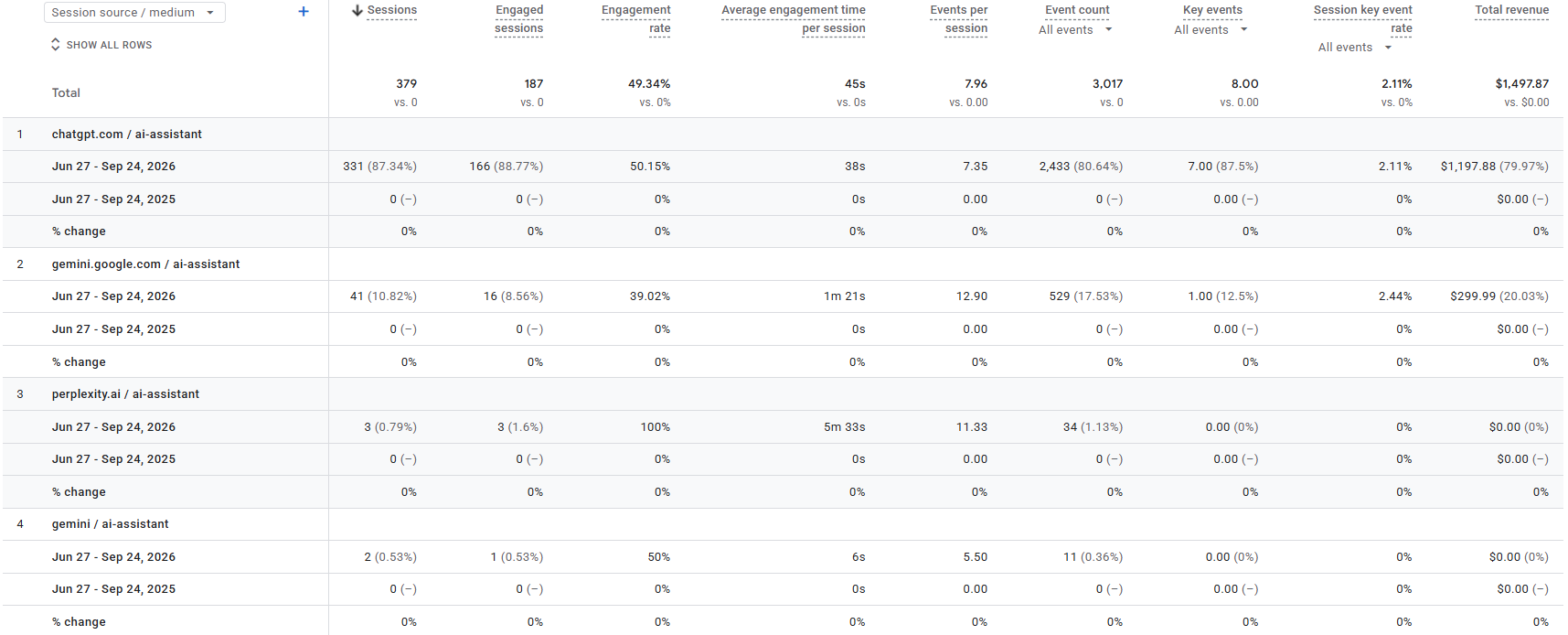
For the same outdoors client, AI assistants sent 379 sessions in the 90 days ending September 24, 2026, with 331 from chatgpt.com alone, and those visits converted at 2.11% against 1.42% for organic search while producing just under $1,500 in revenue from 8 key events. That's a small number.
It equals less than 0.2% of the store's organic sessions. Create a custom channel group in GA4 for chatgpt.com, gemini.google.com, and perplexity.ai so those sessions stop hiding inside general referral traffic and start showing up as their own line in the monthly reports your team reviews.
Earn Citations Inside the AI Answer
Getting cited wins back clicks. Searchers who want proof, sizing, or a product page click the sources listed inside the summary, and Seer Interactive found across 2.43 billion organic impressions and 53 brands that a brand cited in an AI Overview earned 120% more organic clicks per impression than one left out.
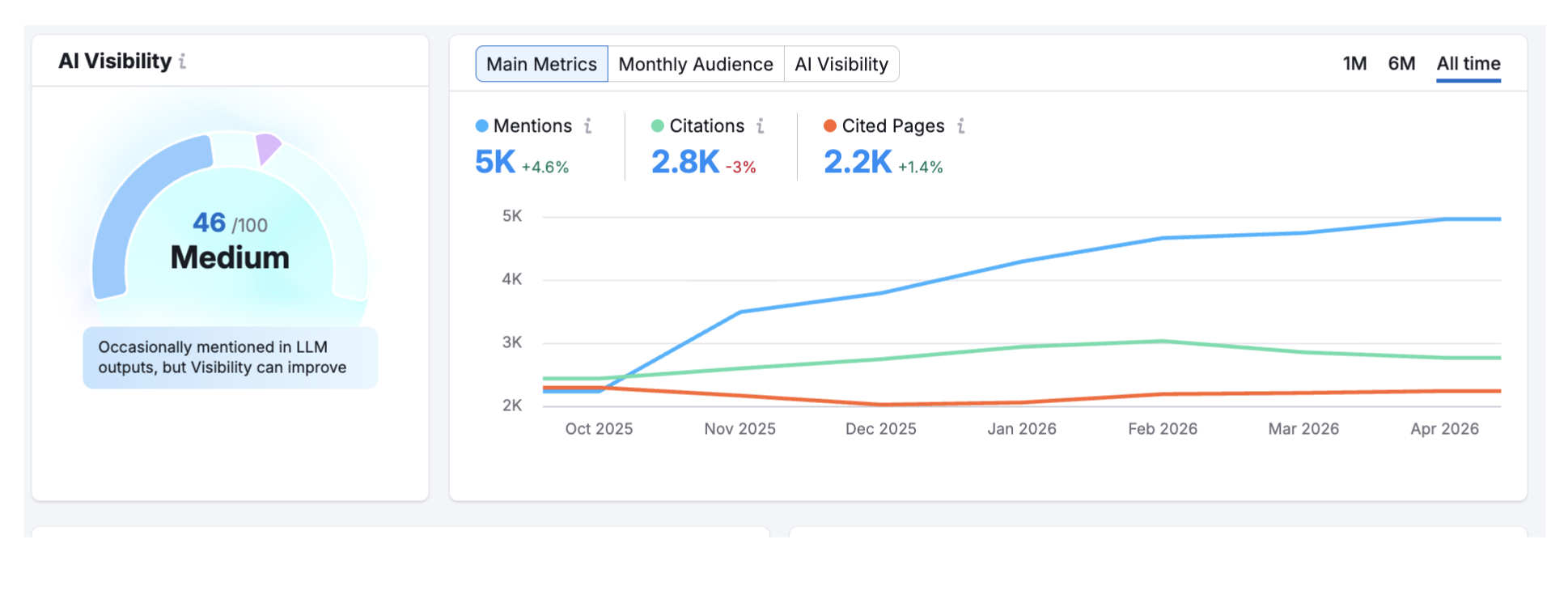
One of our clients, a sports bra brand, raised its Semrush AI Visibility score from 46 to 57 out of 100, and its mentions in AI answers climbed from about 2,300 in October 2025 to 5,000 by April 2026. That's more than double.
Clear specs, sizing charts, and Product schema give AI tools something concrete to quote. Run your brand through an AI visibility tracker like Semrush, list the prompts where competitors appear and you don't, then use our AI Overviews ranking guide to fix the schema, answer placement, and internal links on the pages that should be earning those citations.
Expand Category Pages for Buying Searches
Category pages are the safest bet. Google saves most summaries for informational questions, and Seer's 2026 data shows AI Overviews on 36% of informational queries compared with only 8% of commercial queries and 5% of transactional ones, so a shopper searching "women's trail running shoes" usually gets a grid of products instead of a paragraph.
Category expansion means building new collection pages for the terms buyers actually use, like material, activity, size range, or price point, each with an editorial intro, internal links to related collections, and a short FAQ. Every visitor lands one click from checkout.
eCommerce content marketing earns its keep here. Map the product attributes your shoppers search for most against your existing collections, then build pages for the gaps using our 2026 category page playbook and our breakdown of how AI Overviews affect product and category pages.
Hire a Content Marketing Agency That Tracks AI
AI SEO deserves the same attention as your Google rankings. OpenAI pulls product catalogs through its Agentic Commerce Protocol, Shopify merchants get included automatically through Shopify Catalog, and retailers like Target, Sephora, Best Buy, and Wayfair already share their catalogs this way, so their products appear inside ChatGPT with prices, reviews, and side by side comparisons.
Your data has to match everywhere. A digital content agency that handles search and AI visibility together will check your Product schema, feed accuracy, and on page specs against each other, from Google Shopping to ChatGPT, and our guide to product listings for ChatGPT Shopping walks through that setup step by step.
Vet agencies on proof. Ask any agency for content marketing you're considering to show you AI referral data and AI visibility scores from a current client, with the client's name removed if needed, before you sign anything or hand over access to your analytics.
Rising impressions with falling clicks often point to AI Overviews answering the question on Google. Revenue data shows whether that gap costs you sales, and a content marketing agency that tracks citations, AI referrals, and category growth alongside rankings gives you a clear read on which pages still earn money as search results keep changing.