

For Plumbing Contractors
Plumbing Web Design
Built Around the Emergency Call
A plumbing website has one job the day it launches: turn a panicked, one-handed mobile search into a booked truck. We design and build that site on WorkspaceCMS - our own platform - so it stays fast, editable, and findable. 15 years. 400+ brands. 941+ verified reviews.
The 1Digital® Difference
AI in our toolkit. Humans in the driver’s seat.
Our strategists, designers, developers, and writers are human. The proprietary AI we built makes them faster and sharper - not the other way around.
- Human strategy
- Human copywriting
- Our own AI tools
- Real growth
Trusted by 400+ Brands · Certified Partners




Years in eCommerce
Of results, scale, and quality at the enterprise level.
Expert Team
Specialists across SEO, AI SEO, PPC, design, dev, and strategy.
US Core + Global Talent
US core team for clear communication; vetted global specialists for international client work.
Reputation Score
Rated 4.9/5 across 941+ verified client reviews.
You Are Not Shopping for a Platform. You Are Shopping for Booked Jobs.
Most web design pages on the internet - including most of ours - are organized by platform: Shopify, Magento, WordPress. That framing is useful if you sell products online. It is useless to a plumbing contractor, who has never once been asked by a homeowner which CMS renders the “Book a Drain Camera Inspection” button. What matters to you is whether the phone rings, whether the caller is in your service area, and whether the job is worth the truck roll.
So this page is organized the way a plumbing business actually works. Plumbing is a service business, not a store: there is no cart, no product catalog, no checkout to optimize. The conversion event is a phone call, a booking request, or a form. Everything in the design either shortens the distance to that event or gets out of the way. When a website fails a plumber, it almost never fails because it was ugly. It fails because it made a stranger with water on the floor do one more thing before dialing.
Plumbing web design, step by step
From wireframe to a site that books
Every plumbing site starts as a plan for how a visitor finds what they came for and acts on it. We design that structure first, then build it fast, mobile-first and accessible, with the call to action exactly where the visitor is ready to get in touch.
- ›Layouts planned around how plumbing customers decide
- ›Mobile-first, fast loading and accessible from the start
- ›Built for search from the first wireframe, not bolted on later
The Four Conversion Paths a Plumbing Site Has to Serve
A single homepage hero cannot carry all four of these. Designing for only the first one is the most common mistake in the trade - it leaves the high-ticket work on the table.
Path 1
Emergency now
Burst supply line, sewage backing up into a tub, no hot water in February. This visitor is on a phone, often at night, frequently one-handed and stressed. The design target is a tap-to-call number that is visible without scrolling, a sticky call bar on mobile, a plainly stated after-hours policy, and a service-area answer above the fold. No carousel, no video gate, no newsletter modal. If the number is a graphic instead of a real tel: link, you have already lost calls you will never see in analytics.
Path 2
Scheduled repair
A slow drain, a running toilet, an annual backflow test. This visitor will compare two or three companies and wants a booking form that asks for the fewest fields that still let your dispatcher triage: address or ZIP, problem type, preferred window, and a way to reach them. Every extra field is a percentage of abandonment you pay for permanently.
Path 3
Considered, high-ticket work
Sewer line replacement, trenchless lining, whole-house repiping, tankless conversion, water treatment. These buyers research for days and read before they call. They need real pages - what the process involves, how long the house is disrupted, what permits and inspections are involved, what the warranty covers, what financing exists if you offer it. A thin “Services” page with six bullets cannot win this work, and it is precisely the work that pays for the year.
Path 4
Commercial and property-manager
A restaurant group, a property management company, a facilities lead. They are checking whether you carry the right insurance, hold the right licenses, can produce a certificate of insurance, can service multiple properties, and can be invoiced on terms. That audience needs its own page and its own contact path - routing them through the residential emergency form loses them.
What Makes a Plumbing Website Fail
Unreachable phone number
The phone number is an image, or sits in a header that collapses behind a hamburger menu on mobile - the exact device the emergency caller is holding.
Unstated service area
The service area is never stated in text. Visitors two towns over call and waste your dispatcher's time; visitors in your core ZIP codes are not sure you cover them and call someone who says so plainly.
Ambiguous hours
Hours and after-hours policy are ambiguous. "24/7" in a banner, with a contact form that promises a reply "within one business day," reads as a contradiction and kills trust at 11pm.
One page for everything
One page for every service. Drain cleaning, water heaters, sewer repair, and gas lines get one shared paragraph, so none of them can rank and none of them can persuade.
Stock photography
Stock photos of models in clean coveralls. Homeowners recognize stock imagery instantly and discount everything around it, including your real reviews.
Slow on cellular
Slow on a phone on cellular data. Heavy sliders, uncompressed job photos, and four tracking scripts push the first meaningful paint past the point where a stressed visitor backs out.
No proof
No proof. No license number, no insurance statement, no reviews on the page itself, no photos of actual crews and trucks - nothing that separates you from a lead-generation middleman.
Nothing measurable
Nothing is measurable. Calls are not tracked, form submissions land in a personal inbox, and nobody can say which page produced the sewer job.
Page Architecture We Build For Plumbing Companies
Architecture is where design and search stop being separate disciplines. The sitemap below is a starting blueprint; we cut and extend it against your actual service mix and the towns your trucks realistically reach.
- ›Home - one clear promise, the service area named in text, tap-to-call, emergency path and booking path both visible, proof near the top.
- ›A page per service, not per category - drain cleaning, hydro-jetting, sewer camera inspection, sewer repair and trenchless lining, water heater repair and replacement, tankless conversion, leak detection, repiping, gas line, backflow testing, sump pumps, water treatment, fixture installation.
- ›A page per city or service area you genuinely serve, each with distinct local content - not a template with the town name swapped in, which reads as thin content to search engines and to residents who know the area.
- ›Commercial / property management - insurance and licensing posture, multi-site capability, invoicing, dedicated contact path.
- ›About / meet the crew - real faces, real trucks, years in business, where you're based. This page does more conversion work in the trades than in almost any other vertical.
- ›Reviews and project galleries - before/after job photos with honest captions, organized so a visitor can find work like theirs.
- ›Financing, maintenance plans, and warranty pages, where those offers exist.
- ›Careers - plumbing is a hiring-constrained business, and your site is a recruiting asset. A real careers page with a real application beats a job board post you pay for.
- ›Contact - every path in one place: phone, booking form, service-area map, hours, after-hours policy.
Trust Signals and Compliance Constraints Specific to Plumbing
You are asking a stranger to let a stranger into their home, usually at the worst moment of their month. Trust is not a design flourish here; it is the mechanism. And unlike most verticals, some of what you put on the page is regulated.
Licensing and advertising rules
Plumbing is a licensed trade, and the rules governing how a license is displayed in advertising are set by state - and in some places by county or city. Requirements differ on whether a license number must appear, whose license it must be, and how it must be presented. We do not guess at this. During discovery we ask for your license numbers and the jurisdictions you advertise in, design a persistent place for that information, and ask you to confirm the exact format with your licensing board or counsel before launch. The same applies to any master plumber designation, backflow certification, or medical-gas endorsement you hold.
Claims you have to be able to back
Guarantee language, warranty terms, price claims, “free estimate” offers, financing promotions, and response-time promises all create obligations. We write these as your exact terms, with the conditions stated on the page, rather than inventing marketing superlatives your dispatchers then have to walk back on the phone. If you advertise a 24/7 promise, the design makes the after-hours path real - a live-answer number or an answering service, not a form.
Reviews, photos and accessibility
Reviews must be genuine and gathered without incentives - platforms treat incentivized reviews as a policy violation, and the fallout lands on the profile that feeds your ad eligibility. Job photos should be your own work; if a photo shows a customer’s home in an identifying way, get permission. And the site should meet WCAG 2.2 AA: sufficient contrast, keyboard operation, real form labels, descriptive alt text. Accessibility is both a legal exposure question and a practical one - some of your highest-value customers are older homeowners reading a phone screen in bad light.
Built on
What This Looks Like Built: Plumbing and Trades Demos
Live WorkspaceCMS builds, not mockups. Each one puts the emergency call, the scheduled job, and the considered high-ticket work on separate paths - the four-path structure this page argues for, in working form.
- plumb.workspacecms.ai
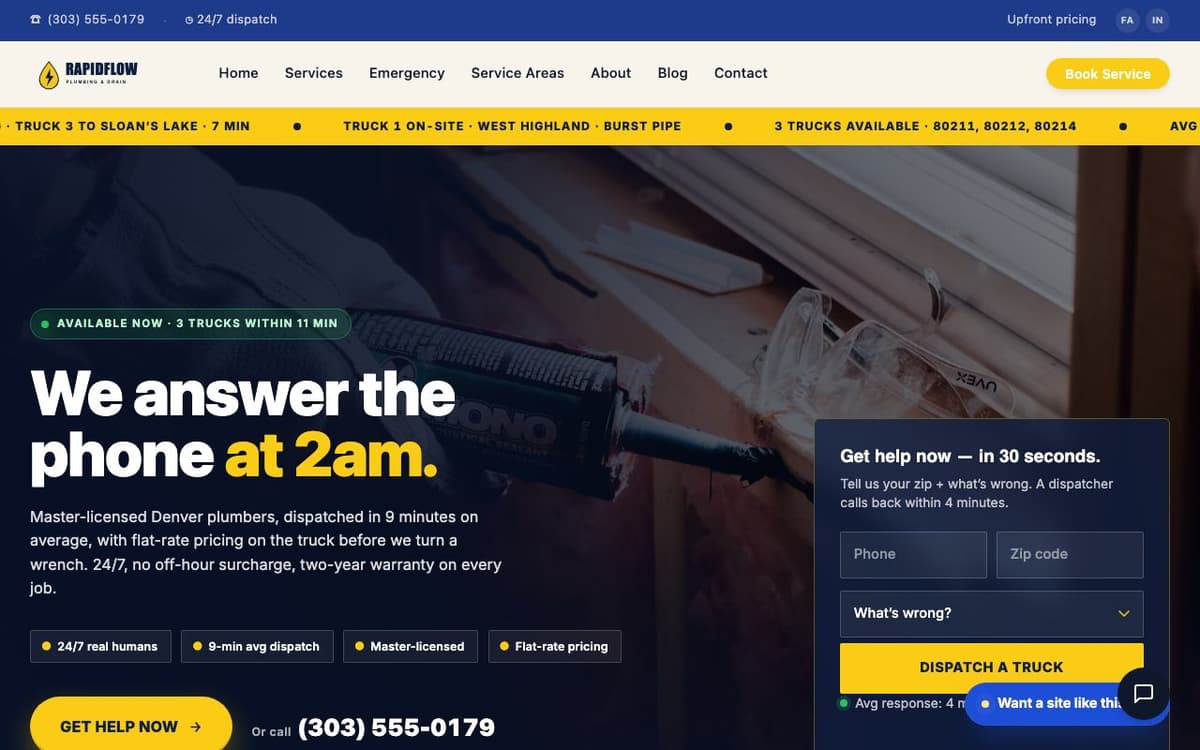 View the live demo →
Copper & Coil Plumbing
Emergency tap-to-call path kept separate from the scheduled booking form
- hvac.workspacecms.ai
 View the live demo →
Northwind Heating & Air
Service-plan and maintenance conversion built into the page flow
- homebuilder.workspacecms.ai
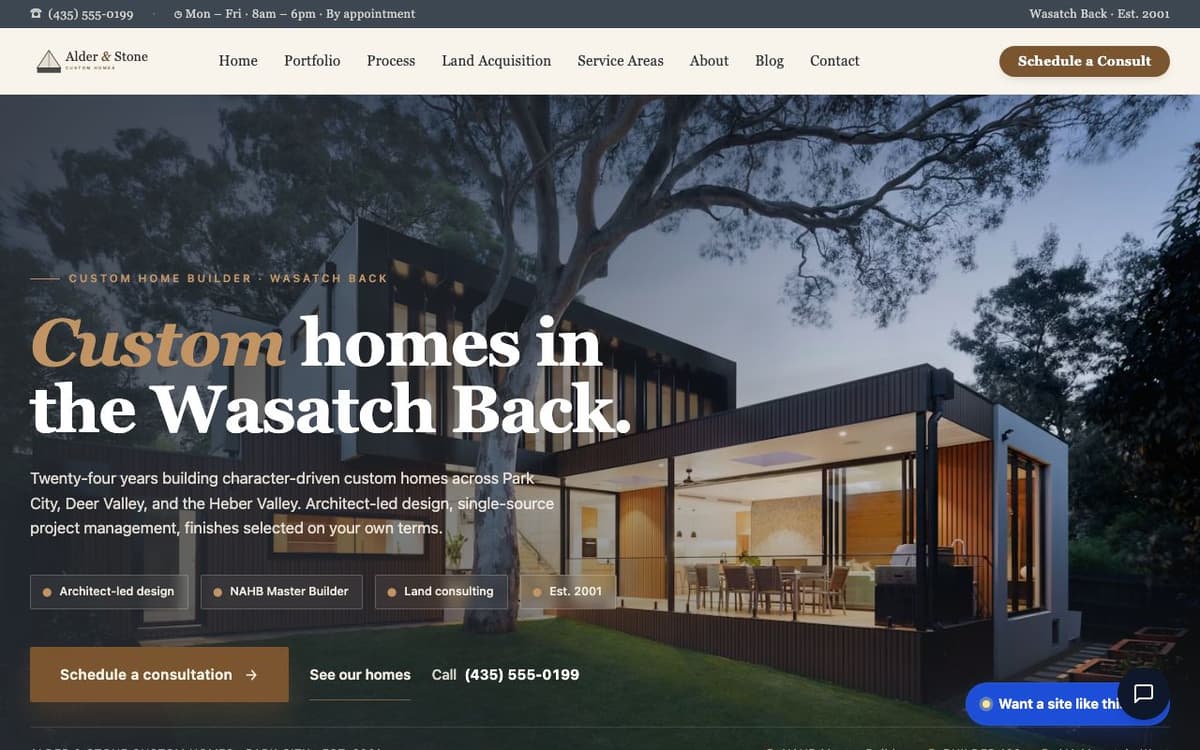 View the live demo →
Cornerstone Builders
Long-consideration intake for the high-ticket, researched-for-days jobs
Introducing
Your Industry. Your CMS. Managed for You.
- Unlimited managed edits - shipped on your plan's SLA
- SEO baked into every page, post, and location
- Technical SEO on every plan; AI schema and internal linking on Premium & Ultra
Why We Build Plumbing Sites on WorkspaceCMS
WorkspaceCMS is our own platform - 1Digital® is the team that designs, builds, hosts, and maintains it. For a service business that decision removes the two problems that quietly wreck plumbing websites. The first is decay: a site launches fast and clean, then a year of plugin updates, a page builder, and three tracking tags turn it into something slow that nobody wants to touch. The second is edit paralysis - you need the holiday hours changed or a new service area added, and it sits for six weeks because nobody knows who owns the site.
On WorkspaceCMS the edits are handled by ticket as part of hosting, so “we added trenchless lining” becomes a message rather than a project. The SEO fundamentals - clean markup, structured data, sane URLs, fast pages - are properties of the platform instead of a plugin you have to remember to configure. See WorkspaceCMS plans and how we build. If your situation genuinely calls for something else - you sell parts and fixtures online, or you have an existing stack you need kept - our custom website design practice covers that, and we will tell you plainly which one you need.
Essentials plan, in 90 seconds
What “Edits Handled By Ticket” Actually Looks Like
Essentials is where most single-truck and small plumbing shops start: the site is built, hosted and maintained by us, and holiday hours, a new service area, or a fresh set of job photos go in as a request instead of a project. This short tour walks the plan end to end so you can see exactly what is included before you ask for a proposal.
How Design Decisions Feed Local SEO and AI Visibility
Local ranking and AI answer engines are not a separate workstream bolted on after launch. They consume the same structure the visitor does, and they punish the same shortcuts.
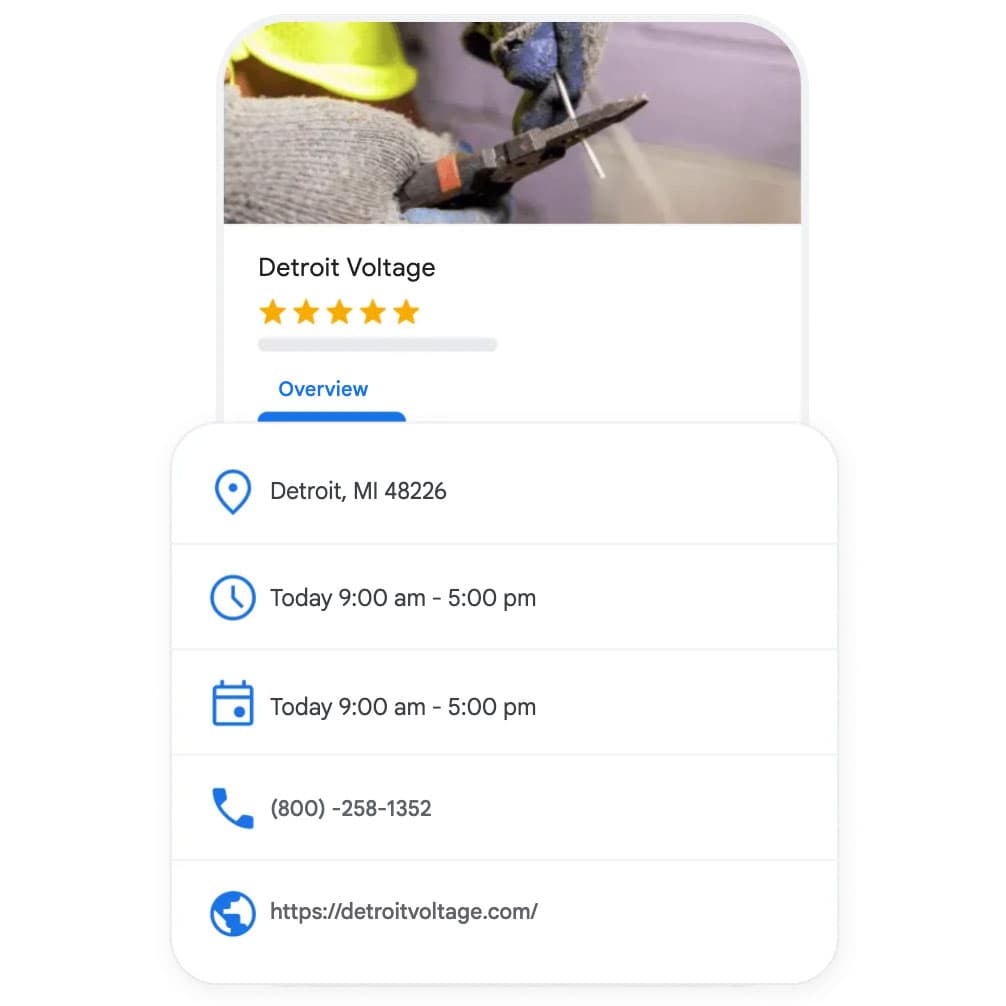
- ›Name, address and phone must be consistent between the site, your Google Business Profile, and every directory listing. A phone number that differs by one formatting convention is a real citation problem, and it starts as a design decision about how the number is rendered.
- ›Structured data - LocalBusiness with the services and areas served, and FAQ markup on the pages that answer questions - gives engines an unambiguous machine-readable version of what a human reads on the page.
- ›One page per service with substantive content is what makes a service query rankable at all. A merged services page cannot rank for "sewer line replacement" no matter how much link work is done later.
- ›City pages have to earn their existence with local specifics - neighborhoods and municipalities you actually serve, the housing stock and its typical problems, permitting realities. Duplicated templates are the fastest way to devalue an entire directory of pages.
- ›Speed and layout stability are ranking inputs and conversion inputs simultaneously. The image discipline that keeps a job-photo gallery light is the same work that keeps Core Web Vitals green.
- ›AI answer engines quote what is stated plainly. Hours, service area, pricing approach, warranty terms and licensing written as clear sentences are extractable; the same facts trapped in a hero graphic are invisible.
- ›Entity clarity - one consistent business name, one canonical description, matching details across the site and your profiles - is what lets an assistant confidently recommend you rather than hedge.
The website is the asset the rest of the program runs on. Once it is right, pair it with plumbing marketing services, local SEO, and Google Business Profile optimization. Ongoing improvement of the booking paths themselves is conversion optimization, and the device behavior described throughout this page is what we mean by responsive design.
Request a proposal
Tell us about your plumbing business
Share your service mix, the towns you cover, and whether you run after-hours. A senior strategist replies within one business day with a pricing band and a draft sitemap.
Plumbing Web Design - FAQ
What platform should a plumbing company's website be on?
For a service business with no online store, we build on WorkspaceCMS - our own platform, designed, hosted and maintained by 1Digital®. It keeps the SEO fundamentals and page speed as platform properties rather than plugins you have to maintain, and edits are handled by ticket as part of hosting. If you also sell parts or fixtures online, or you have an existing stack you need to keep, our custom website design practice covers the alternatives.
How is a plumbing website different from a regular business website?
The conversion event is a phone call rather than a checkout, and a large share of visitors arrive mid-emergency on a phone. That changes almost every design decision: tap-to-call placement, a sticky mobile call bar, the service area stated in text above the fold, an unambiguous after-hours policy, and a booking form short enough to complete while standing in a wet basement. It also needs a second, slower track for considered work like sewer replacement and repiping, which is researched for days before anyone calls.
Do I need a separate page for every service and every town?
A page per service, yes - a merged services page cannot rank for or persuade on “sewer line replacement” and “water heater installation” at the same time. City pages, only for areas you genuinely serve and only if each page carries real local substance. Template pages with the town name swapped in are treated as thin content and can drag down the rest of the site.
Does my license number have to appear on the website?
Requirements are set by state, and sometimes locally, and they differ on whether a number must appear in advertising, whose license it must be, and how it must be formatted. We design a persistent, prominent place for licensing and insurance information, and we ask you to confirm the exact wording with your licensing board or counsel before launch rather than assuming a rule that may not apply in your jurisdiction.
Will the new site rank locally on its own?
A well-architected site is the precondition, not the whole program. Clean structure, one page per service, real local content, structured data, consistent NAP and fast pages are what make local ranking possible. Sustained visibility also needs your Google Business Profile, reviews, citations and - in most competitive metros - Local Services Ads. That ongoing work is our plumbing marketing services engagement.
Can you rebuild an existing plumbing site without losing our rankings?
Yes. A rebuild starts with an inventory of your existing URLs and which of them have earned traffic or links, then a redirect map from every retired URL to its closest replacement, preserved page titles and structured data where they are already working, and post-launch monitoring for crawl errors and ranking movement. Losing rankings in a redesign is a process failure, not an inevitability.
The Humans Behind the Work
A Few of the People You'll Work With
Every engagement is run by a named strategist. Here's the team.

Dan K.
Founder & CEO

Michael P.
Senior Director of Business Development

Matt L.
Director of Merchant Success

Joe C.
Assistant Director of Merchant Success

Sam M.
Senior Sales Strategist

Barry L.
Senior SEO & AI Strategist

Lindsay U.
Senior SEO & AI Strategist

Maria C.
PPC Strategist

Luisina C.
PPC and Social Strategist

Jon L.
Senior Designer

Michael E.
Senior Copywriter

Rebeca T.
Senior Content Writer

Lovely E.
Content Producer

Ruth M.
Content Producer

Anton K.
Sr. Solutions Architect

John T.
Search Strategist