

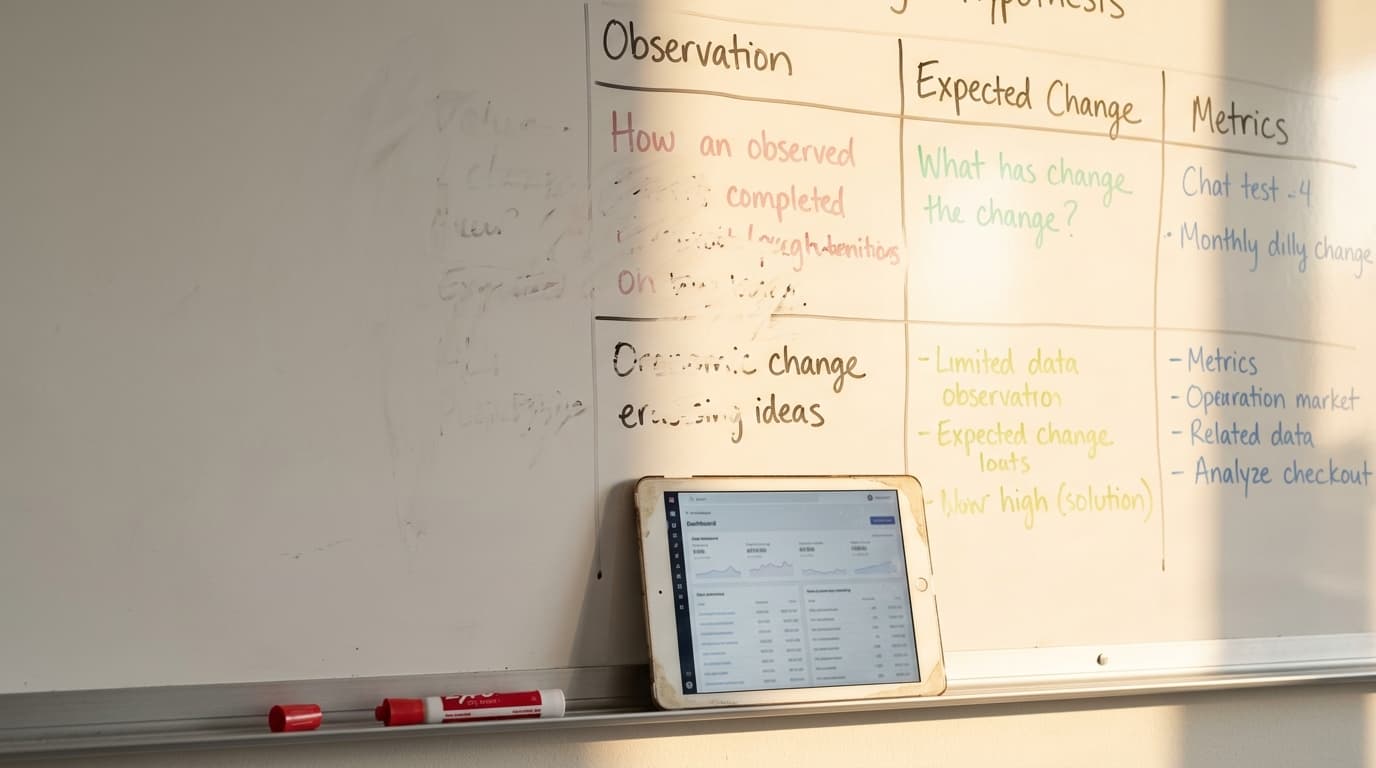
A/B testing on Shopify requires using a third-party app to form a clear hypothesis, test one significant change at a time, and run the experiment long enough to reach statistical significance. The goal is not just to find a "winner," but to develop a repeatable process for understanding what drives customer behavior.
The Hype Is Wrong: A/B Testing Is Not a Magic Wand
Every few years, the conversation around conversion rate optimization (CRO) gets a new coat of paint. A/B testing, also called split testing, is often sold as a simple path to explosive growth. Find the right button color, the perfect headline, and watch the sales roll in. Most of the time, it is none of that.
In practice, A/B testing is a slow, methodical, and often humbling discipline. Most tests do not produce a dramatic lift. Many produce no clear winner at all. The real value of testing isn't in stumbling upon a magic bullet; it's in building a system that replaces arguments from opinion with arguments from data. It stops you from making bad changes just as often as it identifies good ones.
A/B Testing Starts with a Question, Not a Tool
The single most common failure mode in A/B testing is starting with a tool instead of a hypothesis. A team gets a new piece of software, feels obligated to use it, and starts launching tests based on hunches or "best practices" they read in a blog post.
The mistake to avoid: testing random ideas. "What if we make the button green?" is not a hypothesis. It's a guess. Without a theory about *why* green might perform better, you learn nothing from the result. A true hypothesis is a falsifiable statement about cause and effect.
It follows this structure: If we change [Independent Variable], then [Dependent Variable] will change because [Theory].
- Example Hypothesis: "If we change the 'Add to Cart' button text to 'Get It By Friday,' then the add-to-cart rate will increase because it creates urgency and clarifies the delivery timeline."
This is a testable theory. If it wins, you've learned that your customers respond to urgency and delivery promises. If it loses, you've learned they don't, or that this wasn't the right way to express it. Either way, the learning is durable.
Choosing Your Tools on a Platform Not Built for It
Shopify does not have a native, built-in A/B testing feature for theme elements. To run split tests, you need to integrate a third-party application. This is a platform constraint you have to work with.
Popular and effective tools for Shopify A/B testing include:
- VWO (Visual Website Optimizer): A powerful and widely used platform with a visual editor that makes it easier for non-developers to set up tests.
- Optimizely: An enterprise-level tool with robust features for both A/B testing and personalization.
- Convert.com: A strong competitor to VWO and Optimizely, known for its speed and privacy-conscious approach.
The primary failure mode with these tools is performance. Most of them work by using JavaScript to modify the page *after* it starts loading in the user's browser. This can sometimes cause a "flicker" effect, where the original page appears for a split second before the test variation loads. This flicker can contaminate your test results and, more importantly, hurt the user experience. A faster page always wins; a slow test is a bad test.
The honest tradeoff is between cost and control. These apps carry a monthly subscription fee. The alternative is a custom development solution, which is more expensive upfront but gives you total control over performance. For most stores starting out, an app is the correct choice. The cost of the tool is almost always less than the cost of making a major site decision based on a gut feeling.
A 4-Step Process for a Defensible Shopify Test
A disciplined process prevents you from acting on bad data. Follow these four steps for every test you run, without exception.
- Identify a Problem and Form a Hypothesis. Start with your analytics. Where are users dropping off? Look at your product pages with high traffic but low conversion rates. Use a tool like Hotjar to see heatmaps or watch session recordings. Find a real problem, then form a hypothesis about how to solve it.
- Isolate a Single Variable. This is the cardinal rule of testing. If you test a new headline, a new main image, *and* a new call-to-action all in one variant, you have learned absolutely nothing. Even if that variant wins, you have no idea which change was responsible. Test one meaningful thing at a time. The headline changes; the rest of the page does not.
- Run the Test to Statistical Significance. Don't end the test the moment one version pulls ahead. That's just noise. You need to run the test until you have a large enough sample size to be confident in the result. The industry standard is 95% statistical significance. Your testing tool will calculate this for you. You should also run the test for at least one full business cycle (typically one or two weeks) to account for variations in traffic by day of the week.
- Analyze, Implement, and Iterate. If you have a clear winner at 95% confidence, implement the winning variation permanently in your Shopify theme. If the test is inconclusive, you've still learned something: the change you proposed had no meaningful effect on user behavior. Document this. That "failure" just saved you from making an unnecessary change. Your documented result is the input for your next hypothesis.
Test Strategy, Not Decoration
Your time and traffic are finite. Don't waste them on tests that can't possibly have a meaningful impact. The focus should be on changes that affect a user's motivation, clarity, or friction.
What to Test for High Impact:
- Value Proposition: The main headline on your homepage or product page. Does it clearly and quickly communicate why someone should buy from you?
- Call-to-Action (CTA): Test the text on your most important buttons. "Shop Now" vs. "Explore the Collection." "Add to Cart" vs. "Buy Now." This tests clarity and intent.
- Offers and Pricing: This is one of the highest-impact areas. Test "15% Off" vs. "Free Shipping." Test displaying prices as a single sum versus breaking them out into smaller payments with Shop Pay Installments.
- Product Imagery: Test lifestyle photos (product in use) versus clean studio shots on a white background. For some products, seeing it in a real-world context builds more trust.
- Trust Signals: Test adding or removing security badges, customer reviews, or "As Seen In" logos near your CTA.
What to Avoid Testing:
- Minor Button Color Changes: Unless your current button color has a legitimate accessibility or visibility problem, testing red vs. green is a waste of time. The offer matters more than the shade.
- Tiny Font Adjustments: Don't test a 16px font versus a 17px font.
- Element Placement by a Few Pixels: Moving a section up or down 10 pixels is unlikely to change a business outcome.
The principle is simple. A test of the offer is a test of the business; a test of the button color is a test of decoration. Focus on the business.
Most of Your Tests Will Fail, and That's the Point
Alright. Coffee's ready. Let's talk about the hardest part of building a testing culture: being wrong. In a mature CRO program, 70-80% of A/B tests fail to produce a statistically significant winner. This can feel demoralizing if you view testing as a machine for generating wins.
That is the wrong frame. An inconclusive or losing test is a gift. It is data that has just disproven a bad idea. It prevented you from changing your site based on an incorrect assumption. This process is the ultimate defense against confirmation bias - the human tendency to look for evidence that supports our own ideas. A structured testing program forces you to confront what users *actually* do, not what you wish they would do.
The output of every test, win or lose, is a durable piece of knowledge about your customers. That knowledge compounds over time, leading to better and better hypotheses.
Your Test Results Feed Your Roadmap
An A/B test should not end with a report that sits in a folder. The outcome is always an action. A winning variation gets coded into your canonical Shopify theme so all future customers see it. A losing or inconclusive test informs the next hypothesis on your CRO roadmap. This is how a store evolves based on evidence rather than guesswork. Start with one page, one hypothesis, and build the discipline from there.
Frequently Asked Questions
How much traffic do I need for A/B testing on Shopify?
There's no single magic number, but you generally need at least 1,000 visitors per week to the page you want to test to get timely results. The key factor is conversions; you need enough conversions (e.g., purchases, add-to-carts) in each variation to reach statistical significance. If your page gets low traffic or has a very low conversion rate, it can take months to get a reliable result.
Can I A/B test on Shopify for free?
It's difficult. Google Optimize was the standard free tool, but it was discontinued in 2023. Some A/B testing apps offer limited free plans, but they often come with strict traffic limits or feature restrictions. For any serious testing, you should plan to invest in a paid tool.
How long should I run an A/B test?
Run your test for a minimum of one to two full weeks to account for daily fluctuations in user behavior (e.g., weekend vs. weekday shoppers). However, the ultimate answer is to run it until it reaches a 95% statistical significance level. Do not stop the test early, even if one version seems to be winning.