

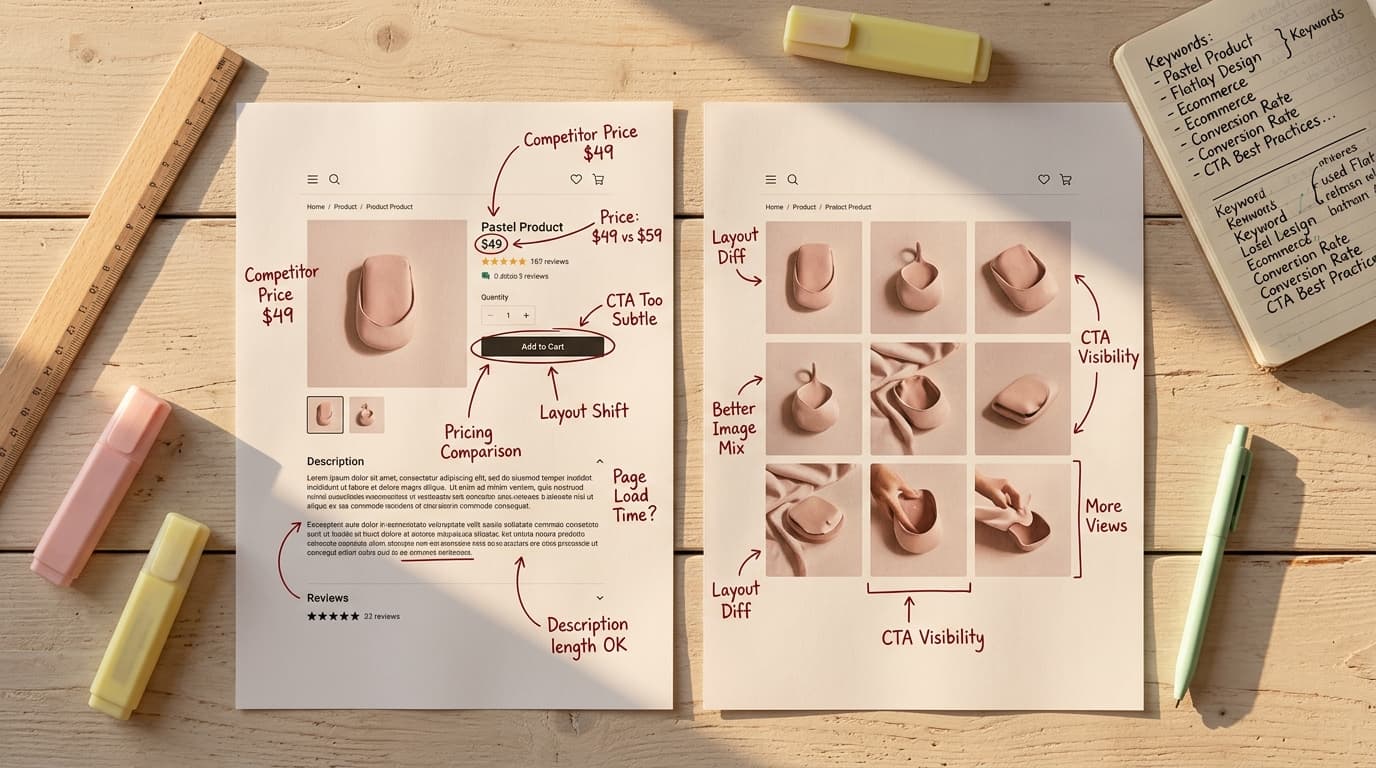
A successful eCommerce competitor analysis reverse-engineers a rival's marketing strategy by systematically examining their SEO footprint, paid advertising campaigns, and on-site conversion tactics. The goal is not imitation; it is identifying the profitable channels and keywords they have already validated with their own budget, allowing you to build a smarter strategy from their proven results.
Most "competitor analysis" is just unfocused browsing. You look at a rival's homepage, click on a few products, and check their prices. This is professionally sanctioned procrastination. It tells you nothing about the machinery that drives their business. It is a surface-level check that produces surface-level insights. A real analysis is a forensic deconstruction.
Your True Competitors Are Whoever Outranks You
The first failure mode is a narrow definition of "competitor." Businesses tend to focus on rivals who sell the exact same products. In practice, your most dangerous competitors are the ones who occupy the search engine results pages (SERPs) for your highest-value keywords, even if their product line only partially overlaps with yours.
If you sell high-end running shoes and a content site like Runner's World outranks you for "best marathon running shoes," they are your competitor for that search. They are capturing the customer's attention and intent before you can. The direct brand is one threat; the SERP rival is another, and often the more significant one.
The fix is to let data define your competitive set. In our own audits, we generate what we call a "Citation Share" report. We extract the top 20 organic results for a client's 50 most valuable commercial keywords and identify which domains appear most frequently. This process often reveals competitors the client had never considered - affiliate sites, major publishers, or niche blogs that own the conversation where customers are forming their opinions.
Deconstruct Their Organic Search Engine
Once you know who you're up against, you can dissect their SEO strategy. The mistake to avoid is simply exporting a giant list of their keywords and calling it a day. Thousands of keywords are vanity metrics; the real work is isolating the ones that actually drive sales.
Focus on three core areas:
- High-Intent Commercial Keywords: Use a tool like Ahrefs or Semrush to filter your competitor's ranking keywords for commercial modifiers like "buy," "review," "vs," and "best." Pay close attention to keywords where they rank on page one. These are the terms they have successfully signaled to Google are worth revenue.
- Top-Performing Content & Backlinks: Identify the pages on their site that have attracted the most backlinks from other authoritative sites. This is not about vanity; it is a map of the content that their industry considers valuable enough to cite. A high volume of links to a specific blog post or buying guide indicates a successful content marketing asset you need to contend with.
- Site Structure and Internal Linking: Analyze how they link between their own pages. Do product pages link up to a central "category hub" page? Do blog posts consistently link to specific products? This architecture is the substrate of their SEO. It shows you how they distribute authority across their site and guide users from informational content to transactional pages.
Expose Their Paid Advertising Playbook
Paid advertising offers a more direct window into a competitor's strategy. Their choices reveal their target audience, their core value proposition, and their most profitable offers. The failure mode here is focusing only on the ad creative while ignoring the mechanics of the funnel behind it.
The visible ad is the invitation; the invisible funnel does the selling. Your job is to map both.
Start with publicly available tools. The Meta Ad Library shows you every active ad a competitor is running on Facebook and Instagram. The Google Ads Transparency Center does the same for search and display ads. Systematically review their ad copy, creative, and calls-to-action. Look for patterns:
- What offers do they push? Are they leading with a discount (e.g., "20% Off Your First Order"), a value proposition ("Free Shipping on All Orders"), or a specific product feature?
- What angles do they use? Are they focused on pain points, benefits, or social proof? The language they repeat is the language that works for them.
- Where do the ads lead? Click through their ads to their landing pages. Do they send traffic to a standard product page, a custom-built landing page, or a category page? The destination reveals the purpose of the campaign. A dedicated landing page signals a high-value, optimized funnel worth studying.
This tells you what messages they believe are compelling enough to spend money on. That's a powerful signal.
This Analysis Is a Map, Not Tracing Paper
Here's the hard truth: this process tells you *what* is working for them, but not always *why* or how *profitably*. Their top-ranking page might be a legacy asset from years ago, not the result of a brilliant, repeatable strategy. Their high-budget ad campaign might have terrible margins. You are seeing the external signals, not their internal P&L.
The honest version is slower but compounds; the blind imitation carries high risk. Do not simply clone your competitor's top-performing blog post or ad campaign. Use your analysis to form hypotheses. "It seems that customers in this market respond to ads that emphasize durability. Let's test that angle with our own creative." Or, "It appears Google is rewarding long-form guides for this keyword. Let's build a better, more comprehensive guide than our competitor's."
Your analysis provides the starting point for your own intelligent tests, not a shortcut that lets you skip the work of learning your own audience.
What To Do With This Information
The output of this analysis is not a report to be filed away. It is a prioritized list of keywords to target, ad angles to test, and content gaps to fill. This data becomes the direct input for your marketing roadmap for the next quarter. This is where the audit hands off into execution.
Frequently Asked Questions
How often should I conduct an eCommerce competitor analysis?
A deep analysis should be performed annually or semi-annually. However, you should monitor your top 3-5 SERP competitors' paid ad campaigns and major content launches on a monthly basis to stay ahead of market shifts.
What are the best free tools for competitor analysis?
While paid tools like Ahrefs and Semrush are more comprehensive, you can get started with free resources. The Meta Ad Library and Google Ads Transparency Center are essential for analyzing paid ads. Google Search itself (using incognito mode) is the best tool for manually analyzing the SERPs for your core keywords.
What is the difference between direct and SERP competitors?
A direct competitor sells similar products to the same target audience (e.g., Nike vs. Adidas). A SERP (Search Engine Results Page) competitor is any website that ranks for your target keywords, capturing customer attention and traffic, even if they don't sell products directly (e.g., a review site or a publication ranking for "best running shoes"). In SEO, SERP competitors are often more important to analyze.