



Some of our best marketing success stories come from SEO and AI SEO clients that operate in restricted industries. In this case study dedicated to the results and efficacy of eCommerce SEO services, I’m going to direct the spotlight on one of our clients that sells knives and other outdoor tools.
They’ve only been with us for a short while, too, which makes this all the more impressive. As of the time of this publication (November 2026), this client has been with us less than a year, only for about 6 months.
And yet, we’ve already managed to deliver some early wins in their national SEO campaign. Here’s what you need to know.
The Challenge

The client in question sells knives, primarily, though they sell other outdoor tools like axes and survival gear. In the case of edged tools, Google and other platforms see them as weapons (despite the fact that they are not used as weapons or even intended as such).
As a result, Google and other platforms will not allow merchants like these to advertise in order to generate sales. The only options at their disposal are organic, such as organic social media marketing, content marketing, and SEO.
This client operates a brick and mortar retailer in Ohio and is active in the industry, but for obvious reasons, clientele is limited through a physical retail outlet. Only people that can get there can shop there. Their eCommerce website opens the door to business around the country.
The problem is generating that business, since Google won’t let them advertise through PPC or other paid channels.
How Organic Marketing Works in the Face of PPC Restrictions
The way around these restrictions is some combination of organic marketing in the form of social media marketing, content marketing, search engine optimization, or AI SEO with a focus on getting attention from AI models.
In this case, our focus was on search engine optimization, since even with all the hype on AI, most website traffic is still driven through search engines like Google, especially for transactional purposes.
That said, the state of search engine optimization has evolved to such a point that copy optimized for search engines is no longer just that, and shares features with copy for content marketing and AI SEO to the effect that it is often interchangeable with them.
Over the past few years, there has been an emphasis developing not just on originality, but on the depth and quality of content published, especially with respect to expertise and trustworthiness. There was a time when one could hit a keyword count and word count length, publish that piece of content, and generate results.
That is no longer the case. Nowadays content needs not only to be original, but to convey actual value in the form of actionable insight that answers questions based on the user’s query. That query could be informational but it could also have a transactional slant.
In the case of this particular client, both were necessary. The copy we used to optimize the campaign had to answer questions about products as well as their uses, since ultimately the goal of the client was to sell knives and other tools online.
Here’s what that looks like and how it works.
What Our Process Entails

As with any SEO client, our process involves:
A strategic audit of the existing client website.
An audit of the competitive industry landscape so we can get a better idea of what the current organic search engine results pages look like.
A keyword research stage where we identify practical and attainable target keywords, with the client’s input.
From there, we develop a strategy consisting of several core components:
We perform an initial technical sweep and analysis of the client’s website to recommend changes based on technical SEO best practices, to find and remove 404s, make recommendations based on site speed and security findings, site structure, and other technical ranking factors.
We set up monitoring for Google Search Console and GA4 to monitor client website performance.
We identify target pages to optimize with category, product and CMS page copy.
We draft short pieces to be disseminated to a variety of third-party domains for the purpose of link-building that increases domain authority and overall visibility.
And, most importantly, we establish a content strategy consisting primarily of blog posts and other onsite content optimizations for the purpose of increasing visibility and authority for select target keywords.
This latter prong is where we make the bulk of our efforts count, and our industry expert copywriters differentiate our client websites with a variety of content optimized for readers, search engines, and large language models (LLMs) such as those used by generative AI engines like ChatGPT.
Differentiating with Optimized Content
As stated, the main differentiator in an account like this that relies on organic marketing to generate online visibility and sales is content. But what exactly does that look like?
Well, for one thing, to produce effective, optimized content for a campaign like this, the campaign needs a writer that is authoritative in the industry. From there, copy such as the following could be produced:
Knife reviews.
Comparisons between knife models.
Guides on how to care for knives.
Sharpening guides.
Steel guides.
Guides to different types of features such as blade profile and grind.
Tutorials on how to use knives for different tasks such as firecraft or woodworking.
News and press releases for new models.
These are just a few of the ways in which high-performing, high-quality copy can differentiate a website from its competition, but as you can see, SEO is no longer just hitting a word count and placing a few keywords in some headers. Those things are just ranking signals, but they are just the skeleton on which the musculature of informative copy hangs.
So what does it look like? We can let the results speak for themselves.
The Results
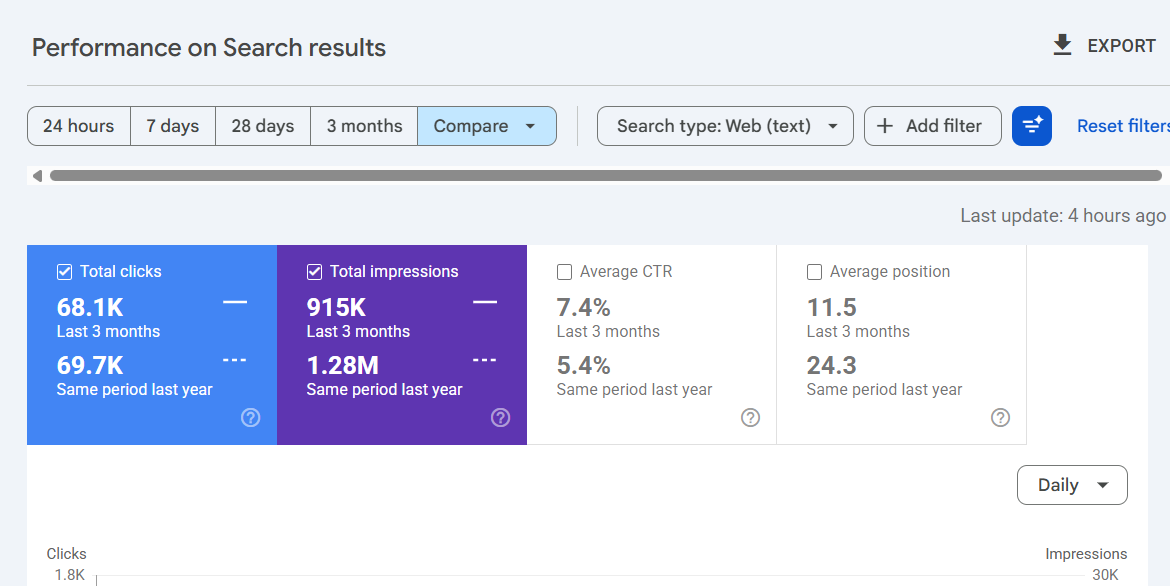
At the end of the day, it all comes down to the results we’ve produced for our clients. Let’s take a look at what GSC shows over the past three months as of the time of this publication compared to the same period from a year before.
This data is interesting. Usually I like to show that clicks and impressions are way up in the case studies that I publish, but this time I’m showing something different. In this particular case, clicks and impressions are sort of stagnant. In fact, they are mostly flat. But there is a huge win in another area: average position is way down. In fact, we moved the client from an average position of page three to an average position that was just beneath page one. A little more time and investment and page one isn’t off the mark. We just need to keep at it. Click-through rate improved, too, which likely indicates that keyword targeting improved considerably.
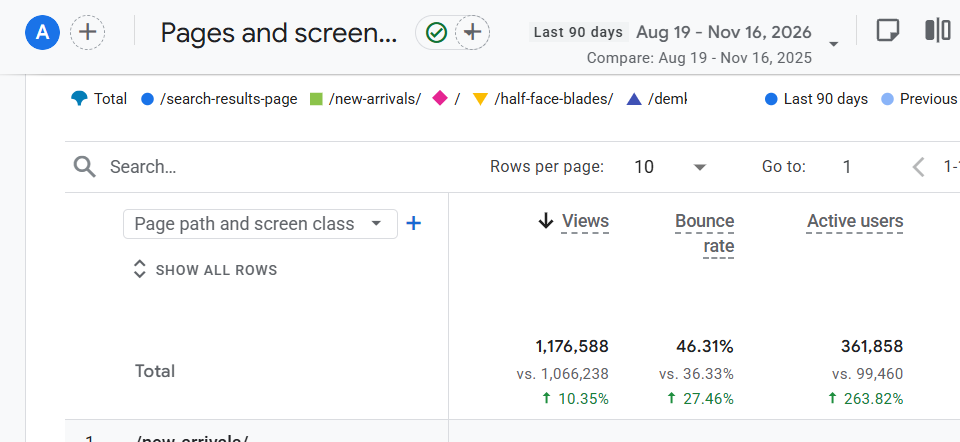
Then, of course, there is what GA4 shows, which in this case is strong positive movement in both views and active users. Views are up more than 10% and active users are up over 200%. In both cases that represents positive movement.
These are the sorts of results we generate for our clients, particularly those who operate in restricted industries. If your business is in a similar situation, get in touch with our SEO experts and we will offer you an SEO audit or go over your options for improving your organic positions as well.