


Our client specializes in selling advanced lithium batteries used as home battery backups, as well as batteries for applications such as RVs, boats, golf carts, and more. They also sell the battery management systems that regulate them as well as hybrid inverters and backup energy storage solutions.
As you can imagine, being in such a market entails fierce technological competition and high sticker prices for the wares they sell.
This makes organic visibility all the more important, as good organic visibility can constitute the difference between a brand that’s ultimately unknown and one that slowly builds momentum in the emerging market.
Here’s how we made a difference for this client.
Keyword Selection
Ultimately, discounting the actual operations, much of the success of an eCommerce SEO campaign comes down to keyword selection.
For a client like this we’re looking for:
Relevance: Is the keyword related to what they actually sell? Is the keyword something that consumers are searching or is it more aligned with B2B operations? Oftentimes a relevance check requires an actual investigation into the actual SERPs.
Attainability: What is the keyword’s difficulty score, and how many large competitors are currently ranking for that keyword? Is the client currently ranking for it, and if so, where?
Volume: How many monthly searches does the keyword get, and do margins on sales justify going after said keyword?
How many results are in the SERPs? If there are fewer results in the SERPs with low competition, a keyword will be more attainable.
Intent: What are people trying to accomplish when they search these keywords and search terms? Do they want to buy something, or do they just want information?
Operations

With keywords selected relevant to the lithium batteries this client sells, our project managers and operations team got to work optimizing the domain in the following ways.
Site audit: We start with a website audit to see areas where things need to be immediately addressed before standard operations can begin. A site audit can show us what’s working well and what isn’t, as well as where any opportunities lie.
Technical optimizations: Our technical specialists draft or optimize existing meta data, eliminate broken links, create redirects where necessary, and improve site structure and security as needed to improve campaign performance.
Off-page copy: Our copywriters draft off-page copy to be posted on third party-domains for the purpose of building backlinks that improve referral traffic and increase domain authority with time.
On-page copy: The most impactful of our operations by far, our copywriters draft blogs, CMS page copy, and category and product page copy aligned with SEO and AEO best practices to generate greater organic visibility.
Ongoing monitoring and consultation: Our project managers monitor the performance of a campaign and serve as a strategic resource whenever keyword shifts need to be executed.
What We Look for
Our project managers and strategists are on the lookout for specific key performance indicators once a campaign gets under way. Here’s what we’re watching.
Ranking and movement trends: First, coming into ranking for a keyword that the domain didn’t previously rank for is huge, but we’re satisfied with positive improvements for target keywords for which the domain is already indexed.
Impressions: When keyword improvements occur, as long as there is volume associated with the keyword, impressions will improve and the website’s listings will get more eyes on them. Assuming we’ve targeted relevant keywords, clicks will follow.
Clicks: Clicks are the precursor to better user engagement and ultimately revenue, so increases in clicks are one of the main indicators we track when monitoring the performance of an SEO campaign.
Time on page: One of the biggest indicators we look for, before we even take note of increases in conversions and revenue is time on page. What we don’t want is a lot of clicks and a high bounce, indicating poorly targeted keywords. Higher time on page indicates at the bare minimum that the keywords we targeted are closely aligned with search intent. It also means our copy is good.
Conversions and revenue: The real proof of success in an eCommerce SEO campaign is an increase in organic conversions and revenue, since this is what eCommerce merchants are after, and what actually validates ROI for the campaign.
Naturally, whenever these increase, especially conversions and revenue (through organic channels) we know that what we’re doing for search engine optimization is working.
And, as is always the case, the proof of the pudding is in the eating of it. So what sorts of results did we produce for the client in question?
Results
We’ve already covered what KPIs we look at to determine the success of our eCommerce SEO services, so let’s take a look at what we produced for the client in question over the past several months of work we delivered.
We’ll start with clicks and impressions, which you can see below:
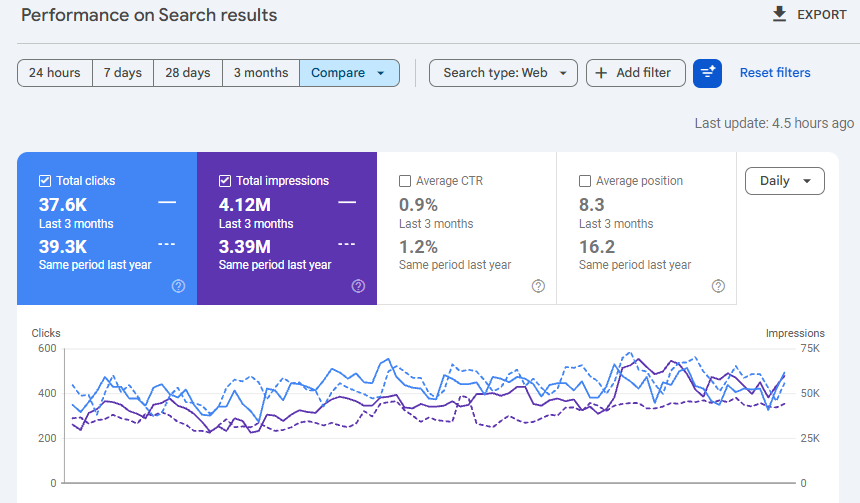
Compared to the same period from last year, clicks were actually down slightly, but impressions were up and the average position for all ranked keywords was halved, which is quite a significant improvement. Occasionally, clicks drop when impressions rise and average position falls just because of changes in keyword targeting.
However, ideally, we would see the average position drop, and both clicks and impressions rise. So to dig deeper we need to look at what sorts of material improvements we made in terms of engagement rate revenue, which you can see below.
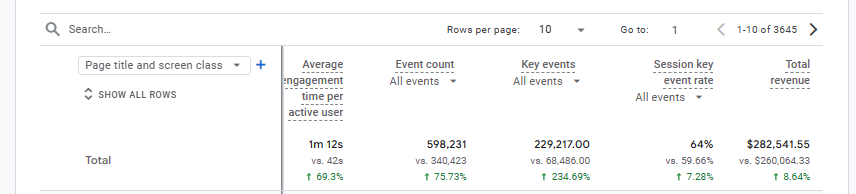
As you can see, while clicks were down slightly, the net impact on user engagement was astoundingly positive, with nearly a 70% improvement in session duration among all users.
That means a few things. One is that we were attracting attention for more relevant keywords that were keeping users on their pages longer. It could also mean that the copy we were drafting for the campaign was more engaging in its own right and was holding the attention of visitors.
But whatever the case, you can’t argue with revenue, which increased by almost 9% over the same period. We’ll take a 10% growth in revenue, and so would any level-headed client, especially since this campaign has been under way for less than a year and the most significant impacts from SEO occur in years two to three after the campaign starts.
Explore Our Collection of eCommerce Case Studies
Interested in other case studies like these? If you want to see what our eCommerce SEO services have done for other clients in different industries, take a closer look through our full collection of case studies or get in touch with one of our experts for personalized assistance.