



We have a client, MCS Gearup, that has been with us for over 4 years now. This client is not an FFL but sells gun parts and shooting attachments like lights and optics, pretty much exclusively. A big portion of their business is micro conversion kits, or MCKs, which are basically platforms that convert handguns into something more like a carbine or SBR, and assembled uppers, which are basically half of a rifle, but which don’t require a NICS check since they are not serialized, nor considered a “firearm”; the lower is.
NoThe key takeaway is this: MCS Gearup operates in an industry that is completely PPC-restricted, meaning paid advertising on Google, Meta, and similar platforms is simply not an option for their core product lines.ven if this client decided today that the business model would accommodate some products that could be advertised, because the basis of their business is gun parts, the account would get flagged and suspended immediately.
Which is what brings me to my main point: the only viable marketing channels for this business are organic, and namely, SEO is the best of them.
That’s not just because SEO offers the best ROI of any marketing channel (including PPC, which is not an option here anyway) but because SEO builds authority that can be morphed into, or at least used to support content marketing efforts and AI optimization down the line.
So let’s take a closer look at how this campaign has evolved over time and how we delivered.
How Our Process Works
Our SEOOur SEO process for clients in PPC-restricted industries is comprehensive and methodical. It begins with three foundational steps: a website audit to see how the domain is currently performing.
Conduct an industry analysis to see what the big competitors are and where the potential opportunities lie.
Find target keywords that are attainable but which have the volume and relevance to go after.
Once we know what keywords we can reasonably go after as well as what we can’t, we can start to make basic optimizations, including but not limited to:
Technical and site structure optimizations to improve technical SEO.
Site speed audits and improvement to content delivery, caching and other factors that improve site speed.
A site security audit to improve any potential issues.
We also made a variety of other optimizations specifically pursuant to keyword and content strategy:
We optimized product and category pages for target keywords to improve overall visibility and rankings.
We drafted fresh copy or optimized existing copy for those pages to lower the average position, increase impressions, clicks and click-through, and improve the likelihood that the page would show up in another search feature like the AI Overview or the People Also Ask section of the search results.
We drafted a series of meta titles and descriptions for target URLs based on relevance to some of the main keywords that we selected.
Our copywriting team drafted a series of blogs of varying length on a variety of topics relevant to the main target keywords to improve the relevance of the selected target URL for those purposes.
Those blogs not only drove traffic to the main pages, but served as consultative resources for visitors, as well as a traffic stream and revenue source in their own right (more on that in a minute).
Lastly, our copywriters and technical team collaborated on a series of third-party posts that were used to distribute backlinks on a variety of offsite domains for the purpose of increasing referral traffic and domain authority to support the ongoing efforts in the rest of the campaign.
Because we made so many piecemeal optimizations to the client’s website for the target keywords we’d chosen, and because we chose high-volume, low-difficulty keywords with very high relevance to the client’s target pages, it was easy for us to generate not just strong increases in impressions and sales very quickly.
That however led to challenges within roughly a year.
Challenges a Year or Two in
While we had pretty significant gains right out of the gate with this client (which very rarely happens with eCommerce SEO if it ever does) the problem was that we more or less maximized performance for those keywords we chose at the outset of the campaign.
The tradeoff was that performance became sluggish a year and change in; not that the client was necessarily losing traffic or money, but he was no longer seeing the growth he had at the beginning of the campaign, and that made him antsy.
Fortunately, he trusted our SEO experts to regroup and come up with some new but still relevant keywords to adjust and realign the campaign. This time around, it took roughly a year to see the same sorts of results, but they are still steadily trending in the right direction.
So let’s take a closer look at what those results look like.
The Results
The results from Google Search Console are telling enough, as you can see in the screenshot below, which shows domain performance over the last 3 months compared to the previous year.
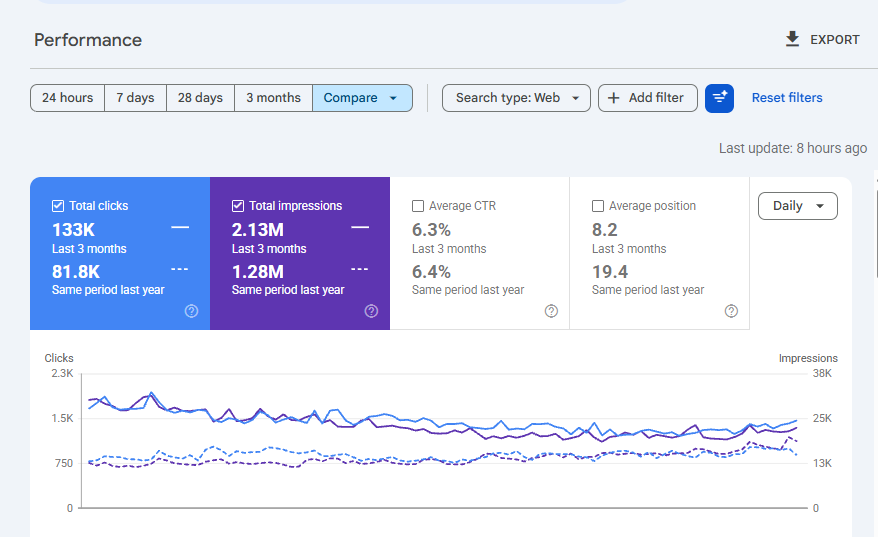
Results have compounded. As you can see, while average click-through rates were roughly the same, both impressions and clicks were up considerably. And on top of that, the average position was more than halved.
This is a huge tell, and what it means roughly is that for all ranked keywords, the client’s domain ranked effectively a full page higher in the search results. In fact, getting these improvements in average position, impressions and clicks and seeing no decline in click-through rate is impressive.
Then of course we can look at GA4 for some other metrics, which you can see below:
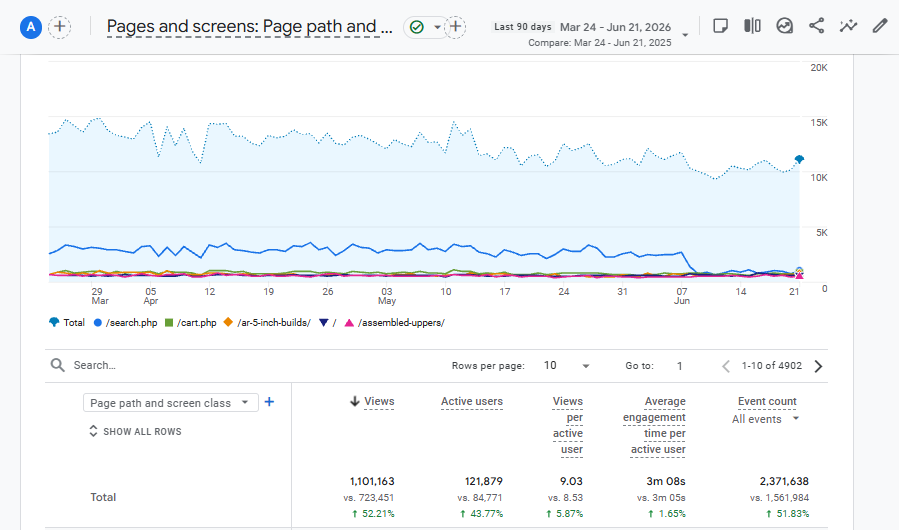
Looking at the same period, results are up in a pretty big way. You can see there has been more than a 50% improvement in overall traffic, and on top of that, average engagement was up, at over 3 minutes on average. Those are big numbers for an eCommerce website.
Increases in Blog Traffic That Prove Quality Content
Blog traffic is big too, because our most important onsite optimizations come in the form of long-form content that typically gets published as either CMS page copy or blog posts. In this case, we’ve done SEO work for this client that consists of a content stream of optimized blogs that do double-duty as content marketing.
You can see this from the growth to the blog alone:
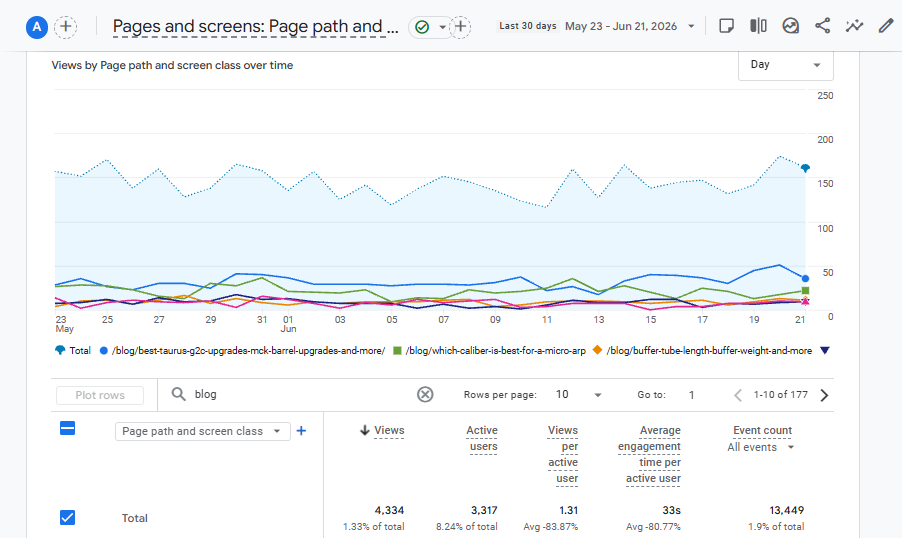
Over the same period, traffic to the blog was up over 260%, and as if that weren’t enough, the client also experienced some big increases in impressions that have already been demonstrated. This improved the client’s number of citations through generative engines, improving its overall authority and credibility.
Moreover, if we look at just the past month of blog traffic without comparing it to another period, you can see that more than 1% of all traffic to this website came in through the blog. That wouldn’t be so impressive for a content marketing website or a blog or news site, but for an eCommerce website, it’s fairly substantial.
eCommerce SEO Results That Work for You
Our collection of eCommerce case studies is filled with examples with success stories like this one, and it’s well accepted in the industry that search engine optimization, especially paired with artificial engine optimization, offers the highest ROI of all marketing channels. It also happens to be the only effective marketing channel for any clients who, like this one, are in PPC-restricted industries.
If you’re interested in how eCommerce SEO services (or GEO services) can benefit your website, get in touch with our experts today and we will shed some light on the marketing channels available to you as well as those which would be the best.