

For Heating & Cooling Contractors
HVAC Web Design
Built To Book The Call
You don't need a “Shopify site” or a “WordPress site.” You need a site that gets a homeowner with a dead furnace on the phone with your dispatcher, proves you're licensed before they ask, and ranks in the towns your trucks actually drive to. That's a different design problem from selling products online - and it's the one we solve.
The 1Digital® Difference
AI in our toolkit. Humans in the driver’s seat.
Our strategists, designers, developers, and writers are human. The proprietary AI we built makes them faster and sharper - not the other way around.
- Human strategy
- Human copywriting
- Our own AI tools
- Real growth
Trusted by 400+ Brands · Certified Partners




Years in eCommerce
Of results, scale, and quality at the enterprise level.
Expert Team
Specialists across SEO, AI SEO, PPC, design, dev, and strategy.
US Core + Global Talent
US core team for clear communication; vetted global specialists for international client work.
Reputation Score
Rated 4.9/5 across 941+ verified client reviews.
Reviewed by the 1Digital® Design TeamLast updated:
An HVAC Site Has Three Jobs, Not One
Retail sites have a single conversion: the order. HVAC sites carry at least three, and they belong to three different people arriving in three different states of mind. Designing one path and hoping the other two sort themselves out is the single most common failure we see when we audit a contractor's existing website.
The emergency.
No heat in January, no cooling in August. This visitor is on a phone, often outdoors, often with one hand free, and is calling two or three companies in a row. They are not reading your About page. The design question is brutally narrow: how few taps from any entry point to a ringing phone, and does the number stay visible while they scroll?
The planned replacement.
A system limping toward the end of its life. This visitor researches for weeks, compares three bids, and cares about equipment options, financing, warranty terms, rebates and whether your technicians look like people they want in their basement. They need depth, and they need it organised so they can come back to it.
The maintenance agreement.
The recurring-revenue line that stabilises your shoulder seasons. It converts best as a low-friction, clearly priced-by-tier commitment - and it is the page most contractor sites bury three clicks deep behind a generic “Services” dropdown.
A good HVAC site keeps all three paths live simultaneously without letting any one of them crowd the others out. In practice that means a persistent click-to-call affordance for the emergency, a genuine content layer for the researcher, and a maintenance-plan entry point that appears in the header rather than only in the footer.
HVAC web design, step by step
From wireframe to a site that books
Every HVAC site starts as a plan for how a visitor finds what they came for and acts on it. We design that structure first, then build it fast, mobile-first and accessible, with the call to action exactly where the visitor is ready to get in touch.
- ›Layouts planned around how HVAC customers decide
- ›Mobile-first, fast loading and accessible from the start
- ›Built for search from the first wireframe, not bolted on later
Why Most HVAC Websites Underperform
The failures are remarkably consistent across the audits we run, and almost none of them are about how the site looks.
- The phone number is an image, or isn't a link.On mobile it can't be tapped, it can't be read by a screen reader, and it can't be swapped for a tracking number - so you never learn which pages produce calls.
- One “Service Areas” page listing forty towns.A single page cannot rank for forty distinct local queries, and the list reads as filler to both a homeowner and a search engine.
- Stock photography of nobody who works there.The purchase decision is “do I let this person into my home.” A generic smiling model in a clean polo answers the opposite question.
- Credentials in a footer badge strip.Licence, insurance, EPA-certified technicians and manufacturer dealer status are the proof points that end comparison shopping. Shrunk to grey logos, they do no work at all.
- A twelve-field “Request Service” form.Every field beyond name, phone, address and problem is a reason to close the tab and call the next company.
- Nobody can update it.The site was built once, the developer moved on, and now a seasonal promotion or a new financing partner takes six weeks and an invoice. Sites that can't be edited stop being edited - and a stale site is a slow-motion ranking problem.
The Page Architecture We Build For HVAC
Structure is where an HVAC site is won, because the structure is what carries both the homeowner's journey and the local search footprint. We build around a service × location matrix rather than a flat brochure.
Service pillars
One substantial page per line of work - AC repair, AC installation, furnace repair, furnace installation, heat pumps, ductless mini-splits, ductwork, indoor air quality, commercial service, emergency service. Each answers what the job involves, what a visit looks like, what affects the estimate, and what happens next. These are the pages that earn links and get cited; a two-paragraph stub cannot.
Location pages that deserve to exist
One page per town you genuinely serve - not per town within a hundred miles. Each carries something only you could write: the neighbourhoods and housing stock you work in, the equipment ages you keep seeing there, jobs you've completed nearby, reviews from that town, and the permit or inspection quirks of that jurisdiction. Spun templates with the town name swapped in are the fastest way to make a site look manufactured to both readers and search engines.
Proof surfaces
A technician roster with real faces and names. A licence and insurance block stated in plain language, not a badge. Manufacturer dealer-program standing where you hold it. Completed-job records with before/after photography, the equipment installed and the town. These are the assets that let a replacement buyer stop comparing.
Commercial surfaces
Maintenance-plan tiers on their own page with the inclusions spelled out. Financing presented as a separate step with your lender's own disclosure language, never numbers we invented. Rebate and tax-credit guidance kept current - the incentive landscape moves, and the contractor whose page is accurate this season is the one who gets the enquiry.
How Design Decisions Feed Local Search And AI Answers
Design and discoverability are not sequential phases here. Several of the choices made in the layout stage are the same choices that determine whether you show up in the map pack or get named when someone asks an AI assistant who services heat pumps in their town.
Consistency of the core identity. Business name, address, phone and hours have to be real text in the markup and identical to what your Google Business Profile says. When a designer sets the address as part of a graphic, that consistency silently breaks. Our templates render it as text, once, from one source - which is also why it can never drift out of sync across a hundred pages. Pair that with profile optimisation and the two surfaces reinforce each other.
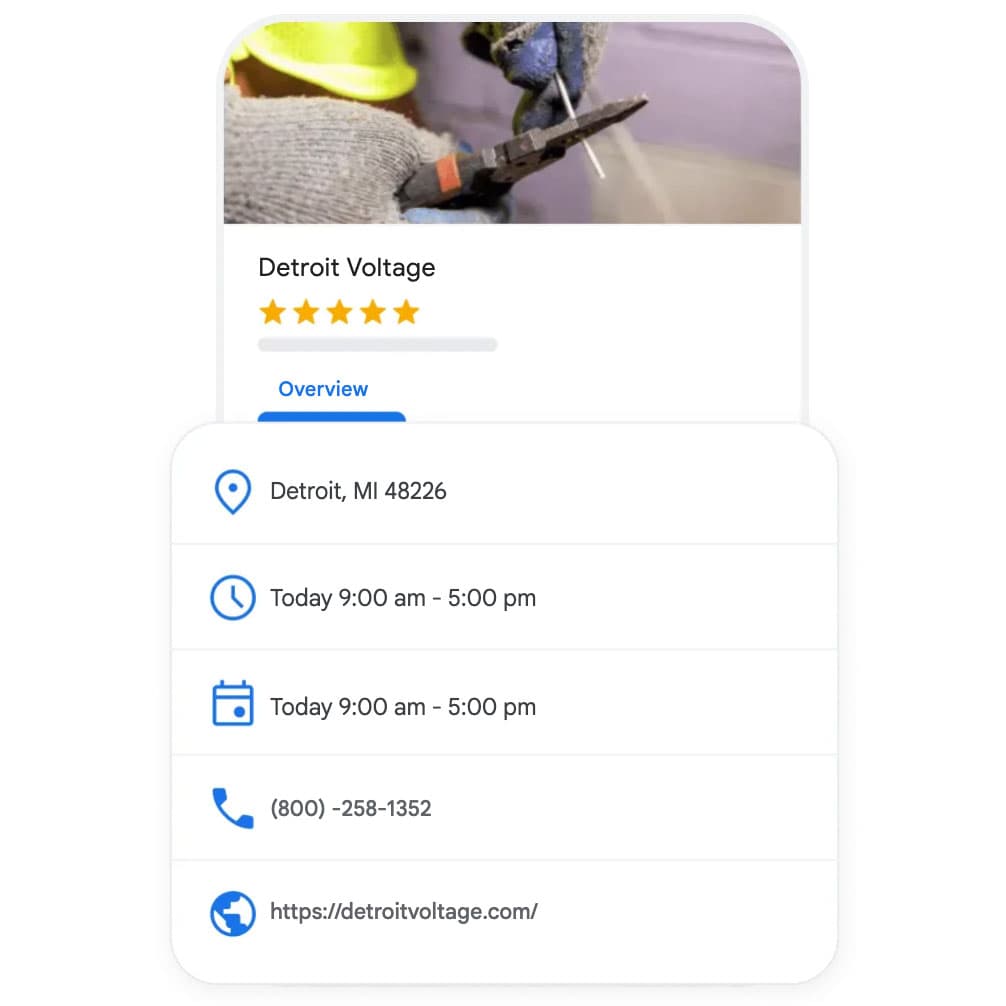
Structure an answer engine can lift. AI assistants quote passages that stand alone. A page with clear headings, a direct answer immediately under each one, and named entities - equipment types, certifications, towns - is extractable. A page whose key facts live inside a slider, an accordion or a PDF is not. Same content, different citability, and the difference is a design decision.
Speed on the worst connection, not your desk.The emergency visitor is on a phone, possibly on a weak signal, in a house that's currently too hot or too cold. Heavy hero video on mobile, uncompressed job photos and layout that shifts while loading cost you that call before the page finishes rendering - and Core Web Vitals are a ranking input on top of that.
Accessibility as conversion insurance.Tap targets a gloved hand can hit, contrast legible in direct sunlight, forms that work with a screen reader. WCAG 2.2 AA is the standard we design to, and on a service site the overlap between “accessible” and “usable in a panic” is nearly total. See responsive design for how that carries across devices.
The site is the foundation; the demand program sits on top of it. For the paid and organic side - Local Services Ads, seasonal calibration, and the content lanes opening up around the current refrigerant and tax-credit changes - see HVAC marketing and SEO, or Local Services Ads optimisation specifically.
The Compliance Constraints A Retail Designer Misses
HVAC is a licensed trade, and a website is advertising. Several requirements therefore land on the design, and a generalist building a “small business site” will not know to ask about them.
- ›Licence display. A number of states require a contractor's licence number to appear in advertising, and treat the website as advertising. We design a fixed, templated place for it so it can't be lost in a redesign - confirm the exact wording with your state board.
- ›Text-message consent. If your dispatch or reminder flow sends SMS, the consent language belongs on the form itself, unchecked by default and separate from the general submit. That is a layout requirement as much as a legal one.
- ›Financing disclosures. Rates and terms come from your lender, verbatim, with their required disclosures attached. We build the slot; we never write the numbers.
- ›Rebate and incentive claims. Utility and federal incentives change. Anything stated should be attributed and dated so an out-of-date claim is visible rather than misleading.
- ›Certification marks. Manufacturer dealer programs and technician certifications have usage rules for their logos and specific terms you are and aren't allowed to use. We follow the program's guidelines rather than approximating the badge.
- ›Accessibility. WCAG 2.2 AA, designed in rather than retrofitted - contrast, keyboard navigation, focus states, semantic structure, real alt text.
Built On WorkspaceCMS - By The Team That Builds WorkspaceCMS
You are a service business, not a retailer, so a commerce platform is the wrong foundation: you would be paying for and maintaining a cart, a catalogue and a checkout you will never switch on. We build HVAC sites on WorkspaceCMS, our own platform - 1Digital® is the team behind it, so the people designing your site and the people who maintain the software are the same organisation.
That matters most for the failure listed above that has nothing to do with design: sites that stop being updated. Adding a town page before the cooling season, swapping a promotion, correcting a financing term, publishing a completed job with photos from this morning - those are the tasks that keep a local site alive, and they should never require a developer, a ticket queue at an agency that has moved on, or a six-week wait. Managed edits are included; you send the change, it gets made.
Built on
What This Looks Like Built
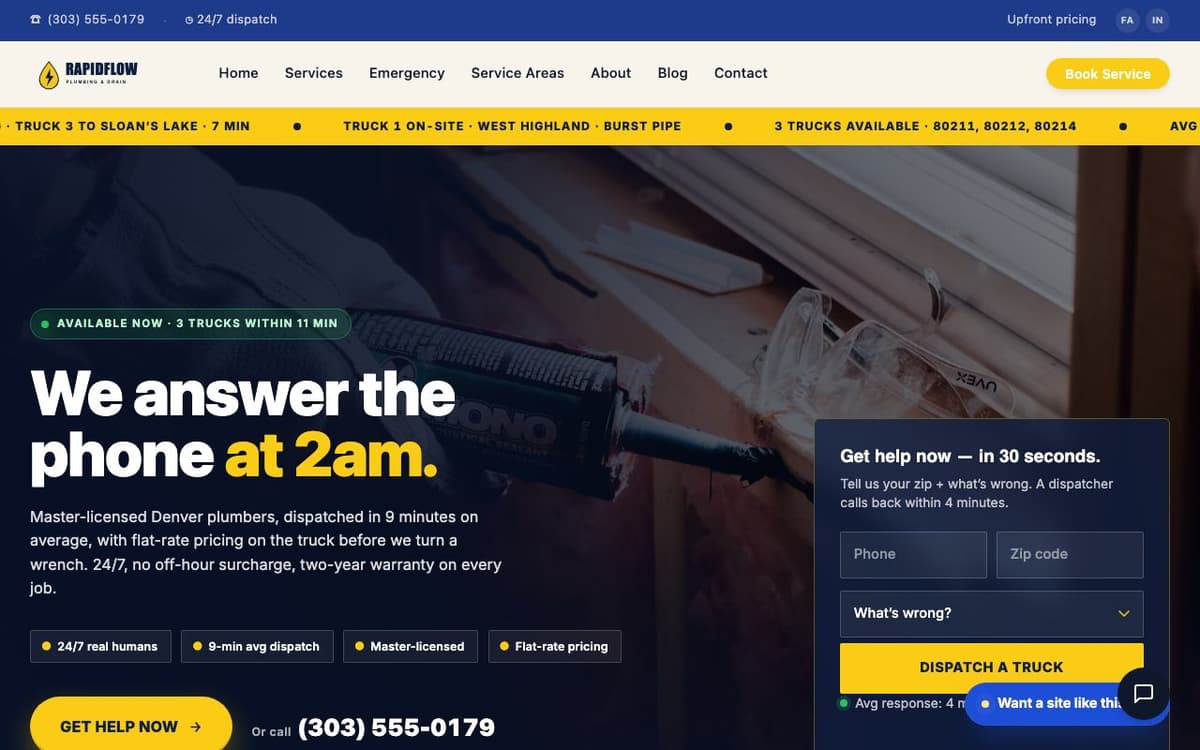
Three live demo builds on WorkspaceCMS, each running the structure described above: the emergency path kept one tap away, credentials and service areas surfaced early, and a maintenance or plan commitment given its own front-door entry rather than a footer link.
- hvac.workspacecms.ai
 View the live demo →
Northwind Heating & Air
Emergency service, planned replacement and maintenance plans as three distinct paths
- plumb.workspacecms.ai
 View the live demo →
Copper & Coil Plumbing
Same-day dispatch with service-area pages that say something specific about each town
- electric.workspacecms.ai
 View the live demo →
Voltline Electric
Sibling trade - licence, insurance and financing placed high instead of in a badge strip
What the plan behind those builds includes
Who Maintains It, And What's Included
The failure that sinks most contractor sites isn't the design - it's that nobody can change anything after launch. This walkthrough of the Essentials plan covers exactly that: what a managed WorkspaceCMS site comes with, how a seasonal promotion or a new town page actually gets published, and what you're billed for month to month.
Introducing
Your Industry. Your CMS. Managed for You.
- Unlimited managed edits - shipped on your plan's SLA
- SEO baked into every page, post, and location
- Technical SEO on every plan; AI schema and internal linking on Premium & Ultra
Request a proposal
Tell us about your service area
Share the towns you cover, your mix of residential and commercial work, and whether you're replacing a site or starting from nothing. A senior strategist replies within one business day.
HVAC Web Design - FAQ
What platform should my HVAC website be on?
For a service business, the honest answer is that the platform question is mostly a distraction - what matters is whether the site loads fast, can be updated without a developer, and is structured around service and location pages. We build HVAC sites on WorkspaceCMS because it gives you all three without the cart, catalogue and checkout of a commerce platform you would never use. If you already have a site somewhere else and it works, we will tell you that too.
Do I need a separate page for every town I serve?
You need one for every town you genuinely serve and can write something specific about - housing stock, jobs completed there, reviews from customers there, local permitting quirks. You do not need one for every town within driving distance. A page that exists only to hold a town name tends to be treated as thin by search engines and reads as filler to a homeowner who lives there. Depth over count is the rule.
How is designing for HVAC different from designing an online store?
An online store has one conversion and the visitor is browsing at leisure. An HVAC site has at least three - the emergency call, the replacement quote, and the maintenance plan - and one of them involves someone standing in an uncomfortable house who will call whoever answers first. That forces different decisions: persistent click-to-call, credentials placed high rather than in a footer, short forms, and a location structure that no product catalogue ever needs.
Where should the phone number go?
Everywhere it can be tapped, and always as a real link rather than an image, so it works on mobile, works with a screen reader, and can be swapped for a tracking number to tell you which pages produce calls. In practice that means the header on every page, a persistent mobile affordance that survives scrolling, and an explicit call option alongside every form - because a good share of your best leads will never fill in a form at all.
Will a redesign hurt my existing rankings?
It can, if it is done without a migration plan - that is how most rankings get lost. Before anything launches we map every existing URL to its replacement, put permanent redirects in place, carry the structured data and page titles across, and keep the content that is already earning visibility rather than rewriting it for the sake of it. Post-launch we watch indexing and rankings so anything that slips is caught in days, not quarters.
Who updates the site after it launches?
We do. That is the point of building on WorkspaceCMS with the team that also maintains it - managed edits are included in the hosting plan, so a seasonal promotion, a new town page, a financing update or this morning's completed job goes through a ticket rather than a development estimate. You can make changes yourself as well; the difference is that you are never blocked from doing so.
The Humans Behind the Work
A Few of the People You'll Work With
Every engagement is run by a named strategist. Here's the team.

Dan K.
Founder & CEO

Michael P.
Senior Director of Business Development

Matt L.
Director of Merchant Success

Joe C.
Assistant Director of Merchant Success

Sam M.
Senior Sales Strategist

Barry L.
Senior SEO & AI Strategist

Lindsay U.
Senior SEO & AI Strategist

Maria C.
PPC Strategist

Luisina C.
PPC and Social Strategist

Jon L.
Senior Designer

Michael E.
Senior Copywriter

Rebeca T.
Senior Content Writer

Lovely E.
Content Producer

Ruth M.
Content Producer

Anton K.
Sr. Solutions Architect

John T.
Search Strategist