

FOR GARAGE DOOR COMPANIES
Garage Door PPC That Fills Tomorrow’s Truck Schedule
A snapped spring does not wait for a comparison-shopping cycle. It creates a phone-first search, a five-minute decision window, and a job worth real money to whoever answers. We build paid-media programs around that reality: Local Services Ads and call-only campaigns for emergency repair, considered Search and retargeting for door replacement, and call tracking that prices every campaign on cost per booked job rather than clicks.
Trusted by 400+ Brands · Certified Partners




Years in eCommerce
Of results, scale, and quality at the enterprise level.
Expert Team
Specialists across SEO, AI SEO, PPC, design, dev, and strategy.
US Core + Global Talent
US core team for clear communication; vetted global specialists for international client work.
Reputation Score
Rated 4.9/5 across 941+ verified client reviews.
The 1Digital® Difference
AI in our toolkit. Humans in the driver’s seat.
Our strategists, designers, developers, and writers are human. The proprietary AI we built makes them faster and sharper - not the other way around.
- Human strategy
- Human copywriting
- Our own AI tools
- Real growth
Why Paid Search Works Differently for a Garage Door Company
Most of the paid-media playbook you will read online was written for retailers. It assumes a product feed, a cart, and a return-on-ad-spend figure calculated against catalogue revenue. None of that applies here. Your conversion is a ringing phone or a quote request; your inventory is technician hours; your ceiling is not catalogue depth but the number of trucks you can put on the road inside a service radius. That single structural difference changes how the account should be built, bid, measured, and budgeted - and it is why we run lead-generation PPC mechanics on these accounts rather than the eCommerce mechanics that dominate the rest of our PPC services practice.
The demand itself splits into two economies that share a keyword space but almost nothing else. Emergency repair is unplanned, non-deferrable, and decided in minutes: a door off its track blocks a car in a garage, and the homeowner calls the first credible result that answers. Price sensitivity in that moment is low; answer speed is everything. Replacement and new installation is the mirror image - a months-long consideration cycle with three quotes, style and material research, and a ticket several times larger than a spring repair. Bidding both from one campaign with one budget and one landing page guarantees you overpay for one and underserve the other.
Then there is seasonality, which in this trade is driven by weather events rather than a retail calendar. Cold snaps stiffen springs and stress openers; wind and storm events rack doors off track; the home-improvement season pulls replacement demand into spring and early summer. Auction pressure spikes on exactly the days your own phones are busiest, so a flat monthly budget spends its best dollars on the quietest weeks. We build pacing that leans into storm windows and cold-weather spikes, and pulls back when the auction is expensive and the demand is soft.
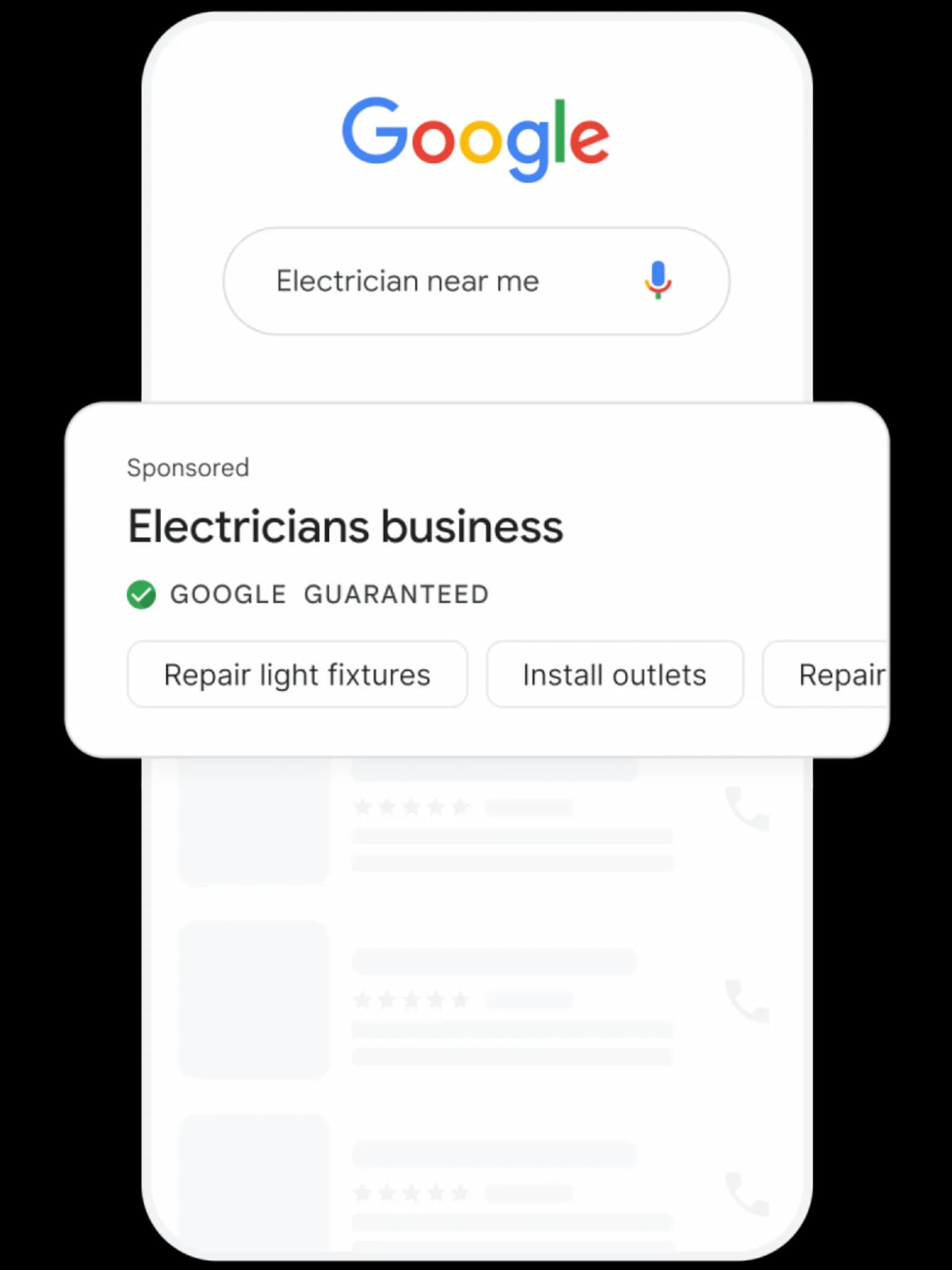
Finally, this category carries compliance limits that eCommerce advertisers never encounter. Local Services Ads require license and insurance verification and a background check before the Google Guarantee badge appears. Superlative and guarantee language in ad copy - “lifetime warranty,” “#1 in the state,” specific arrival-time promises - has to be substantiated and, in many states, sits inside home-improvement contractor advertising rules. Manufacturer-authorized-dealer claims need to match your actual dealer agreements. We write ad copy that stays inside those lines while still sounding urgent, because a suspended LSA profile costs more than any clever headline earns.
- Separate campaign structures for emergency repair versus replacement and new install.
- Ad scheduling matched to real answer capacity, including evenings and weekends.
- License, insurance, and Google Guarantee verification handled during onboarding.
- Geo-fencing to drive-time radius rather than a blunt mileage circle around the shop.
- Weather- and season-aware budget pacing instead of flat monthly spend.
- Reporting in cost per qualified lead and cost per booked job, never impressions.
Garage Door PPC, step by step
Pay for the clicks that become leads
Every click moves from the ad to your page to a lead, and some fall away at each step. The search terms report shows why: the garage door searches that turn into calls earn more budget, and job seekers and freebie hunters are added as negatives.
- ›Search terms read by a senior strategist, not left to automation
- ›Negative keywords that stop paying for searches that never convert
- ›Budget moved toward the services and searches that book
The Channel Mix
Four Campaign Types, Four Different Jobs
Stage 01 - Screened placement
Local Services Ads
Google-screened, pay-per-lead, and pinned above the paid Search block on the queries that matter most. For a licensed, insured, background-checked garage door company, LSAs are usually the cheapest qualified phone call in the account - and the placement a homeowner sees first on a broken-spring search.
Stage 02 - Emergency capture
Call-Only Search
An emergency searcher standing in the driveway does not want a landing page. Call-only campaigns skip the site entirely and dial your dispatch line, scheduled to the hours you can actually answer - because a missed ring on a paid click is spend converted into a competitor's job.
Stage 03 - Considered demand
Standard Search + Sitelinks
Replacement and new-install shoppers do want a page: door styles, insulation R-value, opener brands, financing. Those queries route to considered landing pages with quote forms, while repair queries route to click-to-call. One account, two conversion paths, separately bid.
Stage 04 - Close the estimate
Retargeting & Demand Gen
Nobody impulse-buys a $3,000 insulated door. Quote-abandoners get retargeted across YouTube and Discovery surfaces with the specific proof a replacement buyer stalls on - warranty terms, install-day expectations, financing - until the estimate closes.
Lead Quality Is the Whole Game
A garage door account can look excellent in the Google Ads interface and be losing money. Conversions climb, cost per conversion falls, and the campaign is quietly buying calls from people outside the service area, homeowners hunting a $12 remote, and DIYers who want a technician to talk them through a sensor alignment for free. The interface counts all of those as conversions because it cannot hear the call. So we make the account hear it: dynamic number insertion, call recording with weekly human review, lead scoring, and an offline conversion feed that carries booked-job value back into bidding.
That feedback loop is where a senior strategist earns their keep, and where our WorkspaceCRM AI does the volume work - flagging search-term drift, surfacing the call patterns that correlate with cancelled jobs, and watching cost per qualified lead by campaign and by territory. Humans make the calls on structure, copy, and budget; the AI keeps the daily surveillance honest between reviews. It pairs naturally with the organic side of the same funnel - see garage door SEO for the map-pack and review-velocity work that lowers what you have to buy in the auction, and our Local Services Ads optimization service for the pay-per-lead surface above it.
Call tracking with dynamic numbers
Unique numbers per campaign and per landing-page session so every booked job traces back to a keyword, not just a channel. Without it you are optimizing paid search on form fills while most of your revenue arrives by phone.
Call recording and lead scoring
We listen to a sample of calls every week and score them: service call, out-of-area, warranty question, opener-parts-only, wrong number. That scoring is what teaches the bidding algorithm the difference between a lead and a job.
Offline conversion import
Booked and completed jobs get pushed back into Google Ads with their ticket value, so Smart Bidding optimizes toward revenue instead of raw call volume. This is the single largest performance lever in a service account.
Negative keyword hygiene
Garage door search terms leak badly into DIY, parts, remotes, springs-for-sale, and 'how to fix' research traffic. Aggressive weekly negatives are the difference between a workable cost per lead and a budget eaten by hobbyists.
After-hours answering strategy
Emergency demand does not respect business hours. We map your answer capacity to ad schedules, and where an answering service or overflow line exists, we bid into evenings and weekends - where competition often thins out.
Form and quote-request quality
Replacement leads arrive by form. We instrument those forms for door type, opening size, and timeline so your estimator walks into the call already knowing whether it is a one-day swap or a custom carriage-house build.
Budget and Service-Area Strategy
A garage door budget is capped by geography, not by catalogue. There is a finite number of people inside your drive-time radius whose door will fail this month, which means spend has a natural ceiling - and pouring money past it does not buy more jobs, it buys longer drives and worse margins. We size budget to territory demand, then expand deliberately: one adjacent ZIP cluster at a time, each with its own bid and its own cost-per-booked-job target, so a suburb that looks cheap on clicks but bleeds windshield time gets caught before it becomes half your spend.
Inside a territory, radius targeting is set by drive time rather than mileage - a highway corridor twenty miles out is often more profitable than a congested neighborhood five miles away. Multi-location companies get campaign segmentation per branch so bids reflect each crew’s true capacity, and so a busy branch does not have its budget cannibalized by a slow one. Where a franchise or dealer agreement restricts territory, those boundaries get enforced in the geo settings rather than trusted to the algorithm.
Landing Pages Built for Two Buyers
Emergency traffic lands on a page that loads fast on a phone in a driveway with one bar of signal: phone number above the fold, service area stated plainly, hours and answer promise visible, and nothing between the tap and the call. Replacement traffic lands somewhere else entirely - door styles and materials, insulation and opener options, warranty terms, financing, and a quote form that captures enough detail for an estimator to prepare. Same account, same brand, deliberately different pages, because sending both to a generic services page suppresses conversion on both halves of the demand.
A wasted click
- Lands on a slow homepage and waits while a hero video loads on one bar of signal.
- Phone number sits in the footer, so calling means pinching, scrolling and squinting.
- No service area on the page - the homeowner cannot tell if you come to their street.
- One generic contact form for repair, replacement and parts questions alike.
- Nothing that answers “can they come today?” - so the next result gets the call.
A converting click
- Tap-to-call button above the fold, sized for a thumb and wired to your dispatch line.
- Loads fast on mobile because the page was built for the driveway, not the desktop.
- Service area and answered hours stated plainly, near the top, in words not a map widget.
- Repair traffic and replacement traffic land on separate pages built for each decision.
- Quote form captures door type, opening size and timeline so the estimator arrives prepared.
Why 1Digital® for Garage Door Paid Media
We have run paid media for home-services and contractor businesses alongside a deep eCommerce practice, which means we bring retail-grade measurement discipline to a trade where most accounts are still reporting on clicks. Every account is owned by a senior strategist who knows the difference between a call and a job. Start with a free PPC audit, or browse the rest of our PPC by industry work and the broader contractor marketing services we build around it.
Managed Websites by 1Digital®
Your Ads Are Only As Good As The Site They Land On
Every garage door click you buy ends up on a page that either books the job or loses it. If that page is slow on a phone, buries your number, or leaves the service area unclear, the spend is gone. WorkspaceCMS builds and manages that site for you - free on a 12-month plan - so the emergency-repair and replacement traffic your campaigns generate has somewhere worth landing.
- Tap-to-call dispatch number above the fold on every mobile screen
- Fast-loading pages for homeowners searching from the driveway
- Service area, hours and answered-call promise stated up front
- Quote forms that route repair and replacement leads separately
Free build on a 12-month plan. Managed hosting and updates included.
 Explore Ironclad Garage Door Co. →
Request a proposal
Tell us about your service area and crew size
Share your territories, truck count, and how calls are answered after hours. A senior strategist replies within one business day with a pricing band and a draft campaign structure.
Garage Door Companies PPC - FAQ
Should a garage door company run Local Services Ads or Search ads first?
Usually LSAs first, then Search. Local Services Ads sit above the paid Search block, charge per lead rather than per click, and carry the Google Guarantee badge once your license, insurance, and background check clear - all of which suits an emergency-repair searcher choosing fast. But LSA lead volume is capped by your budget and by how many screened competitors share the area, and LSAs cannot address replacement or brand-specific queries at all. Search picks up everything LSAs cannot reach, which is why the mature accounts run both.
How do you keep repair and replacement campaigns from competing with each other?
By separating them at the campaign level with distinct keyword sets, negatives, landing pages, bids, and conversion actions. Repair campaigns own symptom and urgency language and route to click-to-call; replacement campaigns own style, material, opener, and installation language and route to a quote form. Each gets its own negative list so the other’s terms are actively excluded. Without that separation the emergency terms - which are cheaper and convert faster - soak up the shared budget and the higher-ticket replacement demand quietly starves.
Why does call tracking matter so much in this vertical?
Because most of your revenue arrives by phone, and Google Ads cannot hear the call. Left alone, the account optimizes toward whatever produces the most calls - including out-of-area callers, parts-only inquiries, and DIY questions that never become jobs. Dynamic number insertion attributes each call to a campaign and keyword, recording plus weekly human review scores it as qualified or not, and offline conversion import sends the booked-job value back into bidding. That loop is what turns a call-volume machine into a booked-revenue machine.
How does seasonality affect garage door ad budgets?
More than most trades, and it is driven by weather rather than a calendar. Cold snaps stress springs and openers, and wind or storm events rack doors off their tracks, so repair demand arrives in bursts your competitors are bidding into at the same time. Replacement demand follows the broader home-improvement season, concentrating in spring and early summer. We pace budget to lean into those spikes and pull back during soft, expensive weeks, rather than spreading an even monthly amount across very uneven demand.
What ad-copy claims should a garage door company avoid?
Anything you cannot substantiate on demand. Lifetime or unconditional warranty language, “#1” or “best in the state” superlatives, and hard arrival-time promises all create exposure - under Google’s policies, under state home-improvement contractor advertising rules, and with the customer standing in the driveway when the truck is late. Manufacturer-authorized-dealer claims must match your actual dealer agreement. We write to concrete, defensible specifics instead: hours answered, years in business, brands genuinely carried, and warranty terms exactly as written.
How large a service area should we advertise in?
Start with the drive-time radius your crews can serve profitably and expand from there in deliberate steps. Mileage circles mislead - a highway corridor twenty miles out can be more profitable than a congested neighborhood five miles away, because the cost that matters is windshield time, not distance. We add adjacent ZIP clusters one at a time, each with its own bids and its own cost-per-booked-job target, so an area that looks cheap on clicks but is expensive on travel gets identified before it consumes the budget.