

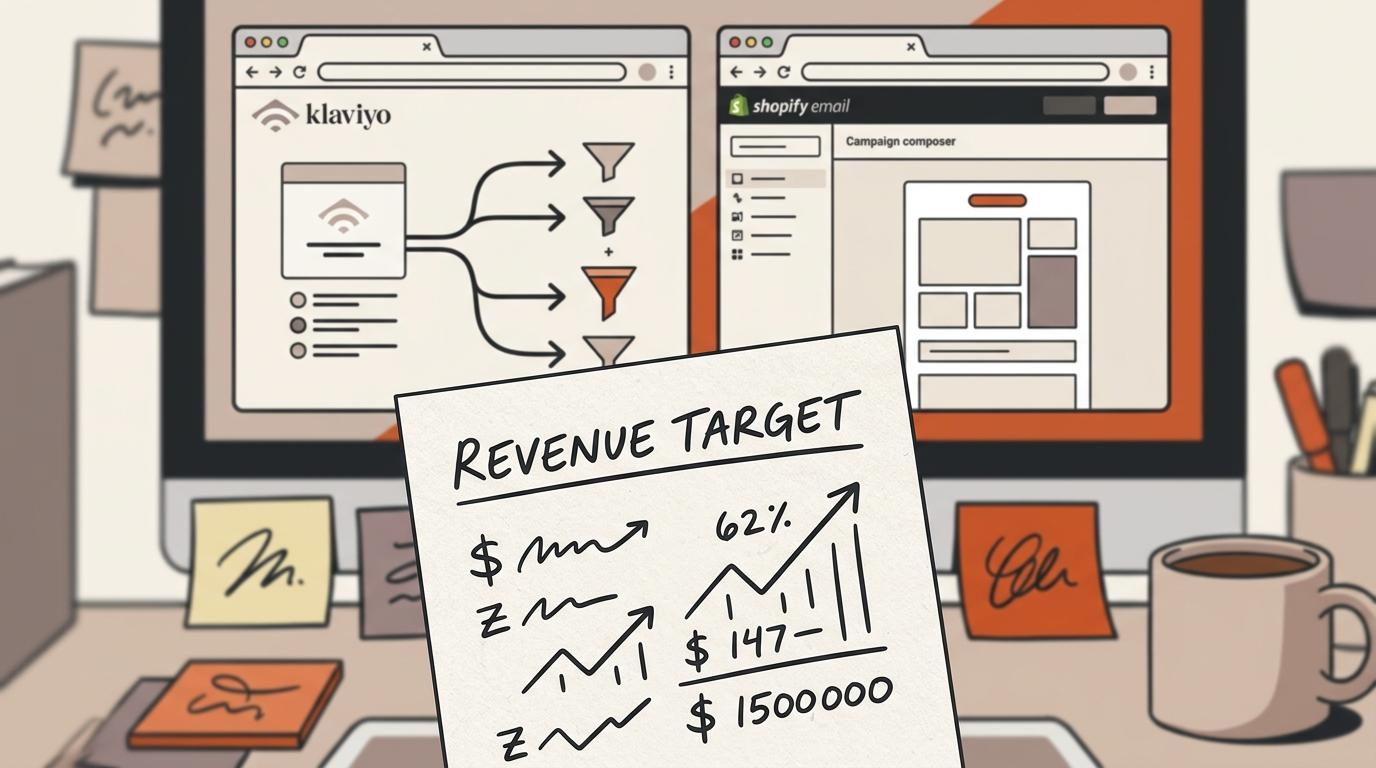
Klaviyo vs. Shopify Email: The Verdict is About Your Stage, Not Just the Features
For new stores, Shopify Email is the right starting point for its simplicity and direct integration. For stores focused on scaling revenue with complex automation and segmentation, Klaviyo is the superior, necessary choice. The debate isn't about which platform is "better." It's about which tool is right for the job you need to do right now.
The marketing internet loves a platform war, framing every choice as a David-and-Goliath fight with a clear winner and loser. This isn't one of them. Choosing between Shopify Email and Klaviyo is like choosing between the screwdriver that came with your IKEA furniture and a professional-grade power drill. One gets a specific, immediate job done with no friction; the other is built for constructing complex systems. Using the wrong one for the task leads to frustration, wasted time, and poor results.
Shopify Email: The Integrated Starting Point
Shopify Email is built directly into your store's backend. There is no new interface to learn, no integration to set up, and no complex pricing to decipher. Its primary job is to let you send clean, effective email campaigns to your customer list. For a new business, this is exactly what's needed.
Where It Excels: Simplicity and Speed
The platform's strength is its directness. You can create a campaign, pull in products directly from your store, select a pre-defined customer segment, and send it. The workflow is frictionless because it was designed as an extension of the core Shopify platform, not a separate entity bolted on. For a founder handling their own marketing, this is a massive advantage. You don't need a dedicated email specialist to get a Black Friday campaign out the door.
The automations cover the absolute essentials: welcome series, order confirmation, and abandoned cart reminders. They work out of the box and start generating revenue immediately. Honestly, for many stores in their first year, this is enough.
The Failure Mode: Hitting the Segmentation Ceiling
The mistake to avoid is trying to force Shopify Email to do more than it was designed for. The platform breaks when your strategy requires nuance. You'll want to send an email to customers who bought Product A but not Product B, who live in California, and have spent over $200 in the last six months. Shopify Email can't do that. Its segmentation is based on broad, pre-set rules.
You can't build complex, multi-path automation flows based on user behavior. You can't A/B test a five-email welcome series to see which version drives more first-time purchases. The platform isn't broken; you've just outgrown it. Sticking with it at this stage means leaving money on the table because you can't personalize communication at scale.
Klaviyo: The Dedicated Growth Engine
Klaviyo is not an add-on; it's a dedicated customer data and marketing automation platform that integrates deeply with Shopify. Its entire purpose is to ingest vast amounts of customer data - purchase history, browsing behavior, email engagement - and turn it into highly personalized, automated marketing systems.
Where It Excels: Automation and Data-Driven Personalization
With Klaviyo, you can build anything. A post-purchase flow that shows different upsells based on the specific product a customer bought. A win-back campaign that triggers 90 days after a customer's last purchase with a specific offer based on their previous order value. A sunset flow that automatically cleans your list of unengaged subscribers to improve deliverability.
Klaviyo’s segmentation is nearly limitless, allowing you to create dynamic audiences based on any combination of events, profiles, and even predictive analytics like "predicted next order date." Shopify Email is for sending campaigns; Klaviyo is for building revenue-generating systems. That distinction is everything.
The Failure Mode: Paying for Power You Don't Use
The most common mistake with Klaviyo is adopting it too early. A new store owner, told they *need* the best, signs up for Klaviyo and is immediately faced with a wall of options. Overwhelmed by the complexity of the flow builder and segmentation tools, they default to sending the same simple weekly newsletters they could have sent from Shopify Email for a fraction of the cost.
They are paying for a power drill and using it as a hammer. The platform's potential is wasted, and the monthly bill creates a drag on a business that needs to protect its margins. The tool's power becomes a source of friction, not a catalyst for growth.
A Direct Comparison: Shopify Email vs. Klaviyo
Let's break down the practical differences. This is where the choice becomes clear.
Segmentation: Shopify is Basic; Klaviyo is Granular
- Shopify Email: Offers pre-built templates for segments like "first-time customers," "repeat customers," and "abandoned checkouts." You can add some filters, but the logic is limited. It's good for broad targeting.
- Klaviyo: Allows you to build segments from any data point it collects. You can use AND/OR logic to create highly specific audiences, like "customers who have viewed 'Blue Shoes' at least 3 times in the last 7 days AND have purchased from the 'Shoes' category before BUT have never purchased 'Blue Shoes'." This is the substrate of true personalization.
Automation: Shopify's Flows are Simple; Klaviyo's are Systems
- Shopify Email: Provides a handful of key, pre-built automations. The setup is simple, but customization is minimal. You can't easily add branching logic (if/then statements) to send users down different paths based on their actions.
- Klaviyo: The visual flow builder lets you construct complex, multi-path customer journeys. You can add time delays, conditional splits, trigger emails based on website activity, and A/B test every single step. This is how you nurture leads and maximize customer lifetime value automatically.
Analytics: Shopify Covers Essentials; Klaviyo Provides Insight
- Shopify Email: The reporting is clean and directly tied to sales. You can see open rates, click rates, and how much revenue each campaign generated. It's attribution made simple.
- Klaviyo: Goes deeper. You get customizable dashboards, cohort analysis, and predictive analytics that forecast customer lifetime value and churn risk. You're not just seeing what happened; you're getting data to model what will happen next.
The Honest Tradeoff: Simplicity Now vs. Power Later
Your decision comes down to a single, honest assessment of your business's current needs and resources.
Choosing Shopify Email means prioritizing speed, simplicity, and low cost. You accept the limitation that you will eventually need to migrate if your growth and marketing sophistication demand it. The honest version is that it’s the right tool for Year One, but likely the wrong tool for Year Three.
Choosing Klaviyo means prioritizing power, personalization, and long-term scalability. You accept the higher cost and steeper learning curve. The risk is paying for features you don't have the time or strategy to implement yet. This approach only makes sense if you have a dedicated team member who can own email marketing or if your revenue already justifies the investment.
In our experience, the inflection point is often around the $500k-$1M annual revenue mark. Below that, the operational simplicity of Shopify Email often outweighs the benefits of Klaviyo's power. Above it, the revenue left on the table by not using advanced personalization becomes too significant to ignore.
The Decision is a Handoff to Your Roadmap
This isn't just an analytical exercise. The choice you make dictates what's possible in your marketing plan for the next year.
If you choose Shopify Email, your roadmap will focus on consistent, high-quality campaign sending. Your primary goal is building a routine with your audience.
If you choose Klaviyo, your roadmap will involve building and optimizing automated flows. Your goal is to create systems that generate revenue without manual intervention. Both are valid strategies, but they are not the same. Choose the platform that supports the work you are actually resourced to do.
Frequently Asked Questions
Is Klaviyo worth the extra cost compared to Shopify Email?
Klaviyo is worth the cost if you use its advanced features for segmentation and automation to generate more revenue than its fee. If you only use it to send basic campaigns, it is not worth the cost. For scaling stores, the ROI is almost always positive; for new stores, it's often a premature expense.
Can you use both Shopify Email and Klaviyo?
While technically possible, it's a bad practice. Doing so would split your customer data, analytics, and messaging into two separate systems, making it impossible to get a clear picture of performance or ensure a consistent customer experience. You should choose one platform to be your canonical source for email marketing.
How difficult is it to migrate from Shopify Email to Klaviyo?
The migration is straightforward. Klaviyo's Shopify integration is excellent and can sync your customer and order history. The main work involves rebuilding your essential automations (like welcome and abandoned cart series) in Klaviyo's flow builder before you make the final switch. Most stores can complete the technical migration in a day, with another week dedicated to rebuilding and testing flows.