
For Roofing Contractors
Roofing Web Design
Built to Book the Job
Websites designed around how homeowners actually hire a roofer - the emergency call, the months-long replacement decision, and the insurance claim in between.
Trusted by 400+ Brands · Certified Partners




Years in eCommerce
Of results, scale, and quality at the enterprise level.
Expert Team
Specialists across SEO, AI SEO, PPC, design, dev, and strategy.
US Core + Global Talent
US core team for clear communication; vetted global specialists for international client work.
Reputation Score
Rated 4.9/5 across 941+ verified client reviews.
Vertical, not platform
You Don't Need a Platform. You Need a Roof Company Website.
Most web design pages start by asking which platform you want. That is the wrong first question for a roofing contractor. You are not selling a catalogue of products with a cart and a checkout - you are selling a high-consideration service, performed at a customer's home, in a defined geography, often under weather-driven urgency, and inside a licensing regime that varies by state. The right question is what the site has to doon the worst day of a homeowner's week.
So we start with the jobs and the geography, then choose the build. For service businesses that is WorkspaceCMS - our own platform, built for exactly this shape of site: fast publishing of service and service-area pages, SEO and schema handled by the platform, and managed edits included so the site keeps up with your season instead of freezing the month it launched. 1Digital® is the team behind WorkspaceCMS; you get the platform and the strategists who built it.
Design and search are the same project here. What you build determines what there is to rank, which is why this page pairs with roofing SEO and roofing PPC. If you run several trades under one roof, see contractor marketing services.
Roofing web design, step by step
From wireframe to a site that books
Every roofing site starts as a plan for how a visitor finds what they came for and acts on it. We design that structure first, then build it fast, mobile-first and accessible, with the call to action exactly where the visitor is ready to get in touch.
- ›Layouts planned around how roofing customers decide
- ›Mobile-first, fast loading and accessible from the start
- ›Built for search from the first wireframe, not bolted on later
Four Visitors, Four Paths
Roofing Traffic Is Not One Audience
The single biggest design decision in this vertical is refusing to treat these four visitors identically. Each arrives with a different urgency, a different question, and a different definition of a good next step.
Emergency - the tarp is already on
Active leak, wind or hail event, tree strike. This visitor will not read. They need a phone number that dials in one tap, an honest statement of response window and after-hours coverage, and proof you are licensed and insured within one screen. Every extra step is a competitor's call.
Planned replacement - researching for weeks
An aging roof, a real-estate deadline, or an energy upgrade. This visitor compares materials, warranties, and crews across several sites before contacting anyone. They need comparison content, a gallery organized by material, warranty specifics, and financing - the depth that turns a bookmark into a booked estimate.
Insurance claim - confused and cautious
A neighbor's roof got approved and theirs did not, or an adjuster used a word they did not recognize. They need process explained without hype, and boundaries stated plainly. Contractors who explain the claim calmly get the call; contractors who promise outcomes make homeowners nervous.
Commercial and property management - spec-driven
A facilities manager or property owner scoping TPO, EPDM, coatings, or a maintenance program. They need capability evidence, bonding and insurance detail, references at similar scale, and a contact path that is not the same residential 'free estimate' form.
Trust Is the Product
What a Homeowner Is Really Checking
A roof is one of the largest unplanned purchases a household makes, sold by someone they have never met, who will be on their house for days, and whose work they will never be able to inspect themselves. The design job is to retire that risk quickly and visibly. Every item below is a design decision - where it sits, how early it appears, and whether it survives on a small screen.
The same evidence supports reputation management and gives search engines and AI assistants concrete facts to cite about your business.

- ›State license number displayed where your state requires it, in the format it requires
- ›Proof of general liability and workers' compensation coverage
- ›Manufacturer certifications and the warranty tiers they unlock
- ›Workmanship warranty terms in plain language, separate from material warranty
- ›Real project photography from your own service area, with location and material named
- ›Reviews surfaced from the profiles they live on, not retyped into the template
- ›Named crew and ownership - a roof is a stranger on your house for three days
- ›Clear, honest statements about response windows and after-hours coverage
Page Architecture
The Structure a Roofing Site Needs
Architecture is where design and search meet. Each of these exists because a real person searches for it and a search engine needs somewhere to send them.
Home
Answers three questions above the fold: what you do, where you do it, and how to reach you right now. Service-area language and a tap-to-call number belong here, not three scrolls down.
Service pages - one per job type
Repair, full replacement, storm and hail damage, gutters, skylights, flat and low-slope, metal, and commercial each deserve their own URL. A single 'Services' page cannot rank for, or answer, eight different jobs.
Service-area pages
One page per town or county you genuinely serve, with real local substance - permit quirks, common roof types, jobs you have completed there. Thin pages that swap a city name are the classic doorway-page failure.
Project gallery
Before/after sets grouped by job type and location, with material named, so a homeowner comparing architectural shingle to standing-seam metal can see both on a house like theirs.
Insurance & claims guidance
A plain-English page on how a claim proceeds, what an adjuster looks for, and where your crew fits - written inside the limits your state places on contractors discussing claims.
Financing
If you offer financing, it needs a page. Replacement is a large unplanned expense, and 'can I pay for this' is often the real objection behind an abandoned quote form.
Credentials, crew & reviews
License number, insurance and workers' comp status, manufacturer certifications, warranty terms, and named crew photos - the evidence a stranger needs before letting you on the roof.
Estimate request
A short form with an address field, a photo upload, and a clear promise about when someone will call back - plus consent language your intake process can actually honor.
Introducing
Your Industry. Your CMS. Managed for You.
- Unlimited managed edits - shipped on your plan's SLA
- SEO baked into every page, post, and location
- Technical SEO on every plan; AI schema and internal linking on Premium & Ultra
Why Roofing Sites Fail
The Recurring Ways a Roofing Website Loses the Call
Bad roofing sites rarely look bad. They fail on the specifics of the vertical - the mobile moment, the geography, the paperwork, and the pace of the season.
Unusable phone number
The phone number is an image, or lives only in the footer - unusable on the phone a homeowner is holding while standing in the driveway looking at a tarp.
Wrong-climate stock photos
Stock photos of roofs that are obviously not in your climate. Homeowners in hail country recognize their own neighborhoods, and they recognize when they are not looking at them.
No service-area page
No service-area page, so both a searcher and a search engine have to guess whether you cover their town.
One form for everyone
A single 'Contact' form as the only path, when the emergency segment wants to call and the planning segment wants to browse gallery and financing first.
Gallery that never loads
Gallery images uploaded straight from a phone at full resolution - a beautiful gallery that never finishes loading on a rural cellular connection is a blank page.
Unchecked claims language
Claims-adjacent copy written without reference to state rules on deductibles, public adjusting, and contract cancellation windows.
Retyped reviews
Reviews pasted as flat text with no connection to the profiles they came from, which reads as invented and earns nothing in search.
Frozen since launch
A site nobody can update, so the storm page from three seasons ago is still the freshest thing on it.
Constraints Worth Designing Around
Licensing, Claims Language & Accessibility
Roofing carries obligations that most web designers never encounter, and they shape the template rather than sitting in a disclaimer. Licensing is the obvious one: several states require a contractor's license number to appear in advertising, in a prescribed format, and a website is advertising. If you operate across state lines, the template has to make that display conditional rather than baking one number into the footer.
Storm and insurance work adds a second layer. Rules on what a contractor may say about deductibles, on acting as a public adjuster, and on cancellation windows for storm-related contracts vary by state and are revised periodically. We design claims content to explain the process and route the homeowner correctly, and we treat the exact wording as something your counsel or state association signs off on - not something a copywriter decides.
Lead forms carry their own constraints: consent language for calls and texts should describe what your intake team will actually do, and the form should capture it in a way you can produce later. And because these sites are used one-handed on a phone, in bright sun, sometimes by an older homeowner, accessibility is functional rather than decorative - contrast that survives daylight, tap targets that work with gloves on, keyboard and screen-reader support throughout. See accessibility compliance and responsive design for how we build it in.
Design Decisions That Feed Search
How the Build Decides What Can Rank - and What AI Can Quote
A roofing site's search performance is mostly set before anyone writes a title tag. If your services live in one accordion on the homepage, there is no page to rank for "flat roof repair." If your service areas are a comma-separated list in the footer, there is nothing to rank for the town three exits north. Structure first, optimization second.
The practical decisions: one indexable URL per service and per service area; consistent business name, address, and phone rendered from a single source in the layout so it never drifts; RoofingContractor and LocalBusinessstructured data emitted by the template rather than pasted per page; galleries served in modern formats at sane dimensions so mobile pages stay fast on a weak signal; and headings that use the words homeowners use - "hail damage," "missing shingles," "roof leak in the ceiling" - instead of internal service codes.
AI visibility follows from the same work. Assistants summarizing "roofers near me who handle hail claims" assemble answers from pages that state facts unambiguously: the towns you serve, the services you perform, your licensing, your warranty, your response window. FAQ blocks that answer in a self-contained paragraph are quotable; sales copy that circles the question is not. That is why the structured, plainly written page beats the beautiful one that says nothing specific - for assistants and for the homeowner skimming on a phone. Related: local service business SEO and local AI SEO.
Built on
Roofing and Trades Builds You Can Open Right Now
Everything above is easier to judge on a live site than in a paragraph. These are real WorkspaceCMS builds for roofing and adjacent trades - branching contact paths, galleries that carry job detail, and licensing proof placed where a homeowner is already looking.
- roof.workspacecms.ai
 View the live demo →
Summit Ridge Roofing
Storm-response and planned-replacement paths kept separate from the first screen
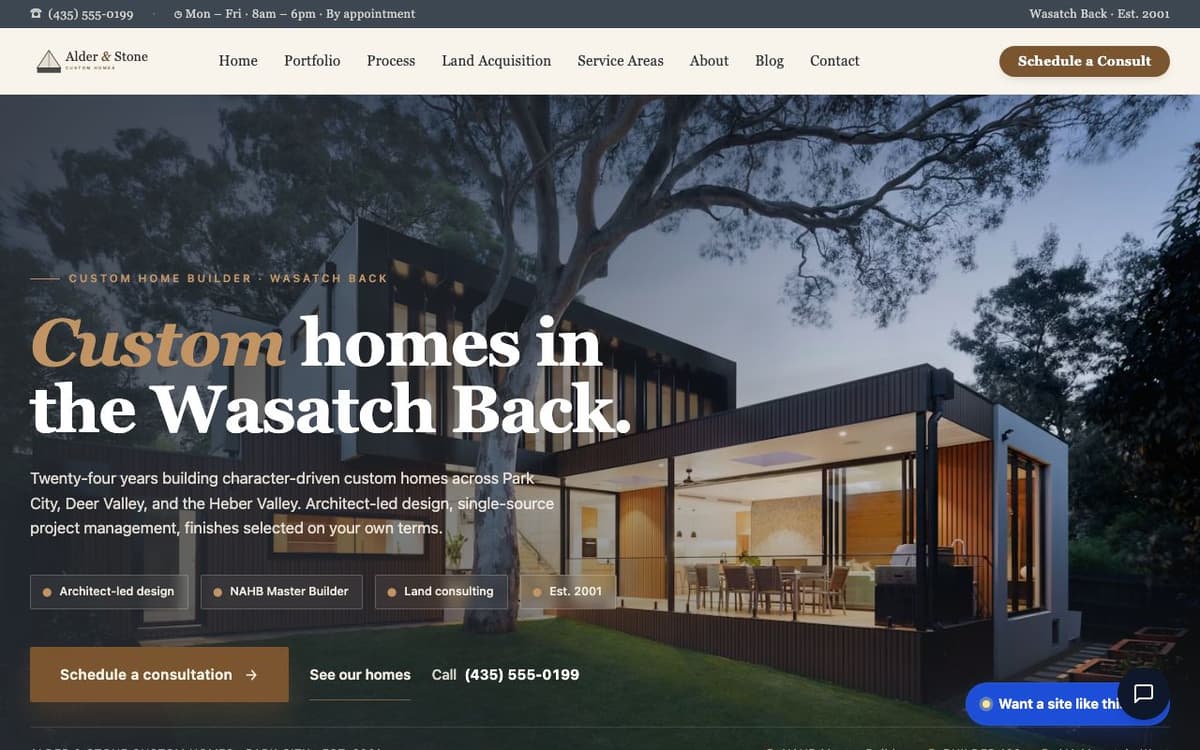
- homebuilder.workspacecms.ai
 View the live demo →
Cornerstone Builders
Project galleries that name material, scope and location instead of just looking good
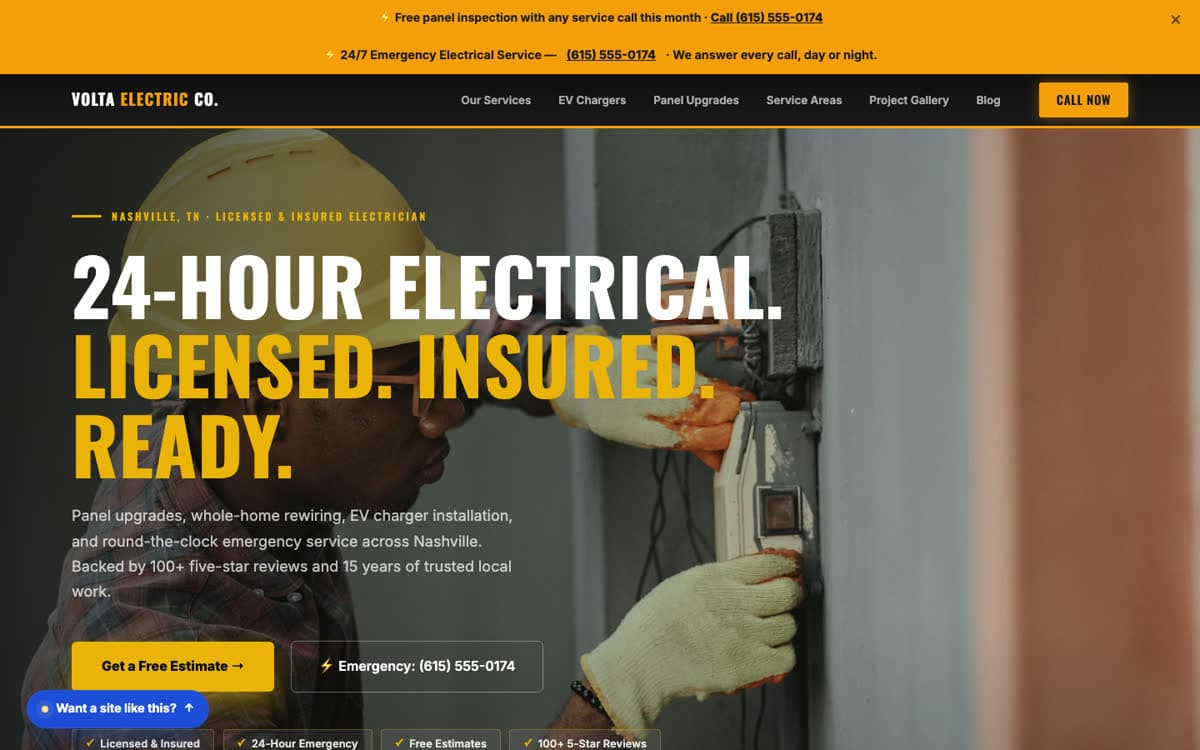
- electric.workspacecms.ai
 View the live demo →
Voltline Electric
Licensed-trade layout with emergency dispatch and credentials above the fold
Where a Roofing Site Starts
What the Entry Plan Actually Includes
If those builds look like more than a first website needs, this is the plan most roofers begin on. The walkthrough covers what Essentials includes, what stays managed for you, and where the line sits before you need more - so you can size the decision before you ask for a proposal.
A Roofing Website That Works in Storm Season
Fast on cellular, clear about your service area, and easy to update the morning after a hailstorm.
Request a proposal
Tell us about your roofing business
Share your service areas, the job types you want more of, and whether storm work is part of the mix. A senior strategist replies within one business day with a pricing band and draft roadmap.
Roofing Web Design - FAQ
What makes a roofing website different from a generic small-business site?
Traffic arrives in distinct emotional states - emergency leak, planned replacement, insurance confusion, commercial spec - and a generic template funnels all of them into one contact form. A roofing site has to branch: an immediate call path for the emergency segment, deep comparison and financing content for the planners, careful claims guidance for the insurance segment, and a separate commercial track. It also has to load on a weak cellular signal, prove licensing and insurance early, and cover a service area explicitly rather than by implication.
How many pages does a roofing website actually need?
Enough that every job type and every service area has a page worth reading - and no more. One page per service (repair, replacement, storm damage, gutters, flat/low-slope, metal, commercial), one per town you genuinely serve, plus gallery, credentials, financing, reviews, and estimate request. The discipline is in what you refuse to publish: a service-area page with nothing local in it hurts you, because it looks like a doorway page to search engines and like filler to homeowners.
Should our site talk about insurance claims?
Usually yes - it is one of the highest-intent question sets in the vertical - but the copy has to be written inside your state's rules. Many states regulate what a roofing contractor may say about deductibles, restrict acting as a public adjuster without a license, and require specific contract-cancellation language on storm-related agreements. Those rules differ by state and they change. We write claims content to explain the process and set expectations, and we ask your counsel or state association to confirm the specifics before it publishes.
How does the website design affect our local SEO?
Design decides what there is to rank. Template-level name, address, and phone consistency; one crawlable URL per service and per service area; heading structure that mirrors how homeowners phrase jobs; image weight that keeps mobile pages fast; and RoofingContractor / LocalBusiness structured data wired into the layout rather than bolted on. A gallery-heavy design with no page structure gives local SEO nothing to work with, and a fast, well-structured site makes Google Business Profile work harder too.
What does AI visibility mean for a roofing company?
Homeowners increasingly ask an assistant "who repairs hail damage near me and what should it cost" before they open a search results page. Assistants answer from pages that state facts cleanly: named service areas, explicit service lists, licensing and warranty details, and FAQ blocks that answer a question in a paragraph rather than burying it in a sales pitch. The same structure that makes a page quotable makes it easier for a homeowner to skim - this is not a separate workstream, it is a consequence of writing plainly and marking it up correctly.
Who builds and maintains the site - and on what platform?
1Digital® builds it, and for a service business like roofing we build on WorkspaceCMS, our own platform. Roofing is not retail: there is no cart, no catalogue, no checkout to maintain - what you need is fast publishing of storm pages, service areas, galleries, and reviews, with SEO and schema handled by the platform instead of by a stack of plugins. Managed edits are included, so a new service area or a post-storm landing page is a ticket rather than a project. See WorkspaceCMS for how it works.
Build the Site Your Season Deserves
1Digital® designs and builds roofing websites on WorkspaceCMS - structured for service areas, fast on mobile, and managed so your team never has to wait on a developer to publish a storm page. Tell us where you work and what you want more of.