

For Med Spas & Aesthetics Practices
Med Spa Web Design Built Around the Booked Consultation
You are not shopping for a platform. You are shopping for a site that turns a phone in a parking lot into a consultation on next week's calendar. We design med spa websites around that one path - treatment pages that match how people actually search, providers named with their credentials, compliance-aware copy, and local SEO engineered in rather than added later.
Trusted by 400+ Brands · Certified Partners




Years in eCommerce
Of results, scale, and quality at the enterprise level.
Expert Team
Specialists across SEO, AI SEO, PPC, design, dev, and strategy.
US Core + Global Talent
US core team for clear communication; vetted global specialists for international client work.
Reputation Score
Rated 4.9/5 across 941+ verified client reviews.
What a Med Spa Website Actually Has to Do
A med spa website has a narrower job than almost any other kind of site, and the narrowness is the opportunity. There is no catalogue to merchandise, no cart to optimize, no shipping logic to get wrong. There is one question: does a stranger who just searched a treatment name and a neighborhood end up on your calendar, or on the calendar of the practice two miles away? Every design decision either serves that question or is decoration.
That job is harder than it sounds because the visitor arrives in one of several very different states of readiness. Someone searching a specific injectable by brand name has decided what they want and is comparison-shopping on price, provider, and availability - they need pricing context and a booking button within a thumb's reach. Someone searching a concern rather than a treatment has not decided anything and needs to be educated before a consultation request means anything to them. Someone who was referred by a friend is checking whether you look legitimate - they are on the provider bios and the reviews, and they will leave if the injector their friend named is not on the site. One layout cannot serve all three, which is why a med spa site needs a real architecture rather than a homepage and a services page.
It is also worth saying plainly what a med spa site is not. It is not an online store. Copy that talks about product catalogues, cart abandonment, and checkout flow has been imported from an ecommerce template and tells you the agency writing it has not thought about your business. The conversion unit here is a booked appointment with a human being, and the design implications of that are completely different.
Med Spa web design, step by step
One site that works on every screen
Most med spa customers find you on a phone. We plan each page so it rearranges for the screen in front of them rather than shrinking, then build it fast and accessible, with the call to action exactly where the visitor is ready to get in touch.
- ›Layouts planned around how med spa customers decide
- ›Mobile-first, fast loading and accessible from the start
- ›Built for search from the first wireframe, not bolted on later
Five Booking Paths, Not One CTA
Most med spa sites are built with a single call to action and lose everyone whose preferred contact method is something else. Different patients convert through different channels, and the channel preference splits by age, by treatment, and by how urgent the visit feels. A site that supports all of these, visibly and everywhere, converts a materially wider slice of the same traffic:
- Call nowthe dominant path for over-40 audiences and for same-week availability
- Book onlinethe dominant path for injectable regulars who know exactly what they want
- Request a consultationthe form path for high-consideration treatments and new patients
- Text the practiceincreasingly the preferred channel and the one most sites omit entirely
- Join the promo/membership listthe path for visitors who are interested but not ready
The corollary is that your front desk has to be ready for all five. We would rather design three paths you can genuinely staff than five that route into an inbox nobody watches - an unanswered form is worse than no form, because the patient has already decided to come in and you have already lost them.
Booking, Built In
See the Booking Path Running on a Real Site
Everything above describes how a med spa site should move someone from a treatment question to a calendar. This is that path assembled and working on the WorkspaceCMS Growth plan - appointment scheduling on the page, the request routed somewhere a human sees it, and the whole thing editable when a new treatment or injector joins the menu.
The Page Architecture That Works for Med Spas
Architecture is where a med spa site is won, and it is decided before a single visual is drawn. The structure below is the default we start from and then adapt to how your practice is actually organized:
Home - one job, not seven
The homepage is a router, not a brochure. Above the fold it answers who you are, where you are, what the flagship treatments are, and how to book. Everything else on the page exists to move a visitor into a treatment page or into the booking flow.
A page per treatment, not a services list
Neurotoxins, dermal filler, laser hair removal, microneedling, body contouring, IPL, skin resurfacing, medical-grade facials, hormone or wellness services - each gets its own URL with its own consultation CTA. A single 'Services' page collapses a dozen distinct searches into one document that ranks for none of them well.
Provider bios that name the license
RN, NP, PA, MD, DO, licensed aesthetician - stated plainly, with training and years in practice, and cross-linked to the treatments that provider actually performs. This is the highest-value trust content on a med spa site and the most commonly missing.
Location pages that earn their existence
One page per physical site, each with its own address block, hours, parking and landmark detail, staff, and treatment availability. Duplicated location pages with the city name swapped are worse than none - they compete with each other and read as thin to both visitors and crawlers.
Pricing and financing, handled honestly
Whether you publish per-unit pricing, ranges, packages, membership tiers, or 'consultation required,' the site should answer the money question somewhere. Silence on price is the single most common reason a high-intent visitor leaves for the competitor two miles away who answered it.
Booking as a first-class surface
Whatever your scheduler is, it belongs in the header, in every treatment page's sticky footer, and at the end of every bio. A booking widget buried on a contact page is a booking widget that does not get used.
Trust Signals and Compliance Constraints
Aesthetic treatments are elective, they involve a needle or a laser, and they are paid for out of pocket. That combination makes trust the dominant conversion variable - more than layout, more than photography. The trust content that matters is specific and verifiable: which licensed professional performs which treatment, what their training is, what the room looks like, what actually happens during the visit, what recovery involves, and what other patients in your city have said recently. Generic reassurance - “luxury,” “state-of-the-art,” “award-winning” - carries no weight because every competitor claims it too.
The constraint that shapes the writing is that this content sits next to medical claims. We describe the procedure rather than promise the outcome, we attribute expertise to a named credentialed person rather than to the brand in the abstract, and we keep testimonial and before/after material inside whatever governance your practice has established. Advertising rules for aesthetic medicine differ by state and by license type, and we do not pretend to be your compliance advisor - what we do is build the site so that the constraints your counsel gives us are structurally enforceable, with per-image consent tracking, disclaimer slots that cannot be skipped, and copy templates your team can fill without wandering into claim territory.

Accessibility belongs in this section too rather than in a technical appendix. We design to WCAG 2.2 AA - contrast, keyboard navigation, focus states, semantic structure, real alt text - because a medical-adjacent practice with an inaccessible website carries a risk profile it does not need, and because the same structural discipline makes the site more legible to search engines.
Why Bad Med Spa Websites Fail
Failed med spa sites are rarely ugly. They usually fail in one of a handful of specific, repeatable ways - and every one of them is fixable in a rebuild if you know to look for it:
Designed as a mood board
Full-bleed serif type over a spa-stock image, four scroll-lengths of ambience, and no treatment named until the fold nobody reaches. It photographs beautifully in a portfolio and books nothing.
Treatments hidden behind hover menus
A desktop mega-menu that collapses on mobile into an accordion nobody opens. Most med spa traffic is a phone in a parking lot; if the treatment is not reachable in one thumb tap from the home screen, it effectively does not exist.
Phone number as an image
Or set in a graphic header, or written as plain text with no tap-to-call link. A med spa loses more booked consultations to un-tappable phone numbers than to any design choice.
Before/after galleries with no governance
Photos published without documented patient consent, without consistent lighting and framing, and captioned in language that reads as a promise of results. This is a legal and board-advertising exposure question long before it is a design question.
A site nobody can update
A custom build handed over with no practical editing path means the holiday promo never goes up, the injector who left is still on the team page in March, and the new laser is unmentioned for a year. Stale sites lose local rankings quietly.
Rebuilt without redirect mapping
A redesign that changes every URL and maps none of them hands back years of accumulated local ranking. The rebuild looks like a success on launch day and like a traffic cliff six weeks later.
How Design Decisions Feed Local SEO and AI Visibility
Design and ranking are usually sold as separate projects, which is why so many practices pay twice. In this vertical they are the same decisions viewed from two angles. Choosing to build a page per treatment is a design decision about clarity and simultaneously the reason treatment-plus-city queries become winnable. Writing real, distinct content for a second location is a design decision about usefulness and simultaneously the reason that location can rank in its own map pack instead of being crowded out by your flagship. Naming providers with their license type is a design decision about trust and simultaneously the expertise signal that health-adjacent content is judged on.
The AI-visibility layer follows the same logic. Answer engines summarize pages by extracting specific, attributable statements - who does this treatment, where, what happens during it, what it costs, what the aftercare is. A site whose pages answer those questions in clean headed sections is quotable. A site built as an uninterrupted scroll of ambient imagery and adjectives contains nothing to quote, so it is not cited, regardless of how well it converts the visitors who do arrive. We structure content for extraction - explicit headings, question-shaped subheads, consistent business and location details across every page - so the same work that helps a human skim also helps an engine cite.
Performance is the last connection, and the most brutal. Med spa traffic skews heavily mobile and often arrives on cellular. A hero video that delays first paint, uncompressed gallery photos, and a scheduler widget that blocks rendering will cost more bookings than any copy choice. We treat image strategy, layout stability, and script loading as design constraints from the first mockup rather than as a post-launch cleanup - see conversion optimization for the ongoing testing side of the same work.
How We Run a Med Spa Build
We start with your actual service menu, your provider roster and their credentials, your locations, and your booking system - because those four things determine the sitemap, and the sitemap determines everything else. From there: information architecture and URL mapping (including redirects from the existing site, so a rebuild never hands back the rankings you already have), design system and templates, treatment and provider content written against your compliance constraints, build, accessibility and performance QA, then launch with local search fundamentals in place rather than scheduled for later. Read more about how we build.
After launch, the thing that separates practices that keep growing from ones that plateau is whether the site stays current - new provider, new device, new promotion, new membership tier, updated hours. That is the reason we point service businesses at WorkspaceCMS: the update path is a ticket to our team rather than a project you have to schedule. 1Digital® designs, builds, and maintains it.
Built on
What This Architecture Looks Like Built
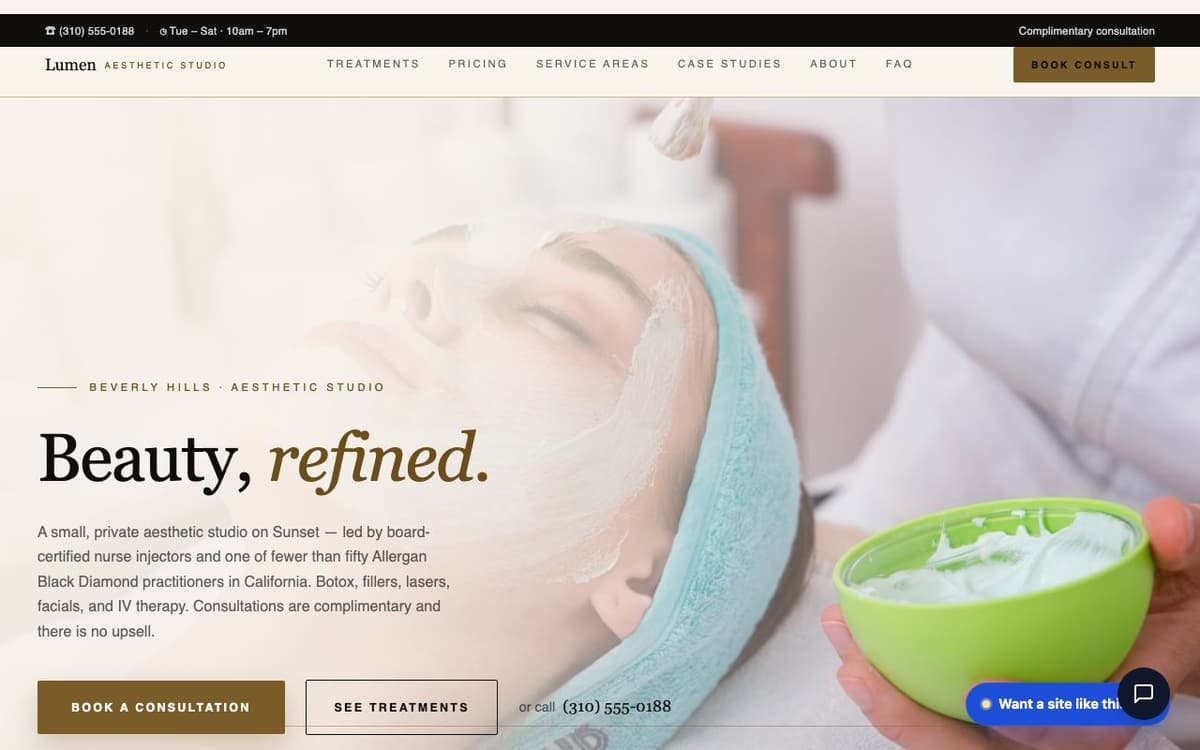
Three live WorkspaceCMS builds in the aesthetics and wellness space - every one of them structured around the same booking path this page describes: treatments as their own pages, money answered on the page, and a way to book within a thumb's reach.
- medspa.workspacecms.ai
 View the live demo →
Lumen Aesthetics
A page per treatment, pricing answered honestly, booking on every screen
- beauty.workspacecms.ai
 View the live demo →
Osmose Beauty
Visual-first service merchandising that still names the treatment above the fold
- wellness.workspacecms.ai
 View the live demo →
Haven Wellness
Membership and package tiers built into the consultation flow, not bolted on
Introducing
Your Industry. Your CMS. Managed for You.
- Unlimited managed edits - shipped on your plan's SLA
- SEO baked into every page, post, and location
- Technical SEO on every plan; AI schema and internal linking on Premium & Ultra
Med Spa Web Design - FAQ
What makes a med spa website different from a regular small-business site?
Three things. First, the conversion unit is a booked consultation, not a purchase - which means the entire information architecture is built to move someone from a treatment question to a calendar, not to a cart. Second, the content is health-adjacent, so provider credentials, procedure descriptions, and any before/after material carry a compliance and credibility weight that a restaurant or a boutique site simply does not carry. Third, discovery is overwhelmingly local and treatment-specific: people search a named treatment plus a place, so the site needs a real page for each treatment and each location rather than one catch-all services page.
Do we need an ecommerce site to sell skincare products?
Usually not, and treating the website as a store is a common misstep. Retail skincare is typically a post-treatment add-on rather than a discovery channel - the visitors arriving from search are looking for treatments and providers, not for a cart. We recommend building the site as a service and booking surface, and handling product retail through whatever channel you already use in-clinic or through a separate, dedicated storefront if retail volume ever justifies one. If your practice genuinely runs a product-led business, that is a different engagement and we will scope it as one - see custom website design.
Which platform should our med spa website be built on?
This is the question med spa owners are usually pushed to answer first, and it is the least important one. What matters is that the site is fast on a phone, that your team can update a promo or a provider bio without filing a development ticket, that the SEO fundamentals are structural rather than bolted on, and that nobody is responsible for security patching on a Friday night. That is precisely the brief WorkspaceCMS was built for, and it is why we point service businesses there rather than at an ecommerce platform they will never use half of. 1Digital® is the team behind WorkspaceCMS - same designers, same developers, same SEO group.
How should before/after photos be handled on the site?
As a documented process, not an upload. Before you design the gallery, settle who obtains and stores patient consent, what that consent covers (website, social, paid ads), how images are captured so the pairs are comparable, and what the captions may and may not say. Advertising rules for aesthetic practices vary by state and by the license type performing the treatment, so the wording is a question for your counsel or your state board rather than for a designer. Our role is to build a gallery that supports whatever governance you land on - consistent framing, per-image captions and disclaimers, and the ability to remove an image everywhere at once if consent is withdrawn.
What about HIPAA and the forms on our website?
Assume that any form collecting health information needs to be treated carefully, and confirm your practice's specific obligations with counsel - whether a med spa is a HIPAA covered entity depends on the services offered and how they are billed, so it is not a question a web agency should answer for you. Practically, we design public-facing forms to collect the minimum needed to schedule (name, contact, treatment of interest, preferred time) and route detailed intake and medical history into whatever compliant system your practice already uses, rather than into a general-purpose website inbox.
How does the design work connect to ranking and AI visibility?
They are the same project. Page architecture is the SEO strategy - a page per treatment is what makes treatment-plus-city queries winnable, and location pages with real distinct content are what make a second location rank at all. Named providers with stated credentials are the trust signal Google's quality guidelines look for in health-adjacent content, and they are also the specific, verifiable detail that AI answer engines prefer to cite over anonymous marketing copy. Clear headings, honest pricing sections, and answered questions on the page are what make a site quotable in an AI answer. Design that ignores this produces a beautiful site that no engine can summarize. Ongoing ranking work lives on our med spa SEO page.