

FOR DERMATOLOGY PRACTICES
Dermatology PPC That Fills the Schedule
A dermatology practice does not check out a cart - it answers a phone. So we build paid media around the only numbers that matter to a clinic: cost per qualified lead and cost per booked patient. Search, Local Services Ads where you qualify, and call-only campaigns run as separate medical and cosmetic funnels, with call tracking and outcome coding wired in so bidding chases appointments instead of clicks. 1Digital® has run local healthcare marketing since 2012.
Trusted by 400+ Brands · Certified Partners




Years in eCommerce
Of results, scale, and quality at the enterprise level.
Expert Team
Specialists across SEO, AI SEO, PPC, design, dev, and strategy.
US Core + Global Talent
US core team for clear communication; vetted global specialists for international client work.
Reputation Score
Rated 4.9/5 across 941+ verified client reviews.
The 1Digital® Difference
AI in our toolkit. Humans in the driver’s seat.
Our strategists, designers, developers, and writers are human. The proprietary AI we built makes them faster and sharper - not the other way around.
- Human strategy
- Human copywriting
- Our own AI tools
- Real growth
Why Paid Search Behaves Differently for a Dermatology Practice
Most industry PPC advice is written for retailers, and almost none of it survives contact with a clinic. There is no product feed to optimize and no revenue figure attached to a click, because the transaction happens days later at a front desk. What a dermatology account produces is calls and consult requests - and the honest scoreboard is cost per qualified lead, then cost per patient who actually arrived. Our PPC services team runs practice accounts on that basis, and pairs them with dermatology SEO so the organic side compounds while paid carries the immediate schedule.
The second structural difference is the ceiling. An eCommerce brand scales by widening its catalogue or its geography; a dermatology practice is capped by drive time and by chair hours. Your addressable auction is finite, so growth comes from taking a larger share of a fixed local market and from converting a higher percentage of the calls you already pay for - not from spending more. That is why we treat budget as a service-area allocation problem: which ZIP codes, which offices, which hours, which service lines. A practice with three locations rarely wants one shared campaign; it wants three radius-shaped budgets that stop bidding where the patient would never drive.
Third, dermatology carries two economically opposite demand types on one domain. Symptom-driven medical demand - a suspicious mole, a spreading rash, cystic acne - is urgent, insurance-mediated, and usually decided on the first call to whoever can be seen soonest. Cosmetic demand is elective, cash-pay, and researched for weeks against medspas and national chains with far larger media budgets. Same practice, same website, completely different bid logic, ad copy, landing page, and lag to conversion. Blending them into one campaign is the most common way a dermatology account quietly fails: cosmetic CPCs eat the budget, medical bookings drop, and the aggregate cost-per-lead number looks fine the whole time.
A wasted click
- –Broad match catches an at-home remedy or is-it-contagious search, not a patient.
- –Cosmetic and medical share one budget, so skin-check terms get outbid daily.
- –Ad lands on a page that never states insurance accepted or next availability.
- –Call rings after the front desk has gone home, with nothing catching it.
- –The inquiry logs as a conversion, so bidding buys more of exactly that.
A converting click
- ›Query matches a service line you want on the schedule this week.
- ›Medical and cosmetic run as separate campaigns with separate targets.
- ›Page loads fast on mobile and puts tap-to-call in the first screenful.
- ›Dayparting matches the hours a person genuinely answers the phone.
- ›Call is coded to an outcome, and only booked visits train the bid strategy.
Dermatology PPC, step by step
Move the budget to the searches that call
The search terms report decides where the money goes. The dermatology searches that turn into calls earn more of the budget, and the ones that never will are cut back and added as negatives, so you stop paying for them.
- ›Search terms read by a senior strategist, not left to automation
- ›Negative keywords that stop paying for searches that never convert
- ›Budget moved toward the services and searches that book
Campaign mix
The Channels a Practice Account Actually Needs
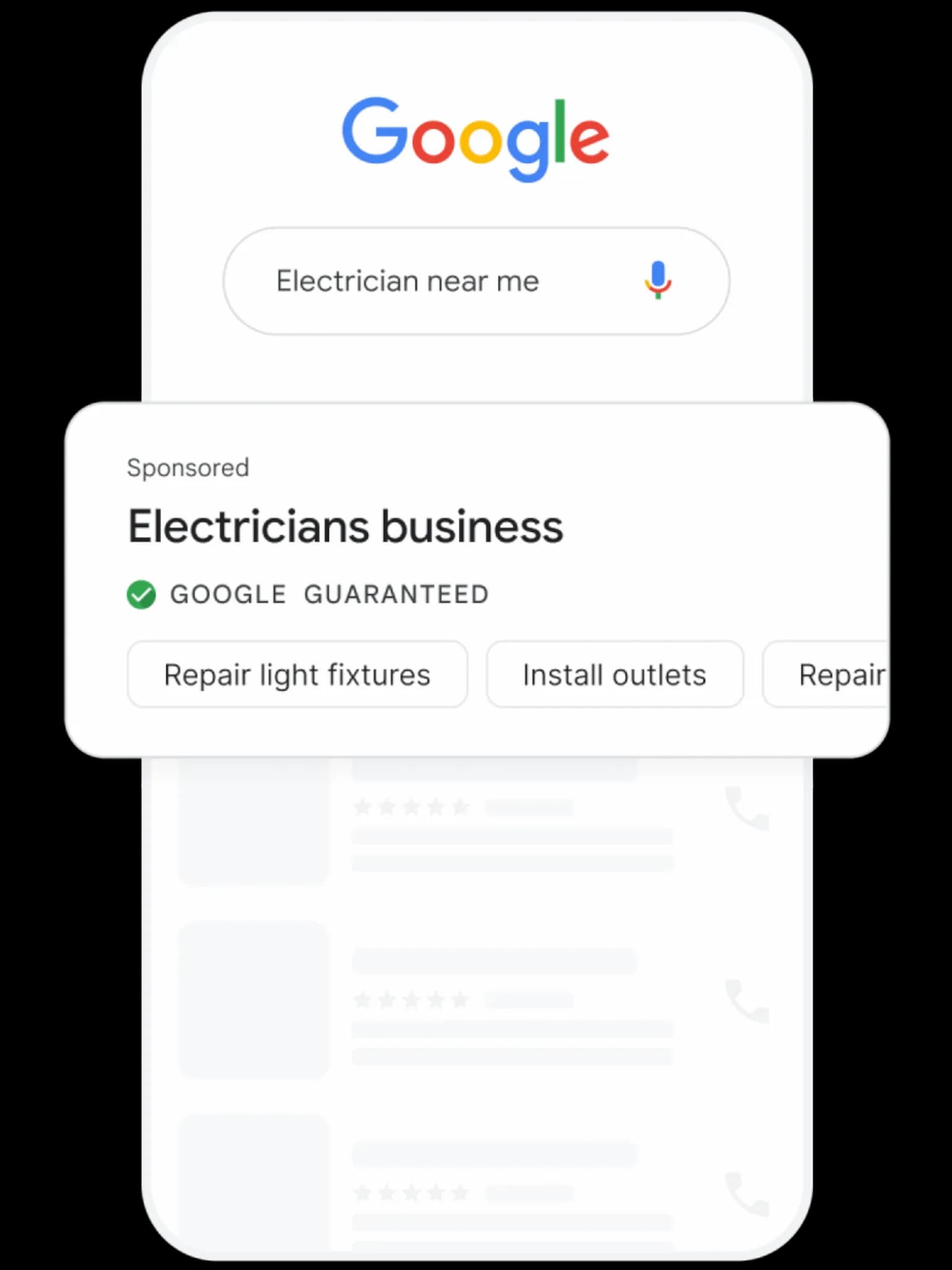
No Shopping campaigns, no product feeds, no retail Performance Max. A dermatology account is built from search intent, phone calls, and verified local placements. Where your category and market support them, Google Local Services Ads sit at the very top of the results page and bill per lead rather than per click - we confirm eligibility before we build a plan that depends on them.
Branded + Defensive Search
Competitors and aggregator directories bid on your practice name and your physicians' names. A tightly capped brand campaign keeps the patient who already chose you from being intercepted on the last click - normally the cheapest booked consult in the account.
Medical Search (Symptom Intent)
Rash, cyst, suspicious mole, severe acne, shingles. These queries are urgent, proximity-bound, and convert on the first session. Exact and phrase match, tight radius, and ad copy that leads with next-available appointment and accepted insurance rather than credentials.
Cosmetic Search (Considered Intent)
Neuromodulators, fillers, laser resurfacing, body contouring. These patients comparison-shop for weeks across medspas, national chains, and your practice. Higher CPCs, longer lag to booking, and a landing page that has to answer price range, downtime, and who is actually holding the device.
Call-Only + Call Extensions
Symptom-driven demand skews mobile and skews toward calling. Call-only campaigns strip the website out of the path entirely during hours the front desk is staffed, then hand off to form-fill and after-hours answering the moment the phones go dark.
Local Services Ads Where Eligible
LSA inventory sits above Search and is priced per lead rather than per click, with Google-verified badging. Eligibility varies by category and market, so we confirm it for your specialty and geography before promising it - and manage the profile, review flow, and lead disputes when it is available.
Demand Gen + Remarketing
Cosmetic patients rarely convert on first contact. Demand Gen and remarketing keep the practice present through the research window with before-and-after creative that survives platform review, sequenced against consult-request conversions instead of impressions.
Lead quality
Counting Booked Patients, Not Raw Leads
A dermatology account can look healthy and still be failing, because the metric most agencies report - form fills and calls - includes wrong numbers, refill requests from existing patients, pharmaceutical reps, people forty miles outside your service area, and homeowners searching for a treatment they intend to try themselves. We instrument the account so the difference is visible, then let bidding learn from the outcome rather than the inquiry. A senior strategist owns the account; WorkspaceCRM, our proprietary AI, watches search-term drift and call-outcome patterns between reviews so nothing rots for a month unnoticed.
Step 01
The paid click
Search, Local Services Ads, or call-only - tagged by campaign, ad group, and search term.
Step 02
Call or consult request
Dynamic number insertion ties the ringing phone or the submitted form back to the query that caused it.
Step 03
Outcome coding
Booked, insurance mismatch, out of area, existing patient, vendor. Only the first bucket counts.
Step 04
Bidding learns
Booked-and-arrived status flows back into Google Ads, so Smart Bidding chases appointments.
Call Tracking With Real Outcome Coding
Dynamic number insertion on every paid session, recordings tied back to campaign and search term, and calls coded by outcome - booked, insurance mismatch, out of service area, existing patient, wrong number, vendor. Only the first bucket is a conversion.
Offline Conversion Import
A form fill is not a patient. We feed booked-and-arrived status back into Google Ads so Smart Bidding optimizes toward appointments that happened, not toward whichever keyword produces the most inquiries.
Negative Keyword Hygiene
Dermatology search is polluted with 'how to treat at home,' 'is it contagious,' student and residency queries, image searches, and product shopping intent. A curated negative list is the single largest lever on cost per qualified lead in this vertical.
Service-Line Budget Splits
Medical and cosmetic demand cannot share one budget pool. We run them as separate campaigns with separate targets, so a spike in cosmetic CPCs never quietly starves the acne and skin-check campaigns that keep the medical schedule full.
After-Hours Coverage
Paid clicks keep arriving after the office closes. We shape dayparting around when the phone is genuinely answered and route the rest to a form, scheduler, or answering service - an unanswered ring is a lead you paid full price for and lost.
Compliance-Aware Ad Copy
Ad copy is reviewed against your state medical board's advertising rules and platform health policies: no outcome guarantees, no superlative claims you cannot substantiate, and no identifiable patient imagery without marketing-specific written authorization.

Budget & service area
Spend Shaped by Drive Time and Chair Hours
Budget in this vertical is a geography question before it is a keyword question. We map the radius each office realistically draws from, exclude the outer ring where inquiries never turn into arrivals, and weight spend toward the ZIP codes and hours that actually produce booked visits. Multi-location groups get location-level campaigns and location-level reporting, so a strong flagship office never masks a satellite clinic that is buying leads it cannot serve. When a provider’s schedule fills, we throttle that service line instead of paying for demand you would have to turn away.
Paid and Organic, Pulling in the Same Direction
Paid search buys the schedule you need this month; organic visibility lowers what that schedule costs next year. Running them together lets each one inform the other - converting paid search terms become the content roadmap, and pages that already rank tell you which keywords you can stop paying full price for. See how the two funnels are built on our dermatology SEO page, compare approaches across verticals on PPC by industry, or start with a free PPC audit of your existing account.
Practices that run broader patient-acquisition programs - reputation, local listings, and referral-network work alongside paid media - can fold this into our wider medical marketing services. Whichever scope fits, a senior strategist owns the account day to day: AI accelerates the analysis, humans make the bidding, creative, and compliance calls.
Managed Websites by 1Digital®
The Ads Are Only As Good As the Page They Land On
A dermatology click is one of the most expensive in local search, and it is wasted the moment it lands on a slow page that never says which insurance you take or how soon a patient can be seen. WorkspaceCMS gives practices a managed site built to receive that traffic - medical and cosmetic service lines separated, tap-to-call in reach, consult requests routed to the front desk. It is built free on a 12-month plan.
- Tap-to-call in the first screenful, where symptom-driven mobile traffic lands.
- Fast mobile pages so urgent skin-concern searches do not bounce while loading.
- Locations, hours and service area stated plainly for multi-office practices.
- Consult forms that capture service line and concern, routed to the front desk.
Free build on a 12-month plan. Managed hosting and updates included.
 Explore Lumen Aesthetic Studio →
Request a proposal
Tell us about your practice and service area
Share your locations, service-line mix, and the markets you draw from. A senior strategist replies within one business day with a pricing band and a draft campaign plan.
Dermatology PPC - FAQ
How is dermatology PPC different from eCommerce PPC?
There is no cart, no product feed, and no ROAS number to report. The conversion is a phone call or a consult request, and its value is set by what that service line bills and how long the patient stays with the practice - a cash-pay laser consult and an insurance-billed rash visit are worth very different amounts and cannot share one bid strategy. Budget is capped by drive time to your office rather than by catalogue size, so scaling means winning more of a fixed local auction, not adding SKUs. Everything downstream - call tracking, front-desk answer rate, schedule capacity - sits inside the campaign, not outside it.
Should we run Local Services Ads or Search first?
Search first, in almost every case, because it is universally available and gives you the search-term data that makes every other channel smarter. Local Services Ads sit above Search and charge per lead with a Google-verified badge, which is compelling - but eligibility depends on category and market, and the inventory is thin in some metros. We confirm what your specialty and geography actually qualify for before building a plan around it. Where LSAs are available, they work best alongside Search rather than replacing it: LSA captures the ready-to-book call, Search captures the researcher and the entire cosmetic funnel.
How do you keep cosmetic ad spend from cannibalizing medical bookings?
By refusing to let them share a budget. Cosmetic keywords carry higher clicks costs and attract aggressive medspa and national-chain bidding, so in a shared campaign they will consistently outbid acne, eczema, and skin-check terms and quietly drain the medical pipeline. We separate them into distinct campaigns with distinct daily budgets, distinct cost-per-lead targets, and distinct landing pages. That also makes reporting honest: you can see what a booked cosmetic consult costs versus a booked medical visit, and shift money deliberately rather than watching the auction make that decision for you.
What does call tracking actually change in the account?
It converts an unreadable phone number into a feedback loop. Dynamic number insertion attributes each call to a campaign, ad group, and search term; recordings and outcome coding then separate booked appointments from wrong numbers, vendors, existing-patient calls, and out-of-area inquiries. Without it, Smart Bidding optimizes toward whichever keyword generates the most ringing - often the vaguest, cheapest, least qualified terms. With it, bidding chases the terms that produced appointments. It also exposes front-desk gaps: missed-call rate by hour is frequently the biggest single leak in a dermatology account.
Is dermatology paid search seasonal?
Two overlapping curves rather than one. Medical demand is fairly steady year-round - skin cancer screening, acne, and chronic conditions like psoriasis and eczema do not wait for a season, though sun-exposure concern tends to rise with warm weather and screening interest lifts during awareness campaigns. Cosmetic demand is far more cyclical: laser and resurfacing treatments requiring sun avoidance skew to cooler months, while injectables and body treatments spike ahead of weddings, reunions, and holidays. We build the budget calendar around both curves instead of running a flat monthly number and being surprised.
What compliance limits apply to dermatology ad copy?
Two layers. Platform health-and-medical policies restrict claim language and personalized advertising for health-related audiences, which constrains remarketing and some targeting options. On top of that, your state medical board governs professional advertising: guarantees of outcome, unsubstantiated superlatives, and misleading credential language are common violations. Patient photography needs marketing-specific written authorization - a treatment consent does not cover promotional use - and manufacturer-sponsored results require disclosure. We write and route creative with those constraints assumed, because a suspended account or a board complaint costs far more than the click it saved.