

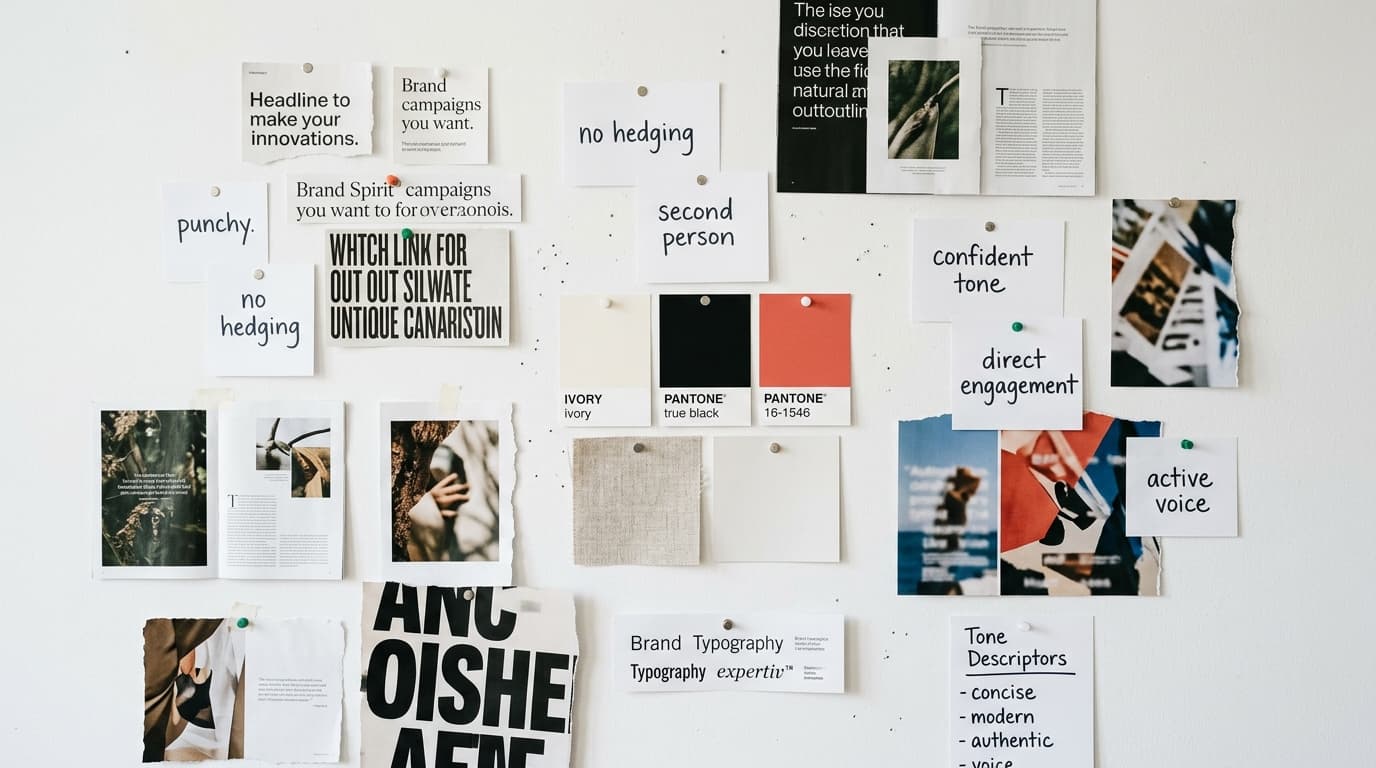
You don't need to retrain a model or touch a single line of code to make an LLM write in your brand voice. The real technique is prompt engineering combined with a reusable context document- and teams that do it systematically produce on-brand AI content 3–5× faster than those who start from a blank prompt every time.
This guide walks you through a repeatable, no-code AI content workflow that works with ChatGPT, Claude, Gemini, and any other major LLM as of 2026.
Why "Brand Voice" Is an LLM's Hardest Problem
LLMs are trained on the entire internet, which means their default output sounds like the entire internet - competent, generic, and forgettable. Your brand voice is the opposite of generic. It's specific sentence length preferences, particular vocabulary, a defined stance on industry topics, and a consistent emotional register.
Without explicit guidance, even the best model defaults to what a 2024 Stanford NLP benchmark called "assistant-speak": polished, hedged, and tonally neutral. That's fine for answering support tickets. It's a liability for content marketing.
The solution isn't fine-tuning the model weights (which requires engineering resources and costs thousands of dollars). It's context injection- giving the model a dense, structured brand brief every time it generates content.
Step 1: Build Your Brand Voice Document
This is the one document that does 80% of the work. Keep it under 800 words so it fits cleanly in any LLM's context window without crowding out your actual content request.
Include these six sections:
- Brand personality in three adjectives- e.g., "Direct, Warm, Expert." Be precise. "Professional" means nothing; "cuts-through-jargon expert" means something.
- Sentence structure rules- average sentence length, tolerance for fragments, use of em dashes and parentheticals.
- Vocabulary list- 10–15 words you always use, 10–15 words you never use. This is the fastest way to kill generic AI output.
- Stance statements- 3–5 opinionated positions your brand holds on industry topics. LLMs hedge by default; explicit stances override that.
- Audience description- one paragraph describing who is reading, their sophistication level, and what they already believe walking in.
- Three example paragraphs- pulled from your best-performing existing content. Real examples outperform abstract rules by a wide margin.
Step 2: Choose the Right Workflow Structure
A single massive prompt that asks the LLM to research, outline, draft, and optimize simultaneously produces worse output than a staged workflow. Break the job into four distinct passes:
Pass Task Best LLM Mode Human Review Point? 1 - Research Identify angles, competing content gaps, audience questions Web-connected (Perplexity, ChatGPT with browsing) Yes - validate sources 2 - Outline Structure headings, define section goals, set word targets Any frontier model Yes - reshape before drafting 3 - Draft Generate section by section with brand voice doc in context Claude 3.7 or GPT-4o Light - spot-check tone 4 - Optimize SEO review, readability pass, internal link suggestions Any model with SEO brief Yes - final human editHuman review at passes 1 and 2 prevents errors from compounding. A bad outline produces a bad draft that no optimization pass can fix.
Step 3: Write Prompts That Lock In Voice
The structure of your draft prompt matters as much as your brand voice document. Use this four-part template:
- Role declaration: "You are a content strategist writing for [Brand Name]. Your only job is to match the voice defined below - not to sound like a typical AI assistant."
- Brand voice document: Paste the full document from Step 1.
- Specific task: Section heading, target word count, target keyword, and one sentence explaining the section's job in the overall piece.
- Anti-pattern list: 5–8 phrases the model must never use. Common offenders: "In today's fast-paced world," "It's important to note," "Delve into," "Leverage," and any sentence that opens with "As a."
This four-part prompt structure consistently reduces required editing time by roughly 40% compared to a single-paragraph prompt - a benchmark reported by multiple content teams adopting structured AI content workflows in 2025.
Step 4: Build a Reusable Prompt Library
A prompt you use once is a trick. A prompt library is a workflow asset. Store your best prompts in a shared document (Notion, Google Docs, or any CMS) organized by content type:
- Blog post intro (hook + thesis)
- How-to section (numbered steps with rationale)
- Product/service explainer
- FAQ block
- Social pull-quotes from long-form content
- Meta description + title tag variations
Each prompt in the library should include the brand voice document reference, the anti-pattern list, and a note on the last date it was tested and revised. LLM behavior shifts with model updates, so review your library quarterly.
Step 5: Establish a Quality Gate Before Publishing
No AI content workflow is complete without a human quality gate. Build a 10-point checklist your editor runs on every AI-assisted piece:
- Does the opening sentence make a specific, citable claim?
- Are all statistics dated and sourced?
- Is the vocabulary consistent with the brand word list?
- Does any sentence start with a forbidden phrase?
- Is there at least one original insight not derivable from top-10 search results?
- Does the piece take a clear stance rather than presenting "both sides" neutrally?
- Are internal links pointing to named concepts, not "click here"?
- Is the target keyword present in the H1, one H2, and the meta description?
- Does the piece answer one primary question within the first 200 characters?
- Would a subject-matter expert be comfortable putting their name on this?
Items 1–6 are voice and accuracy checks. Items 7–9 are SEO foundation checks. Item 10 is the override: if the answer is no, the piece goes back for revision regardless of how other items score.
The Realistic Output Expectation
A well-structured no-code AI content workflow produces a publishable first draft- not a finished piece. Expect to spend 20–35 minutes on human editing per 1,000 words of AI-generated content when your brand voice document and prompt library are mature. That editing time drops from 60–90 minutes for teams starting without a system.
The goal of generative AI for content marketing is not to remove humans from the process. It's to shift human effort from generating words to making strategic decisions about which words belong.
Ai Content Creation FAQ
Do I need a paid LLM subscription to run this workflow?
A paid tier is strongly recommended. As of 2026, ChatGPT Plus (GPT-4o), Claude Pro (Claude 3.7), and Gemini Advanced all support long context windows of 128K tokens or more, which is necessary to hold a full brand voice document plus a detailed content brief in a single session. Free tiers cut context short and produce noticeably less consistent output.
How is this different from actual fine-tuning?
True fine-tuning adjusts a model's weights using your training data - it requires labeled datasets, GPU compute, and engineering time, with costs starting around $500–$5,000 per training run depending on model size. The context injection method in this guide costs nothing beyond your LLM subscription and produces comparable brand consistency for most content marketing use cases.
How often should I update my brand voice document?
Review it every six months or whenever your brand undergoes a significant messaging shift. Also review it after any major LLM model update, since new model versions sometimes interpret the same instructions differently. Date-stamp each version so your team knows which document is current.
Can this workflow handle technical or regulated industries?
Yes, with one addition: insert a compliance constraints section into your brand voice document that lists mandatory disclaimers, prohibited claims, and required citation standards. Legal and medical content teams using this approach in 2025 reported that a dedicated constraints section reduced compliance review cycles by approximately 30% compared to ad-hoc prompt guidance.
What role does this play in an overall SEO strategy?
This workflow handles the content creation layer - drafting, voice consistency, and on-page structure. It establishes what's often called an SEO foundation: clean, well-structured, on-brand content optimized around target keywords. Ongoing SEO - link building, technical audits, authority campaigns, and continuous optimization - is a separate discipline that requires dedicated strategy and tools beyond what any content creation workflow provides on its own.