

Welcome to the 1Digital AI Lab
Agentic Commerce Services
Prepare your catalog, feeds, and checkout for the agentic economy - where AI agents don't just recommend products, they buy them. We structure, optimize, and syndicate your product data so ChatGPT (Instant Checkout + Agent), Perplexity Shopping, Gemini, and the emerging agentic-commerce ecosystem can confidently evaluate, recommend, and transact with your brand.
The 1Digital® Difference
AI in our toolkit. Humans in the driver’s seat.
Our strategists, designers, developers, and writers are human. The proprietary AI we built makes them faster and sharper - not the other way around.
- Human strategy
- Human copywriting
- Our own AI tools
- Real growth
Trusted by 400+ Brands · Certified Partners




Years in eCommerce
Of results, scale, and quality at the enterprise level.
Expert Team
Specialists across SEO, AI SEO, PPC, design, dev, and strategy.
US Core + Global Talent
US core team for clear communication; vetted global specialists for international client work.
Reputation Score
Rated 4.9/5 across 941+ verified client reviews.
Reviewed by the 1Digital® AI SEO TeamLast updated:
TL;DR: Agentic Commerce is the emerging pattern where AI agents - ChatGPT Agent + Instant Checkout, Perplexity Shopping, Gemini in Chrome, and others - autonomously find, compare, and purchase products on a shopper's behalf. 1Digital® is an agentic commerce agency that prepares brands for this shift through machine-readable catalogs, Generative Engine Optimization (GEO), Product/Offer/Review schema, identifier completeness (GTIN/MPN/brand), Google Shopping feeds, and emerging agentic protocols (ACP, AP2, MCP).
Agentic commerce, step by step
Let AI agents find and buy from your store
Shopping assistants are starting to complete purchases for people, not just recommend products. That only works if your catalog, prices, stock and checkout can be read and used by an agent. We get your store ready for that, on the protocols the assistants use.
- ›Catalog and stock readable by AI agents
- ›Checkout ready for agent purchases
- ›Set up on the protocols assistants support
What is Agentic Commerce?
From clicks to autonomous agents.
Agentic Commerce is the next shift where autonomous AI agents - sophisticated assistants within ChatGPT, Gemini, Perplexity, Claude, and Copilot - are tasked by a consumer to find, compare, decide on, and purchase products or services with minimal human input.
Unlike traditional search or chatbots that only recommend, an AI agent acts as the purchaser - streamlining the shopping journey from intent to transaction, often without the consumer ever visiting your website. The customer journey transforms from a series of clicks into a single, intent-driven request executed by an algorithm.
Apply for Early Access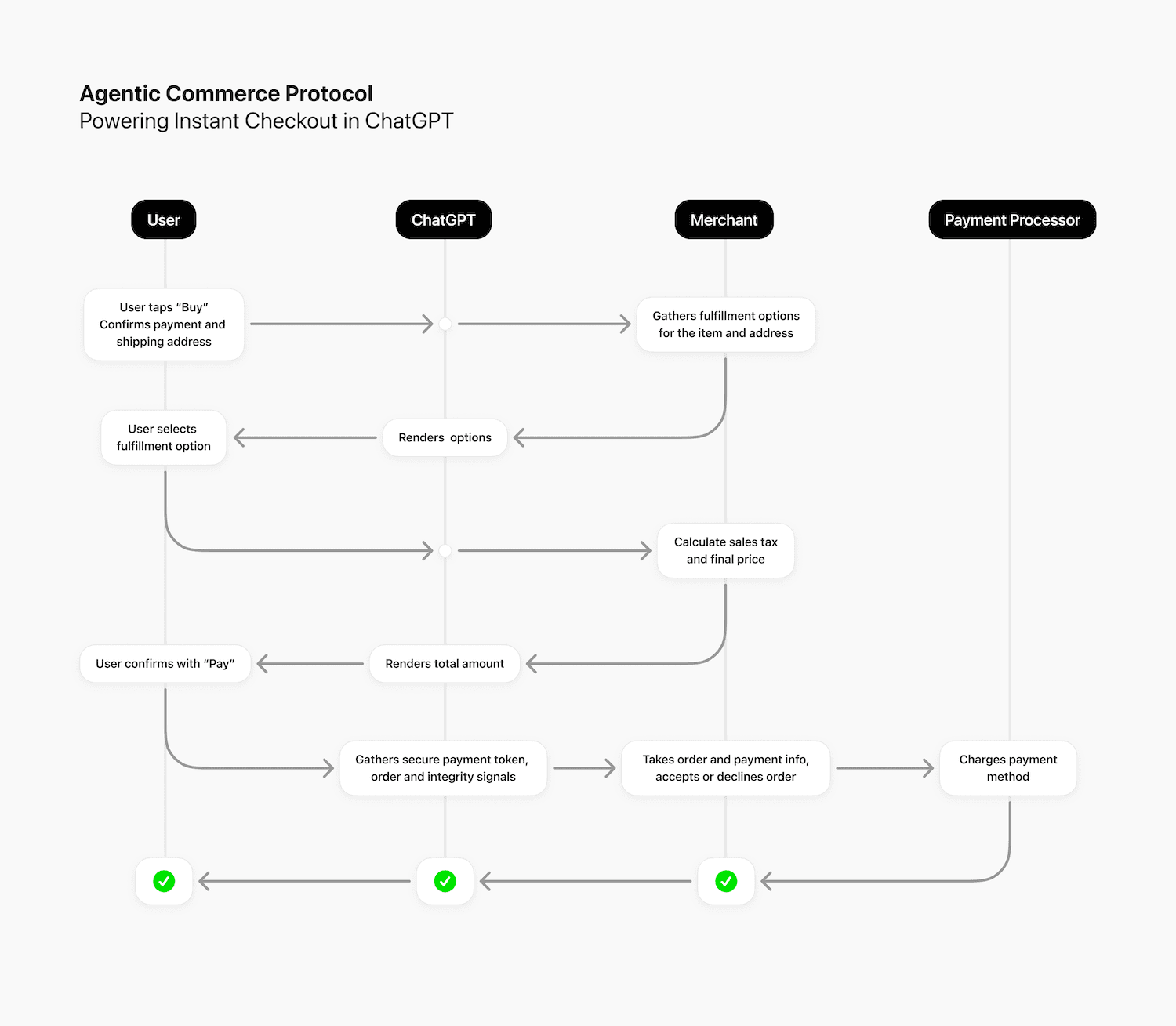
Why it Matters
The rails are shipping now.
If your products aren't structured for AI agents, you risk being cut out of the new commerce funnel.
Disintermediation Risk
AI agents reduce the need for consumers to browse your website. Without agent-optimized product data, feeds, and policy signals, your brand may be skipped while competitors capture the automated purchase.
GEO & Machine-Readable Identity
In agentic commerce, AI agents choose what to buy based on what they can parse, verify, and trust - accurate product attributes, identifiers, pricing, availability, and policy clarity.
Logic Over Emotion
Agents prioritize logic - price, availability, policy, trust signals - over traditional brand imagery. Strong brand entity signals, verified reviews, and policy clarity protect your margin against commoditization.
Which AI agents are actually transacting today?
ChatGPT Agent
OpenAI's browsing/computer-use agent (rolled out across Pro, Plus, Team, Enterprise, and Education tiers in 2025, replacing the Pro-only Operator research preview) - completes purchases across the open web on the shopper's behalf.ChatGPT Instant Checkout
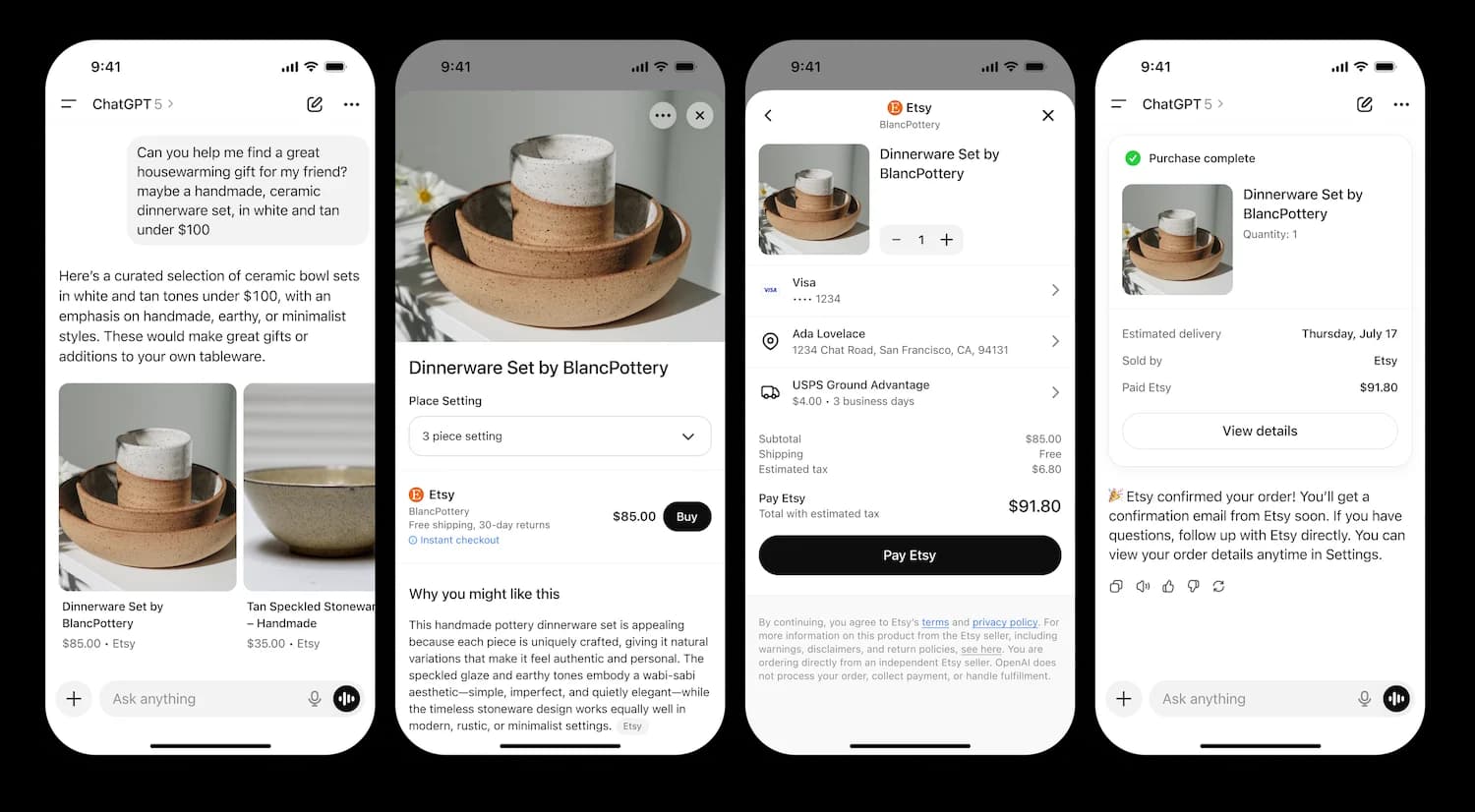
Native in-ChatGPT purchase flow, GA in the US since February 2026 for Free, Plus, and Pro users - Etsy sellers live, Shopify merchants (incl. Glossier, SKIMS, Spanx, Vuori) rolling out.Perplexity Shopping (Buy with Pro)
Native checkout inside Perplexity for cited products - currently US Pro-tier users only, select merchants.Gemini in Chrome
Piloting agentic purchase flows in-browser.Shopify Agentic APIs
Native agentic commerce integrations for Shopify merchants.Stripe / Visa / Mastercard
Payment rails built specifically for AI agents - Intelligent Commerce, Agent Pay, and ACP.
The Three Protocols Shaping
Agentic Commerce
Brands that adopt early shape the standards - brands that wait adopt them later on someone else's terms.
Agentic Commerce Protocol (ACP)
Published by OpenAI and Stripe, ACP is the open standard for AI agent-to-merchant transactions. It defines how agents request product information, confirm pricing and availability, and complete purchases with delegated payment authorization - powering ChatGPT Instant Checkout and related OpenAI transactional flows.AP2 (Agent Payments Protocol)
Google's open protocol for AI-agent payments, backed by Mastercard, American Express, and partner networks. AP2 covers payment authorization, credential delegation, and fraud controls for agents transacting on behalf of consumers across Gemini and the broader Google commerce surface area.Model Context Protocol (MCP)
Anthropic's open standard for how AI systems - Claude and others - connect to external tools, data sources, and commerce APIs. MCP is increasingly adopted across the AI ecosystem and underpins how agents access your catalog, policies, and checkout flows during agentic transactions.
Our Agentic Commerce Strategy
Win the Algorithm
We bridge the gap between your existing eCommerce stack and emerging AI platforms - helping improve visibility and conversion performance as discovery and transactions shift to agents.
AI-Ready Data Structuring Audit
- Structured data inspection (Product, Offer, AggregateRating, Review, Organization schema)
- Product feed quality scoring
- Attribute completeness review (GTIN, MPN, brand, identifiers)
- AI crawler accessibility (GPTBot, PerplexityBot, ClaudeBot, Google-Extended)
- Gaps and inconsistencies identified across channels
Product Content Optimization
- Enhanced titles, specs, and descriptions tuned for agent parsing
- Expanded attributes tailored to AI matching and reconciliation
- Use-case and benefit-driven descriptions agents can quote
- Structured Q&A and FAQPage schema for agent extraction
- Trust signal enhancement - verified reviews, ratings, policy clarity
Technical Enablement
- Google Merchant Center and marketplace integrations
- JSON-LD schema implementation
- API and feed setup for AI platform ingestion
- Agentic protocol readiness (ACP, AP2, MCP)
- Checkout accessibility and agentic-safe flows (stable URLs, clean forms)
Ongoing Monitoring & Performance
- Agentic Commerce Readiness Updates
- Track visibility across ChatGPT (Instant Checkout + Agent), Perplexity Shopping, Gemini
- Monitor Share of Model and Share of Shelf versus competitors
- AI-referral traffic and attribution in GA4
- Improve conversion paths over time
How We Can Help
A significant technical shift - we make it manageable.
- Agentic Strategy Consulting: Identifying where AI agents can drive the most ROI in your sales funnel.
- Technical Integration: APIs, schema, and data structures required for agent discovery and checkout across ACP, AP2, and MCP.
- AI SEO Foundation: Increase the likelihood LLMs recommend your products through foundational SEO and a research-backed AI layer.
- Ongoing Monitoring: Share of Model tracking, protocol updates, and continuous catalog optimization as the ecosystem evolves.
Agentic Commerce - Quick Answers
What is 1Digital® as an agentic commerce agency?
1Digital® is a US-based agentic commerce agency and Google Partner, founded in 2012 and trusted by 400+ brands. Through the 1Digital® AI Lab- our dedicated research division - we prepare eCommerce brands for the agentic economy across Shopify, BigCommerce, Magento (Adobe Commerce), and WooCommerce.
Which AI agents are actually transacting today?
- ChatGPT Agent- OpenAI's browsing/computer-use agent, available across Pro, Plus, Team, Enterprise, and Education tiers (the Operator Pro-tier research preview was sunset and folded into Agent).
- ChatGPT Instant Checkout- native in-ChatGPT purchase flow, US GA since February 2026 (Free, Plus, Pro users); Etsy live, Shopify merchants rolling out.
- Perplexity Shopping (Buy with Pro)- native checkout for cited products, currently US Pro-tier only on select merchants.
- Gemini in Chrome- piloting agentic purchase flows in-browser.
- Shopify agentic APIs, Stripe agentic payments, Visa Intelligent Commerce, Mastercard Agent Pay.
Which agentic-commerce protocols matter?
- Agentic Commerce Protocol (ACP)- OpenAI & Stripe's open standard.
- AP2 (Agent Payments Protocol)- Google's payment protocol.
- Model Context Protocol (MCP)- Anthropic's open standard for tool/data interaction; see MCP for eCommerce for the implementation playbook.
How do AI agents evaluate which products to buy?
- Machine-readable identity: GTIN, MPN, brand, SKU.
- Accurate pricing and availability: real-time Offer schema.
- Policy clarity: shipping, returns, warranties on-page and structured.
- Trust signals: reviews, ratings, verified brand data, consistent NAP, fulfillment reliability.
- Checkout accessibility: stable URLs, predictable flows, no CAPTCHA/3DS friction.
How fast is agentic commerce growing?
From near-zero production transactions in early 2025 to named-partner rollouts across OpenAI, Perplexity, Shopify, Stripe, Visa, and Mastercard through 2025–2026. Agent-driven transaction volume is still small in absolute terms but growing fast - early-mover brands will own category share as volume scales.
1Digital® AI Lab | Agentic Commerce Expertise
Find out if your business is eligible for our Agentic Program. Limited spots for the 2026 cohort.