

For Accounting & CPA Firms
Accounting Firm Web Design That Earns The Consultation
You do not need to know what platform your firm's website should be built on. You need a site that makes a stranger trust a licensed professional with their finances, gets an existing client into the portal in one click, and stays accurate through tax season. We design and build that - on WorkspaceCMS, our own managed platform for service businesses.
Trusted by 400+ Brands · Certified Partners




Years in eCommerce
Of results, scale, and quality at the enterprise level.
Expert Team
Specialists across SEO, AI SEO, PPC, design, dev, and strategy.
US Core + Global Talent
US core team for clear communication; vetted global specialists for international client work.
Reputation Score
Rated 4.9/5 across 941+ verified client reviews.
Reviewed by the 1Digital® Design TeamLast updated:
Stop Shopping For A Platform. Start With What The Site Has To Do.
Most agency web-design pages are organized around software - one page for one storefront platform, one for another. That framing is useless to an accounting firm, because a firm does not sell products. It sells a licensed professional's judgment, and the website's entire job is to make that judgment credible before anyone speaks to you. The platform question is downstream of that and, honestly, it is our problem rather than yours: a firm website needs pages, forms, a scheduling integration, a portal link, fast hosting, and a way to change a deadline in two minutes. It does not need a shopping cart, a catalogue, or a checkout, and paying for that machinery is a common and expensive mistake.
That is why we build accounting firm sites on WorkspaceCMS, the managed platform our own team built and runs. It is SEO-native, the hosting plans include managed edits, and the editing model is designed for an office manager in March rather than a developer with a deploy pipeline. If you want the mechanics of how we design and ship, that is on how we build and custom website design.
Accounting web design, step by step
From wireframe to a site that books
Every accounting site starts as a plan for how a visitor finds what they came for and acts on it. We design that structure first, then build it fast, mobile-first and accessible, with the call to action exactly where the visitor is ready to get in touch.
- ›Layouts planned around how accounting customers decide
- ›Mobile-first, fast loading and accessible from the start
- ›Built for search from the first wireframe, not bolted on later
The platform behind the build
So What Is WorkspaceCMS?
We just told you the platform question is ours rather than yours - but your firm still ends up living on whatever we choose, so here is a look at it before you take our word for it. A short tour of the managed platform our team built and runs: how a site gets published, what editing looks like for the person who has to change a deadline in March, and what "managed" actually covers.
The Four Conversion Paths An Accounting Site Actually Has
An ecommerce site has one funnel. A firm site has four, running simultaneously, serving audiences with almost nothing in common. Designing for a single "contact us" goal is why so many firm websites underperform their marketing spend - three of the four paths are simply missing.
Book a consultation
The primary path, and the one most firm sites bury. A prospective client who has decided you look credible wants a specific time on a specific partner's calendar - not a contact form that promises a reply “shortly.” Real scheduling, visible availability, and a short intake that captures entity type and service need before the call.
Return-client portal login
Existing clients are the heaviest users of an accounting firm's website, and almost all of their traffic is one click: the portal. When that link is hidden in a footer, your support inbox absorbs the difference every January. Portal access belongs in the primary navigation, on the homepage, and on every service page.
Scoped service inquiry
“I need a CPA” and “I need multi-state nexus review for an S-corp with remote staff” are different leads with different values. Service pages that let a visitor self-identify - entity type, industry, service - route better and let you quote faster, because the intake arrives pre-qualified.
Seasonal triage
Between January and April the same homepage serves panicked new prospects, extension filers, and returning clients hunting an organizer. A site that can surface a seasonal band without a rebuild handles that traffic; a static brochure sends all three groups to the same generic contact form.
Each path wants a different measurement, too. Scheduled consultations, portal logins, scoped service inquiries, and seasonal resource downloads are four separate numbers, and blending them into one "leads" figure hides which part of the site is working. We instrument them separately, which is also the groundwork for any serious conversion optimization work later.
Trust Is The Design Brief
Someone choosing an accountant is handing over their tax position, their entity structure, and often their personal financial history. They are looking for reasons to disqualify you, and they do it fast. Design decisions either supply verification or withhold it.

- ›Named, credentialed people. Partner and staff bios stating the credential (CPA, EA, CMA), the jurisdiction of licensure, specialties, and tenure - each with its own URL so it can be found, linked, and cited on its own merits.
- ›Real photography of real people. Stock imagery of a generic handshake is a negative signal in a category built on personal accountability. Budget for a shoot; it outperforms nearly any other single design investment here.
- ›Specificity over superlatives. "We serve dental practices in three states and file multi-state payroll for them" is checkable. "Trusted leader in accounting excellence" is not, and reads as filler to a reader and to a language model.
- ›Visible process and engagement terms. What happens after the consultation, what you need from the client, how billing works. Removing uncertainty converts better than any persuasive adjective.
- ›Security that is legible. HTTPS everywhere, an obvious portal, and intake that never asks for identifiers it should not collect. Clients notice when a firm treats their data carefully - and notice louder when it does not.
- ›Reviews and affiliations, placed in context. Next to the relevant service, not corralled into a testimonial carousel nobody reads.
Compliance Constraints A General Web Designer Will Miss
Accounting is a regulated profession, and a website is marketing communication. The AICPA Code of Professional Conduct addresses advertising, solicitation, and client confidentiality, and every state board of accountancy maintains its own rules on top of that - which is why a firm licensed in two states can face two different sets of expectations for the same page. We are a design and build team, not your compliance counsel, so we work the way that makes review easy: claims stay concrete and verifiable, client identities are never used without documented permission, and anything promotional goes to your compliance reviewer before launch rather than after.
Practically, that shapes the build in four places. Claims: no guaranteed outcomes, no promised refund amounts, no implied assurance the engagement cannot support. Client references: case studies written so they cannot identify a client who has not consented - often described by industry and situation rather than by name. Data handling: intake forms scoped to what you need to route an inquiry, with document exchange pushed to the portal rather than email attachments, and retention decided deliberately instead of by default. Accessibility: WCAG-aligned contrast, keyboard operability, labeled fields, and accessible alternatives to PDF-only resources, which matters both for your clients and for institutional ones with their own obligations - see accessibility compliance for how we handle it.
How Accounting Firm Websites Fail
These are the patterns we find over and over when a firm asks why its site produces nothing. None of them are aesthetic problems, which is why a redesign that only changes the visuals rarely fixes them.
Anonymous “our team”
Stock photography and an unnamed team page reads as a firm hiding something. Prospective clients want to know which licensed professional will handle their return, and search engines cannot build an entity around a firm with no named people.
Contact form as the only door
A single form, no phone treatment, no scheduling, no portal link. Every visitor type funnels into the same queue and the highest-intent ones leave for a firm that offered a calendar.
Service copy that is really a services list
Ten bullet points on one page cannot rank for anything, cannot answer anything, and gives a visitor no way to recognize their own situation. One page per service, written for a specific taxpayer or entity, does all three.
A site nobody can update in March
If changing a deadline, a fee schedule, or an office closure requires a developer ticket and a week, the site drifts out of date exactly when accuracy matters most. That is the single most common reason firm websites quietly rot.
Insecure or careless intake
Forms that invite sensitive identifiers, unencrypted document collection, or a portal link that drops onto an unrelated page. Intake design is a client-confidentiality surface, not a UX detail.
Inaccessible by default
Low-contrast type, keyboard traps, unlabeled form fields, PDF-only resources. Accounting skews toward an older client base and toward organizations with accessibility obligations of their own - this is not a hypothetical audience.
Page Architecture For A Firm Site
Structure is strategy here. One page per thing you want to be found for, one page per thing a client needs to do. Sites that collapse services and industries into a single "what we do" page have no surface to rank with and no page a visitor can recognize themselves in.
- Homepage: who you serve, what you do, one primary action - schedule; one secondary - client login.
- Service pages, one per offering: tax preparation and planning, assurance/audit, bookkeeping and controller services, advisory/CFO, entity formation, specialty work.
- Industry pages for the verticals you actually serve (construction, healthcare practices, restaurants, real estate, professional services) - these convert far better than generic “small business” copy.
- Partner and staff bios with credentials, licensure jurisdiction, specialties, and a direct scheduling link on each.
- Locations page per office, with hours, parking/access notes, and embedded map - the on-site counterpart to your Google Business Profile.
- Client resources: portal login, secure upload, deadline calendar, organizers and checklists.
- Insight/article hub for the questions clients actually ask, structured to be answerable in a single page.
- Careers - accounting hiring is competitive, and the recruiting audience judges you by the same site.
Multi-office firms add one more decision: whether each location gets a full page or a section. The rule we use is simple - a location gets its own page when a real person works there and can take a meeting there. Anything less produces thin pages that dilute the ones that matter, and responsive layouts have to carry all of it on a phone, which is where most "CPA near me" traffic arrives.
How Design Decisions Feed Local Search And AI Visibility
Design and discoverability are not sequential steps. The choices made in layout determine what a search engine or an answer engine can extract from the page later. A firm that structures its site well starts its SEO program from a much better position than one that has to retrofit.
Name, address, and phone rendered as text, identical to your Google Business Profile, on every location page - not baked into an image or loaded by a script. Individual bio pages give the firm a set of named, credentialed entities to be associated with, which is what both local ranking systems and language models use to decide whether a firm is a real, licensed practice. Structured data for the organization, its locations, its people, and its FAQs is emitted from the page structure itself, so it stays accurate when the content changes. Question-shaped headings with direct answers underneath are the single most reliable way to be quoted by an AI assistant: a generative engine needs a passage it can lift cleanly, and a wall of undifferentiated prose does not provide one. Speed and layout stability matter disproportionately for mobile local searches, where a slow page loses the visitor before the phone number renders.
None of this replaces an actual ranking program - reviews, citations, local content, and the seasonal demand curve are a separate discipline, covered on accounting firm SEO. But a well-built site makes that program cheaper, and a badly built one caps how far it can go.
Built on
What This Looks Like Built
Three live WorkspaceCMS demos for professional-services practices. Each one is doing the work described above - self-identifying service navigation, credentialed people made visible, and a scheduling path that does not end in a generic contact form.
- cpa.workspacecms.ai
 View the live demo →
Meridian & Co.
Service-by-entity-type navigation with a seasonal tax intake path
- wealth.workspacecms.ai
 View the live demo →
Northcrest Advisory
Advisory positioning placed above compliance-only work
- law.workspacecms.ai
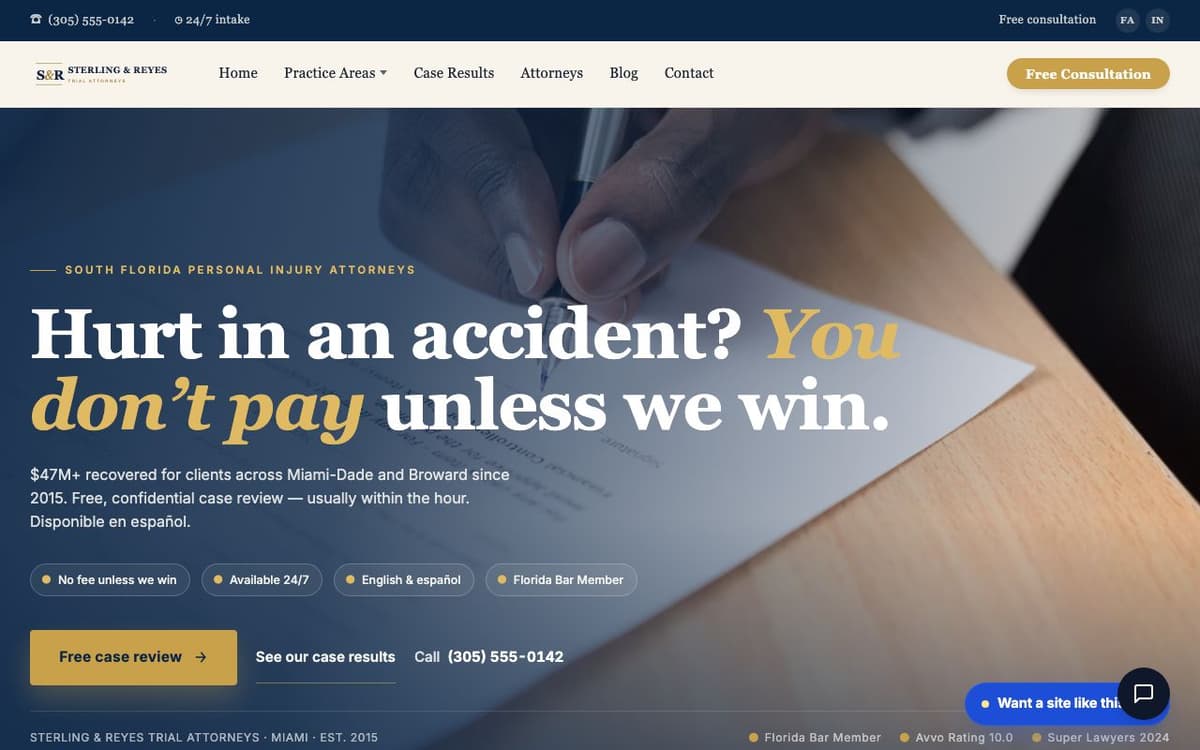 View the live demo →
Sterling & Reyes Trial Attorneys
Credential-forward trust architecture for a licensed practice
Introducing
Your Industry. Your CMS. Managed for You.
- Unlimited managed edits - shipped on your plan's SLA
- SEO baked into every page, post, and location
- Technical SEO on every plan; AI schema and internal linking on Premium & Ultra
Request a proposal
Tell us about your firm
Number of partners and offices, the service mix you want to grow, and whatever is broken on the site today. A senior strategist replies with a scope and a pricing band.
Accounting Firm Web Design - FAQ
What platform should my accounting firm's website be built on?
It is the wrong first question, and we would rather you not have to answer it. A firm site needs pages, forms, scheduling, a portal link, fast hosting, and easy editing - not commerce machinery. We build on WorkspaceCMS, the managed platform our own team built and operates, because hosting plans include managed edits and the editor is usable by an office manager rather than a developer. If your firm has a constraint that points elsewhere - an existing system you are contractually tied to, or an internal team that maintains something specific - tell us and we will scope to it honestly instead of forcing a migration.
How is this different from your accounting firm SEO service?
This page is the website: structure, conversion paths, trust design, compliance-aware content, accessibility, and the build itself. Accounting firm SEO is the ongoing program that earns rankings for it - Google Business Profile work, review velocity, local and specialty content, and managing the tax-season demand curve. They are usually sequenced: build the site so it can be found, then run the program that finds it. Many firms engage us for both, but neither requires the other.
Do we need a client portal, and does it have to be part of the website?
Most firms already have a portal through their practice-management or document-exchange software, and there is rarely a reason to replace it. What matters is that the website treats it as a first-class destination: a login entry point in the main navigation, on the homepage, and on service pages, with an obvious, stable URL. Your returning clients are the heaviest users of your site and almost all of their visits are that one action. Hiding it does not reduce portal support requests - it moves them to your phone.
Can we keep the site accurate during tax season without a developer?
That is the design constraint we care most about. Deadlines, fee schedules, office hours, seasonal banners, organizers, and staffing changes all move between January and April, and a site that requires a ticket and a deploy for each change goes stale exactly when it is most consulted. WorkspaceCMS hosting plans include managed edits on your plan's SLA, so you can either make routine changes yourself or send them to us - and either way the site does not sit wrong for three weeks.
How do you handle advertising rules and client confidentiality in the copy?
We write to be reviewable. Claims stay concrete and verifiable rather than promissory - no guaranteed outcomes or implied assurances - and client work is described by industry and situation unless you have documented permission to name someone. Intake forms are scoped to what is needed to route an inquiry, with document exchange pushed to the portal rather than email. The AICPA Code of Professional Conduct and your state board's rules are the authority here, not us, so we build in a compliance review before launch rather than after.
We serve clients remotely across several states. Does local design still matter?
Partly. If any meaningful share of your work involves in-person meetings, a physical office, or audit fieldwork, then location pages, text-rendered contact details, and profile consistency stay high-leverage. If you are genuinely remote-first, the same effort is better spent on industry and specialty pages - a page about bookkeeping for a specific vertical outperforms a generic city page for a firm with no one in that city. We decide that with you during discovery rather than defaulting to a location-page template.
Let's talk
A Website Your Firm Can Actually Use
Built for the consultation, the portal, and the four months when accuracy matters most - designed and managed by the team behind WorkspaceCMS.