

FOR SECURITY & ALARM DEALERS
Security System Company SEO That Converts Monitoring Shoppers
Security and alarm buyers research obsessively before they'll let a dealer wire their home or business - comparing monitoring contracts, permit requirements, and self-install smart-home kits against traditional professional installs. We build local-dealer visibility, monitoring-plan comparison content, and licensing trust signals that win "security company near me" searches and earn citation in AI answers evaluating burglar, fire, and smart-home security options. 1Digital® has run local-service SEO for regulated home-services categories since 2012.
Free Build
Ready to get your Security & Alarm Systems websitebuilt - free?
1Digital® builds your security & alarm systems site on WorkspaceCMS.ai at no cost - AI-first, SEO-first, live in a few days to a few weeks*. Flat monthly plans from $89/mo.
We Design It
Questionnaire-driven, AI-first, free
You Approve
Review before launch
Go Live
In days to weeks, no cost
No setup fees · 12-month commitment · 4.9★ from 941+ reviews
* Timing depends on how quickly we receive your questionnaire answers and content.
Trusted by 400+ Brands · Certified Partners




Years in eCommerce
Of results, scale, and quality at the enterprise level.
Expert Team
Specialists across SEO, AI SEO, PPC, design, dev, and strategy.
US Core + Global Talent
US core team for clear communication; vetted global specialists for international client work.
Reputation Score
Rated 4.9/5 across 941+ verified client reviews.
Ask AI for a business like yours. Are you in the answer?
ChatGPT, Claude, and Perplexity only recommend sites they can read - and most can't read yours. Scan it free and see exactly where you stand.
Free · no signup · scores the 15 signals AI uses to find you · ~20 seconds
How Security & Alarm SEO Wins Local Trust and Monitoring Contracts
Security system searches split cleanly into two buyer paths that require different SEO treatment. Residential and small-business shoppers search hyper-locally - "alarm company near me," "home security installer [city]" - and convert on trust signals: licensing (many states require an alarm contractor license or DPS registration), UL-listed monitoring, and response-time claims that can be substantiated. Commercial and multi-site buyers search on national or franchise-territory terms and evaluate integration depth (access control, video, fire, and intrusion under one monitoring contract) rather than proximity. A dealer site has to serve both without diluting either signal, which is where most independently owned alarm companies get their information architecture wrong.
The category is also under real disruption pressure from DIY smart-home security (Ring, SimpliSafe, ADT Self Setup) that competes on price and no-contract flexibility against professionally monitored systems. SEO content that draws an honest comparison - professional monitoring's central-station response and insurance-discount eligibility versus DIY's lower upfront cost and no permit requirement - outperforms generic "why choose us" copy, because it's answering the exact comparison query the buyer is already running. We pair that comparison content with locally-coded landing pages per service area, GBP optimization tied to licensing and certification badges, and review-velocity programs, since alarm-company reviews are unusually review-sensitive relative to other home-services categories.
- ›Local service-area landing pages built around licensing, permitting and response-time trust signals
- ›Monitoring-plan and DIY-vs-professional comparison content that answers the buyer's actual research query
- ›Google Business Profile optimization with certification, UL-listing and insurance-discount badges
- ›Commercial integration content (access control, video, fire, intrusion) for multi-site B2B buyers
- ›Review-velocity and reputation programs tuned to the category's unusually review-sensitive buyers
- ›WorkspaceCRM tracking of monitoring-plan and comparison queries surfaced in AI Overviews
Security Systems SEO, step by step
Track every search your buyers make
These are the kinds of security systems searches your buyers type. Expert writers and strategists build the service and location pages that move your business up each one, and we track every search on its own as it climbs toward page one.
- ›Pages written by people who know the search behind the sale
- ›Structure and schema that AI Overviews can read and quote
- ›Rankings tracked search by search, not as one blended average
The Security & Alarm Systems market
What we cover in Security & Alarm Systems SEO
Named sub-verticals and buyer segments inside the Security & Alarm Systems category that we map keyword strategy and content programs to:
Last updated: October 2026
Security & Alarm Systems by the numbers
$27.8 billion
US electronic security services and alarm monitoring industry revenue in 2024
Source: IBISWorld, Security Systems Services in the US, 2025 report
Security & Alarm Systems SEO - buyer questions
Common questions in the Security & Alarm Systems vertical
How is security system SEO different from general home-services SEO?
Security and alarm SEO carries a heavier trust burden than most home-services categories because the buyer is granting access-level trust to their home or business.
Licensing disclosures, UL-listed monitoring-center status, and verifiable response-time data need to be structured and prominent - Google's local trust signals and a nervous homeowner's evaluation criteria overlap almost entirely.
Do DIY security brands like Ring and SimpliSafe hurt SEO demand for professional dealers?
They shift demand rather than eliminate it - DIY brands have expanded overall category search volume and buyer awareness of home security generally.
A meaningful share of shoppers researching DIY systems are pre-qualifying themselves out of DIY; comparison content that's honest about both paths captures more of the funnel.
Is a security alarm company required to be licensed?
Most US states require some form of alarm contractor license, registration, or permit, though requirements vary by state per the Electronic Security Association (ESA).
Prominently displaying a verifiable license number, UL monitoring-center disclosure, and relevant certifications functions as both a compliance requirement and a ranking-relevant trust signal.
How much does UL-listed monitoring matter to buyers researching alarm companies?
UL listing for a monitoring center is one of the most-cited trust factors alarm buyers reference, since insurers frequently discount premiums for UL-monitored systems.
Publishing UL-listing status clearly, alongside insurance-discount eligibility details, answers a specific comparison query buyers are already running.
Should commercial security integration get its own content separate from residential alarms?
Yes - commercial buyers search on integration-specific terms and evaluate vendors on scalability and SLA terms rather than price alone.
Blending residential and commercial messaging on one page dilutes both; separate service architectures let each buyer type land on content matched to their actual evaluation criteria.
Security & Alarm Systems SEO - FAQ
How is security system SEO different from general home-services SEO?
Security and alarm SEO carries a heavier trust burden than most home-services categories because the buyer is granting access-level trust, not just a one-time repair. Licensing disclosures (alarm contractor licenses, DPS or state security-board registration), UL monitoring-center listings, and verifiable response-time data need to be prominent and structured, not buried in an about page. We treat these as ranking and conversion signals simultaneously - Google's local trust algorithms and human buyers respond to the same evidence.
Do DIY security brands like Ring and SimpliSafe hurt SEO demand for professional dealers?
They shift demand rather than destroy it. DIY brands have expanded overall category search volume and buyer awareness, but a meaningful share of shoppers researching DIY systems are actually pre-qualifying themselves out of DIY (renters needing no-contract flexibility vs. homeowners wanting professional monitoring and insurance discounts). Content that transparently compares the two paths captures both segments and outperforms pages that ignore the DIY alternative entirely, since ignoring it doesn't stop buyers from searching for the comparison.
Does local SEO or national brand SEO matter more for an independent alarm dealer?
Local, almost always. Alarm and security installation is fundamentally a local service - someone has to physically wire and service the property - so "near me" and city-modified queries dominate buyer search behavior for independent dealers. National franchise brands (ADT, Vivint) compete on brand-search volume that independents can't chase profitably; the more defensible strategy is owning every service-area city page, GBP listing, and neighborhood-level review footprint a national brand can't localize as tightly.
How much does licensing and compliance content actually affect rankings?
Meaningfully, through E-E-A-T signals Google's quality raters are trained to look for in regulated local services. A licensed-and-insured badge with a verifiable license number, UL-listed monitoring-center disclosure, and named technicians with certifications (NICET, ESA) all function as trust evidence that both Google's algorithm and a nervous homeowner are evaluating simultaneously. Alarm companies that publish this information prominently and accurately consistently outrank competitors who only mention licensing in footer text.
Should commercial security integration services get separate pages from residential alarm services?
Yes. Commercial buyers (property managers, multi-site retailers) search on integration-specific terms - access control, video surveillance, fire and intrusion under one monitoring umbrella - and evaluate vendors on scalability and SLA terms, not price alone. Blending commercial and residential messaging on one page dilutes both; we build separate service architectures so each buyer type lands on content written to their actual evaluation criteria.
How long does SEO take to produce leads for a security system company?
Most independent alarm dealers see local-pack and city-page ranking movement in 3-4 months and a measurable lift in monitoring-contract leads by month 6, assuming consistent GBP optimization, review velocity, and service-area content are running in parallel. Timelines extend in markets with entrenched national-franchise competition, where differentiated trust content and hyper-local relevance matter more than raw content volume.
Get a free proposal
Talk to our Security & Alarm Systems marketing team
Tell us about your business and goals. A senior strategist replies within one business day with a pricing band and a draft plan. No long-term contracts.
4.9/5 from 941+ reviews
Managed Websites by 1Digital®
A Managed Website Built for Security & Alarm Systems Businesses.
- Licensing and UL-monitoring disclosures surfaced prominently for buyer trust
- DIY-vs-professional comparison pages capturing both sides of the funnel
- Commercial access control and residential alarm content kept in separate tracks
- Response-time and monitoring-center credentials built into schema
- Built so AI assistants can read and cite you when buyers ask LLMs for a security company near them
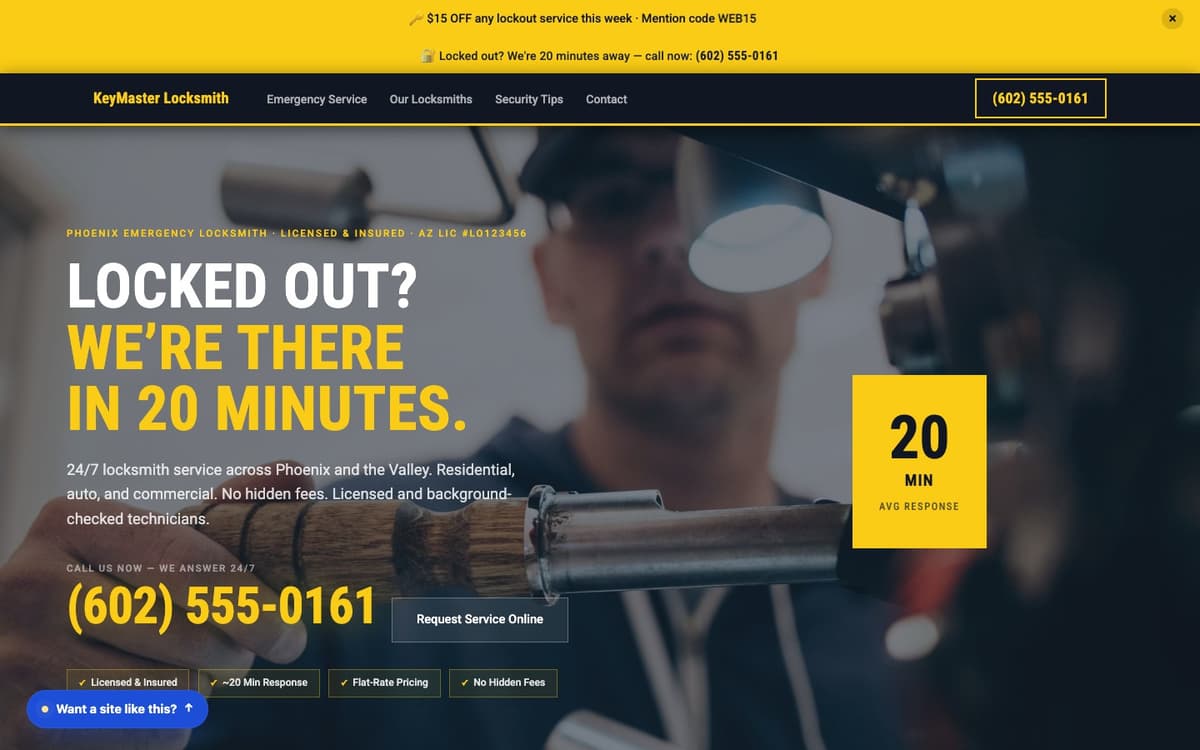
Lighthouse
Visible in Google · ChatGPT · Claude · Perplexity
Powered by
Your Free Security & Alarm Systems Website Is One Call Away.
1Digital® builds your site on WorkspaceCMS.ai at no cost - AI-first, SEO-first, live in a few days to a few weeks*. Unlimited managed edits via ticket. Flat pricing. No tech skills needed.
Essentials $89 · Growth $199 · Premium $449 · Ultra $749/mo
15+ yrs · Google Partner · 4.9★ · 941+ reviews · Live in days to weeks*
* Timing depends on how quickly we receive your questionnaire answers and content.