
FOR EMERGENCY, RESIDENTIAL, AUTOMOTIVE & COMMERCIAL LOCKSMITHS
Locksmith SEO Company:
Local Pack, LSA & Lock-Brand Authority
Locksmith demand splits four ways - emergency lockout, residential rekey/install, automotive transponder and key fob, and commercial master-key systems - and each runs a different SERP, a different Google Business Profile category, and a different conversion path. 1Digital® builds locksmith SEO programs that win the local pack, pass Google LSA verification, route calls into a measurable attribution model, and earn authority on the specific lock brands (Schlage, Kwikset, Medeco, Mul-T-Lock, Yale, Master Lock, ASSA Abloy) buyers search by.
Free Build
Ready to get your Locksmith websitebuilt - free?
1Digital® builds your locksmith site on WorkspaceCMS.ai at no cost - AI-first, SEO-first, live in a few days to a few weeks*. Flat monthly plans from $89/mo.
We Design It
Questionnaire-driven, AI-first, free
You Approve
Review before launch
Go Live
In days to weeks, no cost
No setup fees · 12-month commitment · 4.9★ from 941+ reviews
* Timing depends on how quickly we receive your questionnaire answers and content.
Trusted by 400+ Brands · Certified Partners


Years in eCommerce
Of results, scale, and quality at the enterprise level.
Expert Team
Specialists across SEO, AI SEO, PPC, design, dev, and strategy.
US Core + Global Talent
US core team for clear communication; vetted global specialists for international client work.
Reputation Score
Rated 4.9/5 across 941+ verified client reviews.
Ask AI for a business like yours. Are you in the answer?
ChatGPT, Claude, and Perplexity only recommend sites they can read - and most can't read yours. Scan it free and see exactly where you stand.
Free · no signup · scores the 15 signals AI uses to find you · ~20 seconds
The 1Digital® Difference
AI in our toolkit. Humans in the driver’s seat.
Our strategists, designers, developers, and writers are human. The proprietary AI we built makes them faster and sharper - not the other way around.
- Human strategy
- Human copywriting
- Our own AI tools
- Real growth
TL;DR
What Wins In Locksmith SERPs Today
- ›Local pack is the entire game- “locksmith near me,” “24 hour locksmith [city],” “car key replacement [zip]” queries convert through the 3-pack and LSA card. Organic blue-link rankings matter mostly as supporting authority.
- ›Service-taxonomy specificity matters: emergency / residential / automotive / commercial all run separate query clusters with different GBP categories (Locksmith, Auto Locksmith, Emergency Locksmith) and different conversion narratives.
- ›Google LSA gating- license, insurance and background-check verification is now a hard prerequisite, and the LSA card sits above the 3-pack. Programs that skip LSA forfeit 30–50% of emergency call demand.
- ›Lock-brand authority (Schlage, Kwikset, Medeco, Mul-T-Lock, Yale, Master Lock, ASSA Abloy) wins the residential install and commercial master-key SERPs that head-term “locksmith” queries can't.
- ›Call-tracking attribution is non-optional - without DNI swap and source-attribution, you can't tell organic from LSA from PPC and you optimize blind.
Locksmith SEO, step by step
Climb the searches your buyers make
Here is a typical locksmith search playing out. Expert writers and strategists build the service and location pages that move your business up the results, and the clear answers that get it cited in Google's AI Overview above them.
- ›Pages written by people who know the search behind the sale
- ›Structure and schema that AI Overviews can read and quote
- ›Rankings tracked search by search, not as one blended average
Why Locksmith SEO Is A Four-Service-Line Problem, Not One Service
Locksmiths who treat their SEO as a single service line consistently underperform competitors who architect for the four distinct demand profiles inside the category.
Four demand profiles
Emergency lockout is high-urgency, mobile-first, “near me”-dominant, and converts in seconds on a phone call - the SERP is the local 3-pack and the LSA card, with organic playing a supporting role. Residential (rekey, deadbolt install, smart lock setup, lock replacement after a move) runs longer research cycles, with buyers comparing Schlage Encode vs Yale Assure, Kwikset Halo vs August, and searching by specific lock model. Automotive (transponder programming, key fob duplication, ignition repair, broken-key extraction, dealer-alternative key replacement) is dominated by year-make-model queries and rewards dealer-parity content. Commercial (master-key systems, restricted-keyway, panic hardware, access control, lock servicing) runs B2B sales cycles with longer decision timelines and rewards capabilities-deep content on Medeco, Mul-T-Lock, ASSA Abloy and panic-hardware standards (UL 437, ANSI Grade 1).
How we build it
1Digital® builds locksmith sites with service-line-specific architecture, separate Google Business Profile categories where the multi-location model justifies it (Locksmith, Auto Locksmith, Emergency Locksmith), lock-brand authority pages for Schlage, Kwikset, Medeco, Mul-T-Lock, Yale, Master Lock and ASSA Abloy, transparent licensing and insurance content (Google LSA needs it, residential and commercial buyers reward it), call-tracking with dynamic number insertion so organic, LSA, GBP and PPC each attribute their own call volume, and review-velocity workflows that compound local-pack visibility over years. Our full-stack approach pairs the local-service playbook with broader eCommerce SEO fundamentals for shops that also sell locks, smart-lock kits, or keying hardware online.
- ›Service-line architecture (emergency / residential / automotive / commercial) with separate landing pages and GBP services
- ›Google LSA setup and ongoing verification - license, insurance, background-check, badge maintenance
- ›Google Business Profile optimization with the right primary and secondary categories, services, attributes, and review-response cadence
- ›Lock-brand authority pages for Schlage, Kwikset, Medeco, Mul-T-Lock, Yale, Master Lock and ASSA Abloy
- ›LocalBusiness + Locksmith schema with 24/7 OpeningHoursSpecification, areaServed polygons, and aggregateRating
- ›Call-tracking with DNI for source attribution across organic, LSA, GBP, PPC and direct
- ›Multi-location architecture for franchisees and roll-ups with consistent NAP and per-unit GBP discipline
Managed Websites by 1Digital®
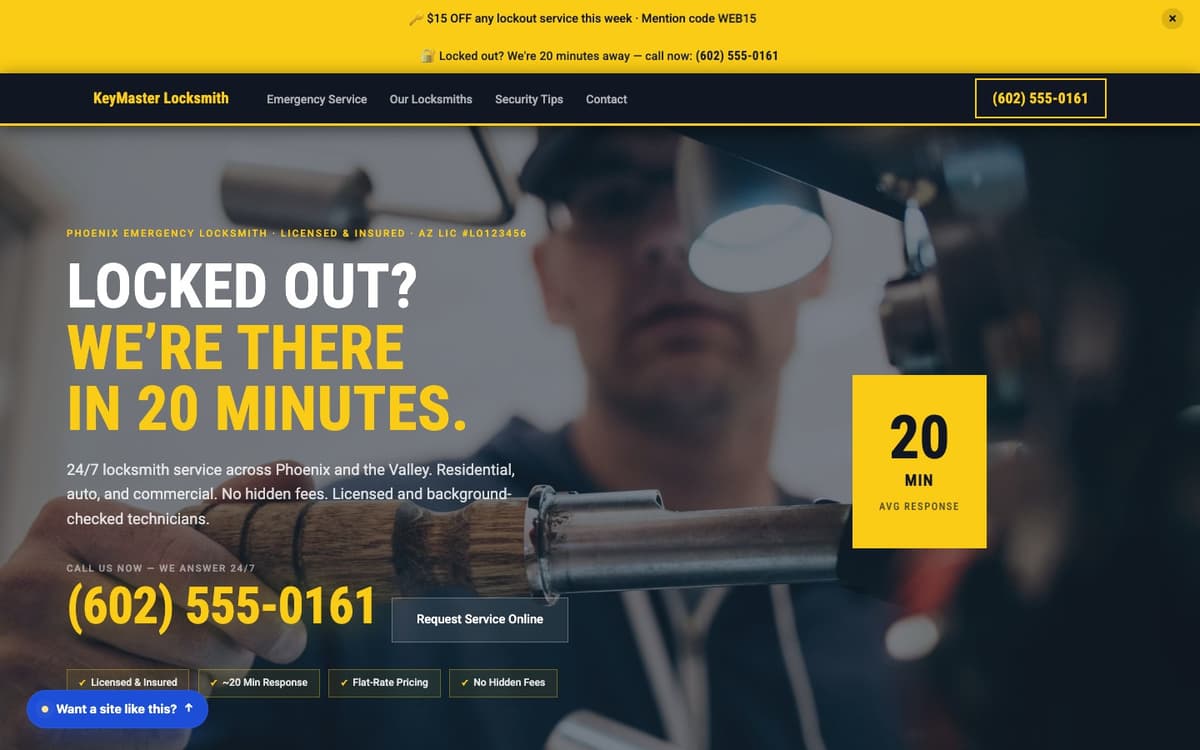
A Managed Website Built for Locksmith Businesses.
- 24/7 emergency lockout CTA above the fold - one tap, instant dispatch
- Service-area pages with zip-level local schema for every city covered
- Commercial and residential service taxonomy pages for market segmentation
- Transparent pricing and free estimate pages pre-qualifying prospects
- Built so AI assistants can read and cite you when someone asks a LLM for a locksmith near them
Lighthouse
Visible in Google · ChatGPT · Claude · Perplexity
Engagement methodology
How A Locksmith SEO Engagement Runs
- 1. Local audit + LSA readiness. NAP citation graph audit across Yelp, BBB, Apple Maps, Yellow Pages, Angi, Thumbtack and locksmith-specific directories. GBP audit (categories, services, attributes, photo cadence, review velocity, Q&A). Google LSA readiness check (license verification per state, insurance certificates, background-check on every dispatcher and tech). Identify the 5–8 most impactful gaps for first-90-days work.
- 2. Service-line landing pages. Dedicated pages for emergency, residential, automotive and commercial - each with locally-specific neighborhood context, lock-brand authority, license and insurance display, real photos of the team and shop, and clear pricing transparency where the market rewards it (residential rekey ranges, car key programming flat fees by year-make-model where defensible).
- 3. GBP + LSA optimization. Primary category alignment (Locksmith) with secondary categories (Auto Locksmith, Emergency Locksmith) where the operation justifies them. Services list with every shipped service. 24-hour OpeningHoursSpecification where accurate. Photo cadence (3–5 new photos weekly minimum). LSA badge maintenance with proactive license-renewal tracking. Review-response cadence with templated-but-personalized responses inside 24 hours.
- 4. Call-tracking with DNI. Dynamic number insertion so each traffic source (organic, LSA, GBP, PPC, direct, referral) gets its own attributable phone number. Call recording for quality assurance and conversion-coaching. Attribution dashboard so you can see exactly which source is producing billable jobs vs price-shopping calls.
- 5. Lock-brand and editorial depth. Brand-authority pages for Schlage, Kwikset, Medeco, Mul-T-Lock, Yale, Master Lock and ASSA Abloy. Year-make-model car key programming guides for the top 50 vehicles in your market. Commercial master-key system explainers. Smart-lock comparison content (Schlage Encode vs Yale Assure vs Kwikset Halo vs August). Content that earns links from home-improvement and small-business-security publishers, not generic blog filler.
- 6. Multi-location scale. For franchisees and roll-ups, per-unit GBP management with corporate brand standards, conquest-query architecture across adjacent territories, NAP citation discipline across ownership changes, and unit-level reporting so corporate can see exactly which units are winning and which are leaking. See franchise SEO services for the multi-location playbook.
Lock-Brand Authority: Schlage, Kwikset, Medeco, Mul-T-Lock, Yale, Master Lock, ASSA Abloy
Residential and commercial locksmith SERPs run heavily on brand-specific queries the generic-locksmith pages don't capture. Buyers who've already decided they want a Schlage Encode installed don't search for “locksmith” - they search for “Schlage Encode installer near me” or “Schlage Encode WiFi setup help.” Building brand-authority pages for the lock manufacturers your shop actually services routinely captures 20–35% incremental organic call volume that head-term SEO can't reach.
The brand-authority surface we standardize on for locksmith sites:
- ›Schlage- Encode, Encode Plus (Apple Home Key), Connect, Sense, BE365, B60N - residential smart-lock and deadbolt depth
- ›Kwikset- Halo, Halo Touch, SmartCode 916, 888, Premis, SmartKey rekey-in-place technology
- ›Yale- Assure Lock 2, Assure SL, Real Living, Nest x Yale - Z-Wave and Bluetooth depth
- ›Medeco- M3, Maxum, Original - high-security restricted-keyway depth for residential security and commercial
- ›Mul-T-Lock- MT5+, Interactive+, Hercular - commercial master-key and high-security residential
- ›Master Lock- ProSeries padlocks, commercial padlocks, key-controlled and combination
- ›ASSA Abloy- full commercial portfolio including Yale, Medeco, Sargent, Corbin Russwin, Adams Rite, HES electric strikes
Pair brand-authority pages with installer-credential content (factory training, certifications, authorized-dealer status), real install photography, and pricing transparency where defensible. Don't fabricate authorized-dealer status - it's a verifiable claim and Google rewards honest depth over puffery.
Locksmith SEO - FAQ
Why is local SEO so important for locksmiths?
Most locksmith demand is emergency or proximity-driven - “locksmith near me,” “24 hour locksmith [city],” “car key replacement [zip]” queries dominate the category and convert through the local 3-pack and Google LSA card, not blue-link organic. Winning the Map Pack and ranking for “[city] locksmith” plus service-specific terms (lockout, rekey, transponder, master-key) is the difference between a steady inbound call flow and competing on paid clicks. We work the Map Pack with Google Business Profile optimization, review velocity, service-area content, and lock-brand authority - and we layer LSA on top because it sits above the 3-pack.
What's the right Google Business Profile category setup for a locksmith?
Primary category should always be “Locksmith.” Add secondary categories based on actual services shipped - “Auto Locksmith” if you do automotive (transponder, fob duplication, ignition), “Emergency Locksmith” if you run a 24/7 lockout operation. Don't add categories that aren't actively run - Google's spam detection algorithms flag mismatches between declared categories and review signal patterns. Populate the full Services list with every service you actually offer (rekey, deadbolt install, smart lock install, lockout, transponder programming, master-key, panic hardware). Set OpeningHoursSpecification accurately - claiming 24/7 when you're actually 8am–8pm gets you suspended and tanks rankings.
Do you support Google Local Services Ads and how does LSA gating work?
Yes. Google's Local Services Ads sit above the Map Pack for locksmiths and only charge per qualified lead, not per click - making them one of the highest-ROI paid surfaces available to the category. LSA verification requires state locksmith licensing (where applicable - licensing requirements vary by state), commercial general liability insurance documentation, and background checks on every dispatcher and field tech. The verification process takes 2–6 weeks and ongoing badge maintenance requires renewals, insurance certificate updates, and prompt response to lead requests. Locksmiths who skip LSA forfeit 30–50% of emergency call demand to verified competitors.
How does call-tracking attribution work for locksmiths?
Dynamic number insertion (DNI) assigns a unique tracked phone number to each traffic source - organic, LSA, GBP, PPC, direct, referral, even specific landing pages - so when a call comes in, you can see exactly which source produced it. Call recording lets you separate billable-job calls from price-shopping calls and coach the team on conversion. Without DNI, you can't tell which marketing channels are producing revenue and you optimize blind. We standardize on CallRail or CallTrackingMetrics integrated with Google Analytics 4 and Google Ads so the attribution data flows into the same reporting surface where everything else lives.
How do you handle SEO across emergency, residential, automotive and commercial locksmith services?
Each service line runs a different SERP, a different intent profile, and a different conversion path - they need separate landing pages and frequently separate sub-architecture. Emergency lockout converts in seconds on a phone call from a mobile device, with “near me” queries and the local pack dominating. Residential (rekey, deadbolt install, smart-lock setup) runs longer research cycles with brand-specific queries (Schlage Encode vs Yale Assure). Automotive runs heavy on year-make-model transponder programming queries. Commercial runs B2B sales cycles with content depth on Medeco, Mul-T-Lock and ASSA Abloy master-key systems plus panic-hardware standards (UL 437, ANSI Grade 1). We architect each line as its own funnel.
Which lock brands matter most for locksmith brand-authority content?
The seven that capture meaningful organic call volume across residential and commercial: Schlage (Encode, Encode Plus, Connect, BE365), Kwikset (Halo, SmartCode 916, SmartKey), Yale (Assure Lock 2, Real Living, Nest x Yale), Medeco (M3, Maxum - high-security restricted-keyway), Mul-T-Lock (MT5+, Interactive+, Hercular - commercial master-key), Master Lock (ProSeries commercial padlocks) and ASSA Abloy (the commercial portfolio including Yale, Medeco, Sargent, Corbin Russwin, Adams Rite, HES). Build brand-authority pages for the brands you actually service. Don't fabricate authorized-dealer status - it's verifiable and Google rewards honest depth over puffery.
How do you build review velocity for a locksmith?
Review velocity is one of the strongest local-pack ranking signals and the strongest LSA-leaderboard signal. Operationalize post-job review requests - every completed billable job gets a same-day SMS with a direct review link, plus a follow-up at 48 hours for non-responders. Train techs to ask in person at job completion. Respond to every review (5-star and 1-star) inside 24 hours with personalized acknowledgment, not templated thanks. Don't buy reviews - Google's review-spam detection is aggressive and a single spam-flagged review can suppress the entire profile. Don't gate reviews (asking happy customers for Google reviews and unhappy ones for direct email) - Google explicitly prohibits this and detects it via review-pattern analysis.
How do you handle multi-location locksmith operations and franchises?
Multi-location locksmith operations (franchise networks like Pop-A-Lock and ARS, plus independent roll-ups) need per-unit GBP management with corporate brand standards, real per-location landing pages with neighborhood context (not city-name swaps that Google flags as duplicate content), NAP citation discipline that holds up across ownership changes and relocations, and unit-level reporting so corporate can see where the network is winning and where it's leaking. Conquest-query architecture across adjacent territories - when unit A and unit B are 20 minutes apart, the territory between them is contested by both. See franchise SEO services for the multi-location playbook.
What schema and structured data matter most for locksmith SEO?
LocalBusiness with Locksmith subtype, complete address with PostalAddress, telephone, OpeningHoursSpecification (with 24/7 only where genuinely staffed), areaServed with City or GeoCircle polygons for service-area boundaries, hasOfferCatalog listing every shipped service, aggregateRating from verified Google and Yelp reviews, and sameAs links to GBP, Yelp, BBB, Angi profiles. For multi-location operations, separate LocalBusiness entities per unit with consistent corporate-parent reference. For commercial-leaning locksmiths, layer in Service schema for master-key system design, access control installation and panic-hardware servicing.
How long until we see ranking and call-volume gains?
GBP optimization moves first - typically within 4–8 weeks for noticeable Map Pack movement and review-velocity gains. LSA verification adds 2–6 weeks before badge goes live. Organic ranking for harder commercial-service queries (commercial master-key, panic hardware, access control) typically compounds over 3–6 months as content and citations mature. Lock-brand authority pages compound steadily over 6–12 months as Google recognizes the brand-entity association. The compounding effect is significant - well-architected locksmith SEO programs at 12 months frequently produce 3–5x the call volume of the same operation at month one, with declining cost-per-billable-job over time.
Request a proposal
Tell us about your shop and service mix
Share your service lines (emergency / residential / automotive / commercial), service area, and current GBP and LSA status. A senior strategist replies within one business day with a pricing band and a draft scope.
The Locksmith market
What we cover in Locksmith SEO
Named sub-verticals and buyer segments inside the Locksmith category that we map keyword strategy and content programs to:
Last updated: October 2026
Locksmith by the numbers
$3.4 billion
US locksmith services industry revenue in 2025
Source: IBISWorld, Locksmiths in the US 2025
Locksmith SEO - buyer questions
Common questions in the Locksmith vertical
Why is local SEO so important for locksmiths?
Locksmith services are almost entirely local and emergency-driven, with Google data showing 76% of 'near me' searches result in a same-day visit or call.
The locksmith vertical is also one of Google's most aggressively spam-filtered categories due to historic lead-generator scams, which means legitimate locksmiths must invest in verified Google Business Profiles, real physical addresses, license documentation, and consistent NAP citations. Local pack rankings drive the majority of qualified calls. 1Digital® builds locksmith SEO around verified GBP optimization, service-area pages tied to specific zip codes, and review velocity - the three signals Google weights most heavily for trusted local service categories.
How does Google handle locksmith scams and what does it mean for legitimate businesses?
Google has taken extensive action against locksmith lead-generation scams since a 2016 New York Times investigation, including stricter GBP verification (video verification, physical address checks) and elevated trust signals required to rank in local pack.
Legitimate locksmiths benefit from these changes because illegitimate fake-storefront listings are now suppressed more aggressively. Practical implications: complete every GBP field, maintain consistent NAP across BBB, Yelp, ALOA directory, and state licensing boards, display state license numbers on the site, and gather reviews steadily over time. Sudden review velocity spikes can trigger algorithmic spam filters even for legitimate businesses.
What role does ALOA membership play in locksmith SEO?
Associated Locksmiths of America (ALOA) membership signals industry legitimacy and provides a high-authority directory backlink from aloa.org, which is one of the most authoritative referring domains in the locksmith vertical.
ALOA's member directory is also a referral source for consumer-facing queries. Pairing ALOA membership with state-level licensing (required in 15 US states including TX, CA, IL, NJ, NC) and BBB accreditation builds the trust profile Google rewards in local pack rankings. Display all three - ALOA, state license, BBB - prominently on the homepage and in footer schema as Organization trust signals.
How do emergency locksmith searches differ from scheduled service searches?
Emergency locksmith queries ('locksmith near me open now,' '24 hour locksmith,' 'locked out of car') spike late nights, weekends, and holidays and convert almost entirely through phone calls within minutes of the search.
Scheduled service queries ('rekey house locks,' 'install smart lock,' 'commercial master key system') follow business-hour patterns and convert through forms and quotes. The two need separate landing pages, call tracking, and ad strategies. Emergency pages should prioritize click-to-call, dispatch radius, and after-hours availability schema; scheduled-service pages should prioritize trust content, pricing transparency, and detailed service descriptions.
Should locksmiths run Google Local Services Ads (LSAs)?
Yes - Google Local Services Ads with Google Guarantee badging are now a primary acquisition channel for locksmiths and appear above the local pack on mobile, often capturing the majority of high-intent emergency clicks.
LSAs require background checks, license verification, and insurance documentation, which doubles as a trust signal. Cost-per-lead in the locksmith vertical typically ranges $25-$75 per call depending on metro and time-of-day, and LSAs charge per lead rather than per click. Run LSAs alongside organic local SEO rather than as a replacement; the two channels reinforce each other through brand search lift and review accumulation.
Powered by
Your Free Locksmith Website Is One Call Away.
1Digital® builds your site on WorkspaceCMS.ai at no cost - AI-first, SEO-first, live in a few days to a few weeks*. Unlimited managed edits via ticket. Flat pricing. No tech skills needed.
Essentials $89 · Growth $199 · Premium $449 · Ultra $749/mo
15+ yrs · Google Partner · 4.9★ · 941+ reviews · Live in days to weeks*
* Timing depends on how quickly we receive your questionnaire answers and content.