

For Brokerages, Teams & Agents
Real Estate Web Design
Built Around How People Actually Buy Homes
Listing experiences, neighborhood pages, agent profiles, and compliant lead capture - designed as one system, on a CMS your team can actually run.
Trusted by 400+ Brands · Certified Partners




Years in eCommerce
Of results, scale, and quality at the enterprise level.
Expert Team
Specialists across SEO, AI SEO, PPC, design, dev, and strategy.
US Core + Global Talent
US core team for clear communication; vetted global specialists for international client work.
Reputation Score
Rated 4.9/5 across 941+ verified client reviews.
Reviewed by the 1Digital® Design Team
You Don’t Need a Platform. You Need a Website That Does a Job.
Most agencies open the conversation by asking which platform you want. That question is backwards for a real estate business. Nobody walks into a listing appointment thinking about content management systems - they think about the seller who chose the other brokerage because that brokerage’s site looked like it belonged to the neighborhood and yours looked like a template.
So we start from the job. A real estate website is not a brochure and it is not a store. It is a lead-routing machine wrapped around a constantly changing inventory you do not fully control, operated by a roster that changes every quarter, in a category where the words you use are regulated. Design decisions either respect those constraints or quietly work against them for years.
Because a brokerage is a service business rather than a storefront, we build these sites on WorkspaceCMS - our own platform, built and maintained by this team. That matters practically: listing content, agent rosters, neighborhood pages, and disclosure blocks all need to change faster than a developer queue allows, and the SEO structure underneath them needs to hold steady while they do.
Real Estate web design, step by step
One site that works on every screen
Most real estate customers find you on a phone. We plan each page so it rearranges for the screen in front of them rather than shrinking, then build it fast and accessible, with the call to action exactly where the visitor is ready to get in touch.
- ›Layouts planned around how real estate customers decide
- ›Mobile-first, fast loading and accessible from the start
- ›Built for search from the first wireframe, not bolted on later
The Platform We Just Named
What WorkspaceCMS Is, In Two Minutes
Saying “we build brokerage sites on our own platform” only means something once you can see it. This is the platform explainer: what a managed WorkspaceCMS site includes, who actually makes the edits, and why that answers the maintenance problem behind roster churn, neighborhood pages, and disclosure updates - the constraints the rest of this page is designed around.
Conversion Paths
Six Different People Arrive. Design for All Six.
The single most common structural flaw in real estate web design is treating “generate leads” as one goal. It is at least six, each with a different urgency, a different amount of information the visitor is willing to give up, and a different person inside the brokerage who should receive it.
Book a showing
The highest-intent action on the site, and the one most often buried under a generic “Contact Us.” It needs to live on every listing view, work in two taps on a phone, and route to whoever is actually on floor duty - not a shared inbox nobody owns on a Saturday.
Request a home valuation
Your seller-side funnel. Address-first, question-light, and honest about what happens next: a real person preparing a comparative market analysis, not an instant algorithmic number the homeowner will immediately distrust.
Ask about a specific property
Buyers rarely convert on the brokerage homepage; they convert on one address. Every listing detail view needs its own inquiry path, pre-filled with the property reference so the agent isn’t emailing back to ask which house.
Reach a specific agent
Referrals and repeat clients arrive searching an agent’s name. Individual agent profiles - bio, license detail, service areas, active and sold listings, direct contact - capture that traffic instead of dumping it on a roster page.
Save a search / get alerts
A slower path, but the one that builds an owned audience. Design it as an opt-in with a plain-language explanation of what will be sent and how often, with consent language your broker has reviewed.
Apply, or ask about management
If the brokerage handles rentals or property management, tenants and owners have entirely different needs from buyers. They deserve their own entry points rather than being funneled through a sales-oriented contact form.
Once those paths are separated, the design work becomes concrete: which one owns the hero, which one follows the visitor down a listing page, how many fields each can justify, and what the confirmation screen promises. That is also where conversion optimization earns its keep after launch - testing the friction, not the color of the button.
What Goes Wrong
How Real Estate Websites Fail
These are the recurring patterns we find in audits. None of them are exotic; all of them are expensive to fix later, because each one is baked into the templates the site uses most.
The IDX iframe is the whole website
A search widget dropped onto a blank page delivers listings without delivering a brokerage. Third-party listing content is frequently not indexable as your own, so a site built entirely on it can have very little crawlable substance of its own - and nothing that distinguishes you from every other office running the same widget.
Media-heavy pages that never load
Real estate is a photography business, and photography is how real estate sites get slow. Unsized full-bleed hero imagery, uncompressed galleries, video tours embedded eagerly, and map scripts all landing at once produce exactly the layout shift and slow largest-contentful-paint that mobile buyers abandon.
A roster that rots
Agents join and leave constantly. When the site is hard to edit, the team page ages into a liability: departed agents still listed, new hires missing, dead phone numbers. The design has to assume weekly churn and make roster maintenance a two-minute task.
One contact form for six audiences
Buyers, sellers, renters, landlords, recruits, and vendors all pushed through one field-heavy form. Everything lands in one queue, response times slip, and the highest-value inquiries get the same treatment as a vendor pitch.
No geography in the architecture
Search happens by place. A site with no substantive pages for the neighborhoods, towns, and communities it actually serves has nothing for a local query - or an AI assistant summarizing an area - to land on.
Compliance treated as a footer problem
Equal housing and licensing disclosures pasted into the footer at the end, IDX attribution missing from listing views, and lead forms with no reviewed consent language. Designed in from the start, these cost nothing; retrofitted, they force rework of the components buyers use most.
Page Architecture
The Sitemap a Brokerage Actually Needs
Scope varies with the size of the office and whether you handle rentals, new construction, or commercial alongside residential. But the spine below holds up for most brokerages, and every line of it exists because a specific audience or a specific search behavior demands it.
Note what is deliberately not on the list: a page for every ZIP code with the name swapped out. Thin duplicated geography pages have been a liability for years. Cover the areas you genuinely work, with genuine knowledge, and let the rest go.

- ›Home - positioning, market proof, and the three primary paths (buy, sell, search) above the fold
- ›Property search - IDX or feed-driven results with filters that match how people describe homes locally
- ›Listing detail - gallery, map, neighborhood context, agent attribution, inquiry and showing CTAs
- ›Neighborhood & community pages - original written coverage of the areas you actually serve
- ›Sell / home valuation - the seller funnel, with process explanation and a low-friction request
- ›Agent directory + individual agent profiles - indexable, name-searchable, directly contactable
- ›Office / location pages - one per physical office, with consistent name, address, and phone
- ›Buyer and seller guides - first-time buyer, financing basics, closing process, moving checklists
- ›Rentals / property management - separate tenant and owner entry points where relevant
- ›Reviews & testimonials - sourced, attributed, and placed next to the decision, not siloed
- ›Careers / join our team - recruiting is a real conversion goal for growing brokerages
- ›Contact - every office, every department, mapped and reachable without a form
Built on
What That Sitemap Looks Like Once It’s Built
Three WorkspaceCMS builds that carry the structure described above - separated conversion paths, indexable geography and people pages, and a listing experience that sits inside a real brokerage site rather than replacing it.
- realestate.workspacecms.ai
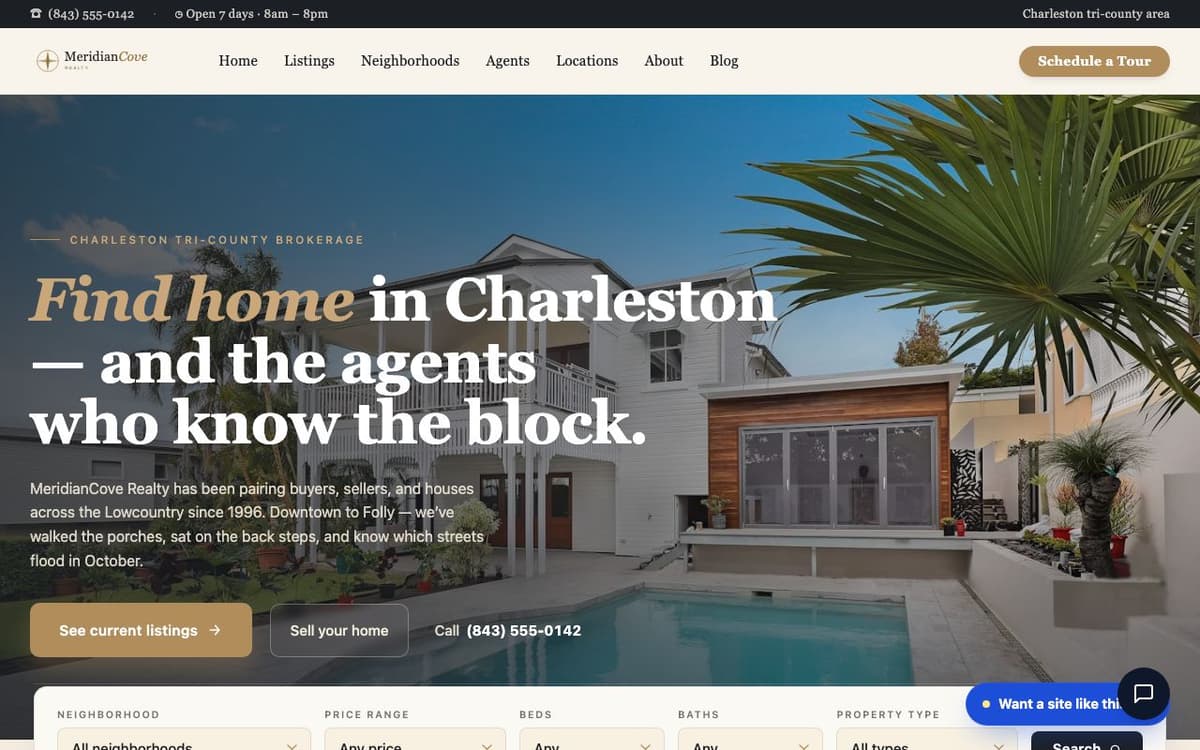 View the live demo →
Harbor & Vine Realty
Listing-led homepage with distinct buyer, seller, and agent paths
- homebuilder.workspacecms.ai
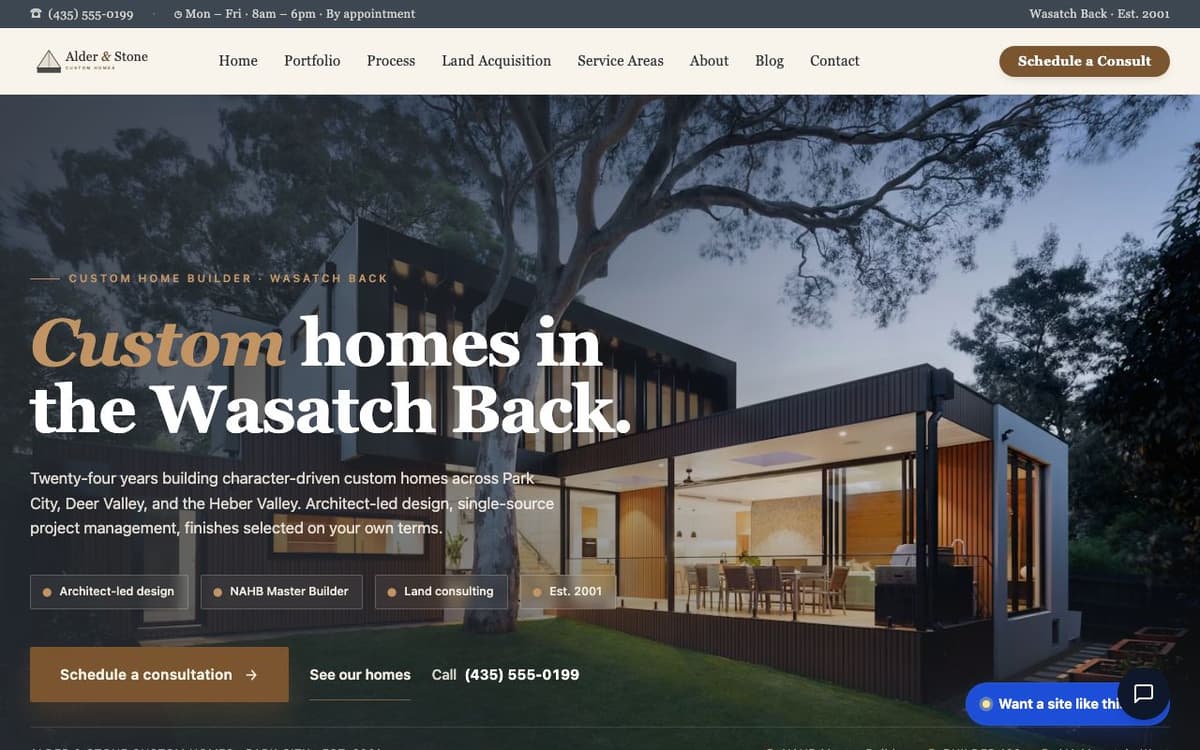 View the live demo →
Cornerstone Builders
New-construction inventory presented as a buying journey, not a raw feed
- wealth.workspacecms.ai
 View the live demo →
Northcrest Advisory
Trust and disclosure patterns from another high-value, regulated transaction
Compliance by Design
The Constraints That Make This Vertical Different
Real estate marketing sits inside a regulatory frame most verticals don’t have. We are designers and engineers, not your attorneys or your compliance officer - the point of the section below is that we build the surfaces where these obligations live as deliberate, editable components, and we ask the questions early instead of discovering them the week before launch.
Fair housing
Housing advertising is regulated. Copy, imagery, and audience-targeting choices all carry fair-housing implications, and the Equal Housing Opportunity mark belongs where it is visible - not buried. Our design reviews flag language that describes the buyer rather than the property, because that is where marketing sites most often drift.
Licensing and brokerage identification
Requirements for displaying license numbers, brokerage name, and office jurisdiction vary by state and are set by your regulator, not by us. We build the disclosure surfaces - agent profiles, listing views, footer, office pages - as first-class components so your compliance officer can populate them and change them without a developer.
IDX / MLS display rules
Every MLS sets its own rules for how member-sourced listing data may be displayed: attribution, required disclaimers, refresh frequency, what may be indexed. These are contractual obligations of your data feed. We design listing templates with the attribution and disclaimer slots built in, then confirm the specifics against your MLS agreement before launch.
Lead-form consent
Alert sign-ups and call-back requests trigger consent expectations for calls and texts. Consent language should be written or approved by your counsel and rendered as readable text next to the submit action - not hidden behind a link or pre-checked by default.
Accessibility
Real estate sites are consumer-facing, transaction-oriented, and image-dense - the combination that makes accessibility both a legal exposure and a usability problem. We design to WCAG 2.2 AA: contrast, keyboard operability, focus states, semantic structure, and meaningful alternative text on property media. See our approach to accessibility and ADA compliance.
Design → Discovery
Every Layout Decision Is Also a Local Search Decision
Real estate demand is expressed geographically, and geography is the part of a website that design controls. If neighborhood knowledge only exists inside a listing widget, a carousel, or an image, it is not text a search engine or an AI assistant can read, quote, or attribute to you. The fix is structural, not cosmetic: render the substance as real HTML, on a page with its own address, linked from somewhere a human would plausibly click.
Practically, that means neighborhood and community pages that carry original writing about schools, commute patterns, housing stock, and price context - not a paragraph of spun boilerplate above an embedded search. It means office pages whose name, address, and phone match your Google Business Profile exactly, character for character. It means agent profiles that are indexable pages rather than modal pop-ups, so a past client searching an agent’s name lands on your domain instead of a portal’s.
The same structure is what makes a site legible to AI assistants. Generative engines summarize source text; they cannot summarize a script-rendered widget or an infographic. Pages that state plainly who you are, where you operate, what you handle, and what a client should expect at each stage are the pages that get cited - which is why we write headings as questions people ask, keep answers in the paragraph directly beneath them, and emit structured data describing the organization, its offices, and its FAQs. Design and real estate SEO are the same project; running them as two projects is how sites get rebuilt twice.
Performance belongs in the same conversation. Property photography is the reason people stay on the page and the reason the page is slow, so image strategy - sizing, format, priority, lazy loading below the fold, reserved space to prevent layout shift - is decided during design rather than patched after launch. Buyers browse listings on phones, often on cellular, frequently while standing in front of the house.
Introducing
Your Industry. Your CMS. Managed for You.
- Unlimited managed edits - shipped on your plan's SLA
- SEO baked into every page, post, and location
- Technical SEO on every plan; AI schema and internal linking on Premium & Ultra
How the Engagement Runs
Discovery starts with your market, your inventory mix, and your intake reality - who answers a lead at 9pm, which agents get which inquiries, what your MLS agreement permits. From there: information architecture, wireframes for the templates that carry the most traffic (listing detail, neighborhood, agent profile), then high-fidelity design in Figma as a reusable system rather than a stack of one-off page comps.
Build happens on WorkspaceCMS with your IDX or listing feed wired in, disclosure components in place, forms routed to the right people, and analytics configured to distinguish a valuation request from a general inquiry. Launch includes redirect mapping so an existing site’s accumulated authority carries over, accessibility QA, and device testing. Afterwards, unlimited managed edits mean roster changes and new neighborhood pages get shipped by us on your plan’s SLA - the maintenance problem that kills most brokerage sites simply stops being your problem.
- 01
Discovery
Market, inventory mix, and intake reality
- 02
Information architecture
The sitemap and the conversion paths, agreed first
- 03
Wireframes
Listing detail, neighborhood, and agent profile templates
- 04
Design system
High-fidelity Figma as a reusable system, not page comps
- 05
Build
WorkspaceCMS, listing feed, disclosures, routed forms, analytics
- 06
Launch & beyond
Redirect mapping, accessibility QA, then unlimited managed edits
If your requirements run past a standard brokerage build - bespoke portals, unusual integrations, a multi-office franchise system - see custom website design for how we approach fully bespoke work, and local SEO for the ongoing visibility program that runs alongside it.
Request a proposal
Tell us about your brokerage
Share your markets, roster size, and how listings reach your site today. A senior strategist replies within one business day with a pricing band and a draft roadmap.
Real Estate Web Design - FAQ
What makes real estate web design different from a normal business website?
Three things: the inventory changes constantly and often comes from a data feed you license rather than own; the staff roster changes almost as often; and the advertising itself is regulated, from fair-housing considerations to state licensing disclosure to the display rules attached to your MLS feed. A design that ignores any of the three works on launch day and degrades from there.
Do I need IDX on my website?
Usually yes, if buyers should be able to search listings on your domain - but IDX should be a component of the site, not the entire site. The pages that differentiate a brokerage and earn search visibility are the ones you own: neighborhood coverage, agent profiles, seller guidance, testimonials. We design the listing experience to sit inside that structure, and we confirm attribution and disclaimer requirements against your specific MLS agreement.
Which platform will you build my real estate site on?
For a brokerage or team, our default is WorkspaceCMS, the platform 1Digital® builds and maintains. It is designed for service businesses rather than online stores, ships with SEO structure and schema automation built in, and includes unlimited managed edits - so roster changes, new neighborhood pages, and disclosure updates get handled without a developer ticket. Where a project genuinely needs something else, we say so.
Can you redesign our site without losing our current rankings?
That is the plan of record for every redesign we run. We inventory existing URLs and their performance, map redirects one-to-one where equivalents exist, preserve titles and heading structure on pages that already perform, keep structured data intact, and QA the whole mapping before and after launch. Redesigns lose rankings when redirects are an afterthought - not because the design changed.
How do you handle agent profiles for a roster that keeps changing?
Agent profiles are a content type, not hand-built pages. Adding an agent creates an indexable profile, links it into the directory and the relevant office and service-area pages, and attaches their listings. Removing one cleanly retires the page rather than leaving a dead end. With unlimited managed edits, you can also just send us the change and it ships on your plan’s SLA.
Will the site help us show up in AI assistants and AI Overviews?
It is built to. Generative engines summarize readable source text, so we render the substance - service areas, process explanations, agent credentials, answers to the questions clients actually ask - as real HTML on crawlable pages, keep the answer directly beneath the question, and emit structured data describing the organization and its offices. That is the same work that supports real estate SEO; the design and the discoverability are one project.
Let’s Design the Site Your Market Expects
Whether you are a single-office brokerage, a growing team, or a multi-market firm, we will map the conversion paths, the geography, and the compliance surfaces before anyone opens a design tool.