

FOR ELECTRICAL CONTRACTORS
Electrician PPC That Buys Booked Jobs
An electrical contractor does not check out a cart. The conversion is a ringing phone at 7 a.m. or a form filled at midnight, and the only number that matters is what a qualified lead costs against what a booked job is worth. We run Google Search, Local Services Ads, and call-only campaigns for licensed electricians - built around call tracking, lead scoring, and a service area drawn by drive time rather than a radius on a map.
Trusted by 400+ Brands · Certified Partners




Years in eCommerce
Of results, scale, and quality at the enterprise level.
Expert Team
Specialists across SEO, AI SEO, PPC, design, dev, and strategy.
US Core + Global Talent
US core team for clear communication; vetted global specialists for international client work.
Reputation Score
Rated 4.9/5 across 941+ verified client reviews.
The 1Digital® Difference
AI in our toolkit. Humans in the driver’s seat.
Our strategists, designers, developers, and writers are human. The proprietary AI we built makes them faster and sharper - not the other way around.
- Human strategy
- Human copywriting
- Our own AI tools
- Real growth
Why Paid Search for Electricians Is Not eCommerce PPC
Most paid-media playbooks are written for stores: a catalogue, a checkout, a return on ad spend calculated against product revenue. None of that transfers to an electrical contractor. Your inventory is truck hours. Your checkout is a dispatcher answering a phone. Your ceiling is not stock levels - it is how many crews you can send out today and how far they can drive before the job stops paying. That single difference reshapes every decision in the account: what you bid on, when you bid, how you measure, and when you deliberately stop spending.
Electrical demand also splits cleanly into two economies that most contractor accounts wrongly blend into one campaign. Emergency and repair intent - no power to half the house, an outlet arcing, a breaker that will not reset, a panel that smells hot - is urgent, mobile, and decided in minutes. The homeowner calls the first credible licensed result and stops searching. Planned work - service upgrades, EV charger installation, standby generator hookups, rewires, commercial fit-outs and code corrections - behaves nothing like that. It is researched over days or weeks, priced against two or three competing bids, and often scheduled a season out. The first economy rewards speed, proximity, and an answered phone. The second rewards credibility, licensing proof, and follow-up. Bidding on them with a single strategy means overpaying for one and under-serving the other.
Paid search also has to coexist with the free channel. Where electrician SEO compounds slowly across service-area pages and review velocity, PPC buys the top of the results page today - which is exactly what you want during a storm week, when a new crew comes online, or when you open a second service territory with no organic footprint at all. We treat them as one budget with two jobs, and we do not pay for clicks on the terms you already own outright in the local pack unless there is a defensive reason to.
- Cost per qualified lead and booked jobs as the reporting spine - not ROAS on product revenue.
- Emergency and planned-work intent split into separate campaigns with separate budgets.
- License-compliant ad copy that never implies a scope you are not classified to perform.
- Ad schedules matched to dispatch capacity - including who is answering after hours.
- Geo targeting drawn by profitable drive time, tightened ZIP by ZIP as data arrives.
- Storm and outage reserve inside the monthly budget, ready to deploy the same day.
Electrician PPC, step by step
Move the budget to the searches that call
The search terms report decides where the money goes. The electrician searches that turn into calls earn more of the budget, and the ones that never will are cut back and added as negatives, so you stop paying for them.
- ›Search terms read by a senior strategist, not left to automation
- ›Negative keywords that stop paying for searches that never convert
- ›Budget moved toward the services and searches that book
The campaign mix
Four Surfaces, Four Different Jobs
An electrical account is not one campaign with a bigger budget. It is a small portfolio, each piece bought on different economics and judged on a different question. Our Local Services Ads optimization work runs alongside the Search build rather than in place of it, and the whole thing sits under our broader PPC management services.
Stage 01 - Emergency intent
Local Services Ads
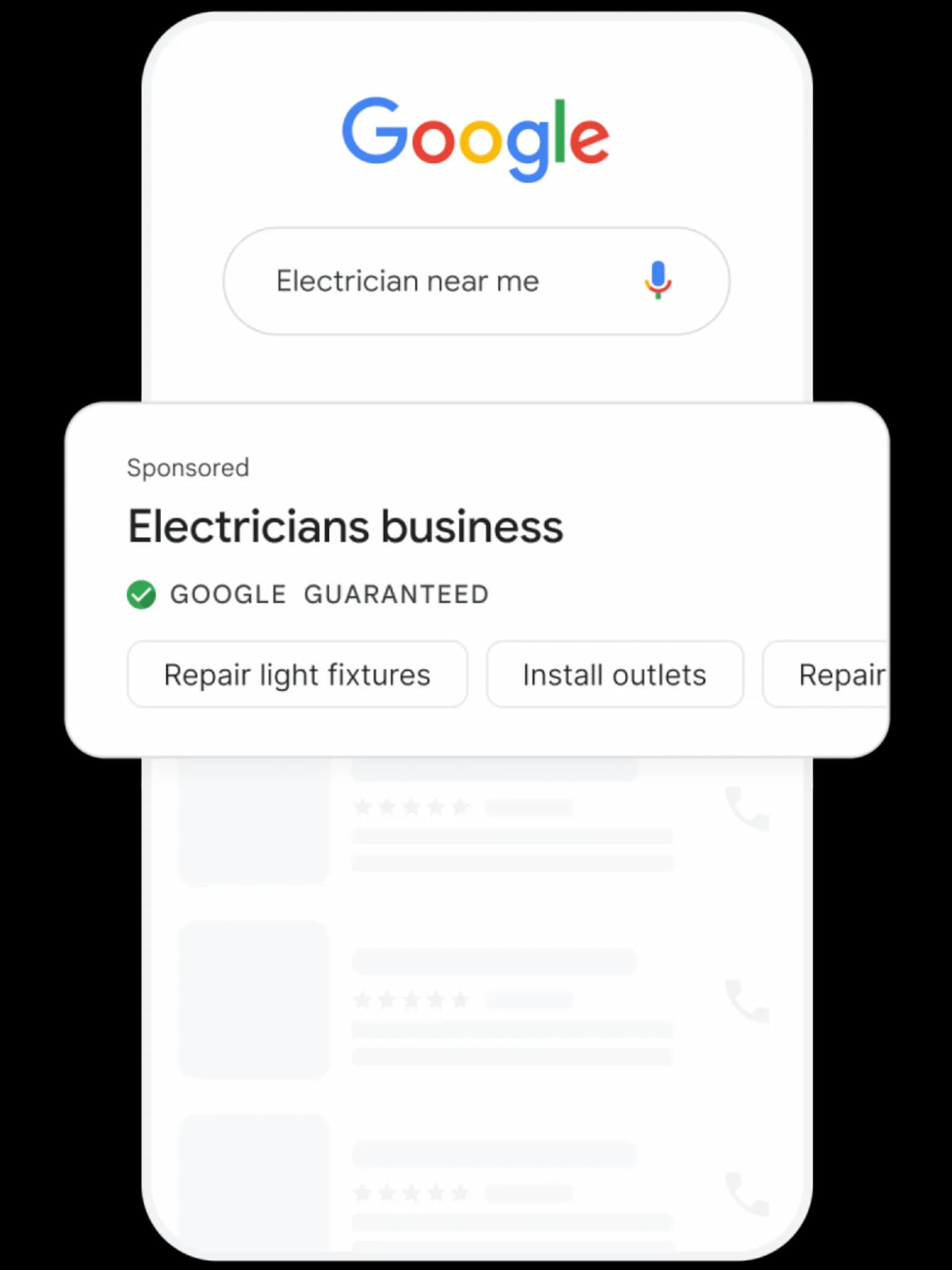
The Google Guaranteed unit sits above every text ad on electrical queries and bills per lead, not per click. We handle license and insurance verification, background-check upkeep, weekly budget pacing, and - the part most contractors skip - disputing the misrouted and spam leads that quietly inflate your cost per job.
Stage 02 - Higher-ticket work
Search
Text ads carry everything LSAs cannot: panel upgrades, EV charger installs, generator hookups, commercial tenant fit-outs, code-correction work. This is where a real keyword and negative-keyword structure separates a $600 service call from a $9,000 bid - and where DIY and jobs-wanted traffic gets excluded.
Stage 03 - After-hours mobile
Call-only
For emergency intent on mobile, a call-only campaign removes the landing page entirely. It runs on its own schedule and its own bids, because a 2 a.m. "breaker sparking" tap is worth a different number than a Tuesday-afternoon estimate request - and only if someone answers.
Stage 04 - Long consideration
Demand Gen & remarketing
Planned electrical work has a long consideration window. Demand Gen and remarketing keep your name in front of homeowners collecting three bids on a service upgrade, and in front of property managers who priced a job in spring and budgeted it for fall.
Lead quality & call tracking
A Cheap Lead Is Not a Cheap Job
The fastest way to make an electrical PPC account look successful and lose money doing it is to optimize toward lead count. Job seekers convert. DIYers convert. Wholesalers, warranty companies, and callers forty minutes outside the service radius all convert. Until the account can tell the difference between a conversion and a booked job, every automated bid strategy in Google will happily buy you more of the cheap ones - because that is what you told it to want.
Call tracking on every campaign
Dynamic number insertion plus per-source numbers, so LSA, Search, call-only, and organic calls land in separate buckets. Without it, every channel claims the same phone call and nothing can be optimized.
Call review, not call counts
We listen to and score calls: was it in your service area, was it in your trade scope, was it a real homeowner or a wholesaler, did it become a scheduled visit? Booked jobs - not raw call volume - become the optimization signal.
Answer-rate accountability
The most expensive line item in trade PPC is the missed call. We report answer rate and after-hours abandonment beside spend, because a 30% miss rate on emergency clicks is a bigger leak than any bid strategy can fix.
Job-value feedback loop
Where your CRM or field-service software allows it, we import offline conversions so Google optimizes toward panel upgrades and rewires rather than the cheap troubleshooting calls that are easiest to generate.
Negative keywords as a standing job
"Electrician salary," "electrician apprenticeship," "how to wire a three-way switch," and the name of every supply house in your metro. Trade accounts bleed budget through job-seeker and DIY traffic faster than almost any other vertical.
Form-fill triage
Forms convert cheaper than calls but skew toward tire-kickers and unlicensed-work requests. We qualify at the form - service address, property type, timeline - so the office is not chasing leads outside the truck radius.
A wasted click
- –Broad keyword catches an apprenticeship or salary search, not a homeowner.
- –Ad lands on a slow, generic page with the phone number buried below the fold.
- –Service area is a round radius, so the lead sits outside profitable drive time.
- –Call rings after hours with nobody assigned to answer it.
- –Conversion logs as a win, so the bid strategy buys more of the same.
A converting click
- ›Query matches a job you actually want - panel upgrade, EV charger, generator.
- ›Page loads fast on mobile with a tap-to-call button in the first screenful.
- ›Geo targeting is drawn by drive time, so the truck reaches the job profitably.
- ›License, insurance and review proof answer the homeowner's first three questions.
- ›Call is tracked, scored and tied back to a booked job the bidding can learn from.

Budget & service area
Spend Is Capped by Territory, Not Catalogue
A store can scale spend by adding SKUs. You cannot. There is a finite number of people searching for an electrician inside your drive radius this month, and once you own that impression share, more budget buys worse leads - broader keywords, longer drives, colder intent. Growth comes from expanding the territory, adding crews, or moving the mix toward higher-ticket work. We tell you when you have hit that ceiling instead of quietly spending past it.
How We Build the First 90 Days
Weeks one and two are plumbing, not advertising: call tracking installed and split by source, conversion actions rebuilt around calls of real length and qualified form fills, license and insurance documents pushed through Local Services Ads verification, and a first pass at the negative keyword list before a dollar goes out the door. We map your trades - residential service, new construction, commercial maintenance, low-voltage - because an account that bids on all of them equally will fill your schedule with whichever is cheapest, not whichever you want.
Weeks three through eight are structure and evidence. Emergency, planned-work, and brand-defense campaigns launch separately with their own budgets and schedules. Landing pages get built around the questions a homeowner actually asks before calling an electrician - license number, insurance, whether you pull the permit, whether the estimate is free, how fast you can be there. We review recorded calls with you rather than sending a dashboard, because the first month of call audio usually reveals more about the account than the click data does.
From there it is compounding: offline conversion imports where your field-service software supports them, geo bid adjustments on the ZIP codes that book, ad copy tested against booked jobs rather than click-through rate, and a slow shift of budget toward the work with the best margin. A senior strategist owns the account throughout - WorkspaceCRM, our in-house AI, watches search terms and call patterns between reviews and flags the drift, but the bidding and creative calls stay with a human who knows what a service upgrade is worth in your market. If you also run electrician SEO with us, the two share one keyword map. See the full PPC by industry lineup, or start with a free PPC audit of the account you are running now.
Managed Websites by 1Digital®
The Ads Are Only As Good As What They Land On
Every click you buy for an electrical job lands somewhere, and a slow or unconvincing page turns the most expensive traffic on your account into a bounce. WorkspaceCMS gives licensed electricians a managed site built to take that traffic - tap-to-call, service-area clarity, licensing and review proof - and it is built free on a 12-month plan.
- Tap-to-call button in the first screenful on every mobile ad landing.
- Fast, lightweight pages so emergency traffic does not bounce while loading.
- Service-area and licensing details stated plainly, where homeowners look first.
- Quote forms that capture address, property type and timeline for dispatch triage.
Free build on a 12-month plan. Managed hosting and updates included.
 Explore Volta Electric Co. →
Electrician PPC - FAQ
Should electricians run Local Services Ads or Google Search ads?
Both, for different work. Local Services Ads dominate the top of emergency and repair queries and bill per lead, which makes them the efficient front door for the calls that convert same-day. But LSAs give you very little control over the job type you receive. Search ads are where you deliberately buy the higher-ticket work - panel upgrades, EV charger installation, generator hookups, commercial service - with keyword-level bids, ad copy, and landing pages you actually control. Running only LSAs usually means a calendar full of small troubleshooting visits.
What is a realistic cost per lead for an electrical contractor?
It varies too widely by metro and job type for any honest agency to quote a number on a web page. Cost per lead in a dense, heavily-advertised metro can be several multiples of a rural service area, and an emergency repair click prices differently than a whole-home rewire click. What matters more is the ratio behind it: what a qualified lead costs, what share of those become booked jobs, and what an average booked job is worth to you. We build that model from your own data in the first weeks, then manage to it rather than to a generic benchmark.
How does seasonality affect electrician PPC budgets?
Electrical demand is less weather-driven than HVAC, but it is far from flat. Storm events and heat waves produce sharp spikes in outage, surge-damage, and generator demand that arrive with no notice. Planned work has its own rhythm - renovations and service upgrades cluster in warmer months, generator interest rises ahead of storm season, and holiday lighting or panel-capacity questions appear late in the year. We keep a reserve inside the monthly budget so a storm week can be funded without starving the campaigns that produce planned, higher-margin work.
Are there advertising rules specific to licensed electricians?
Yes, and they are enforced from two directions. Google requires license and insurance verification before a Local Services Ads profile can carry the Google Guaranteed badge, and it periodically re-verifies. Separately, most state licensing boards regulate contractor advertising - commonly requiring the license number in ads and prohibiting claims that imply a scope or certification you do not hold. We keep license numbers and service-scope language consistent across ads, extensions, and landing pages, and we do not write copy that promises work outside your licensed classification.
How do you keep job seekers and DIYers out of the account?
With aggressive, continuously maintained negative keyword lists and tight match-type discipline. The electrical trade has unusually heavy informational and employment search volume sharing the same head terms as commercial intent - apprenticeship, union, salary, licensing exam, and how-to wiring queries all collide with \"electrician near me.\" We mine the search terms report every week, exclude at the campaign and account level, and avoid the broad-match-plus-automation setups that make this traffic reappear the moment nobody is watching.
How should I set the service area for my campaigns?
By drive time and job value, not by a round radius. We build geo targeting from where your trucks can profitably reach within the response time you advertise, then bid up the ZIP codes where you win work and bid down the ones that generate long unpaid drives. Multi-crew contractors get separate geo segments so a second location is not cannibalizing the first. We also exclude the outer ring where the lead looks cheap but the travel time makes the job unprofitable.
Request a proposal
Tell us about your service area and crews
Share your territory, trade mix, and how calls get answered after hours. A senior strategist replies within one business day with a channel plan and a budget band.