

FOR SOLAR INSTALLERS
Solar PPC That Books Consultations, Not Clicks
A solar install is a five-figure decision a homeowner makes once. There is no cart, no repeat purchase, and no product feed to optimize - there is a phone that has to ring and a consultation that has to get on the calendar. We build Google Ads, Local Services Ads, and call-only campaigns around cost per qualified appointment and cost per signed contract, scoped to the exact territories your crews can actually reach.
Trusted by 400+ Brands · Certified Partners




Years in eCommerce
Of results, scale, and quality at the enterprise level.
Expert Team
Specialists across SEO, AI SEO, PPC, design, dev, and strategy.
US Core + Global Talent
US core team for clear communication; vetted global specialists for international client work.
Reputation Score
Rated 4.9/5 across 941+ verified client reviews.
The 1Digital® Difference
AI in our toolkit. Humans in the driver’s seat.
Our strategists, designers, developers, and writers are human. The proprietary AI we built makes them faster and sharper - not the other way around.
- Human strategy
- Human copywriting
- Our own AI tools
- Real growth
Why Paid Search Behaves Differently for Solar
Most industry PPC advice is written for retailers, and almost none of it survives contact with a solar company. A retailer can spend into a national audience, measure return against catalogue revenue, and let an algorithm find buyers anywhere shipping reaches. An installer is capped in three directions at once: by the utility territories where the payback math works, by the counties where the permitting office and the licensing board let you operate, and by how many crews can physically be on roofs in a week. Spend beyond those limits does not produce revenue - it produces leads you have to apologize to.
The economics invert as well. A high-ticket install means each lead is worth defending, so competitive CPCs in solar sit well above typical retail - and every wasted click is expensive rather than merely inefficient. Meanwhile the sales cycle stretches across weeks of proposal comparisons, financing conversations, HOA approvals, and utility interconnection questions. A click that converts in a retail account inside ten minutes may take a solar account six weeks to resolve into revenue, which means any optimization built on last-click form fills is optimizing against a signal that hasn’t finished arriving yet. That single mismatch is the most common reason a solar account looks healthy in Google Ads and unprofitable in the P&L.
What a wasted click looks like
- A renter three states away, reached through interest-based location targeting.
- A broad head term the national lead resellers are already reselling to four installers.
- A 7pm mobile tap that rings out to voicemail and never calls back.
- A form fill counted as a conversion weeks before anyone knows if it books.
What a converting click looks like
- A homeowner inside a territory your crews and your license actually cover.
- A local query answered by copy naming your company, your crew, and their utility.
- A tracked call answered live, past the duration threshold that defines a real lead.
- A booked consultation pushed back into Google Ads as the signal bidding learns from.
Then there is the competitive set. Head terms in this category are not held by other installers - they are held by national lead resellers who buy the click, harvest the form, and sell the same homeowner to four companies including yours. Bidding against them on their own terms means paying a premium for a lead you will then compete for again on the phone. We build the account to route around that: heavy weight on Local Services Ads and geographically tight non-brand Search, a permanent brand-defense line, and creative that names the local company, the local crew, and the local utility rather than the category.
Compliance shapes the copy too. Solar advertising touches financing terms, tax credits, and savings claims - the three areas where regulators and Google’s own policies are least forgiving. Payback periods, monthly savings, and “free solar” framing are exactly the claims that draw disapprovals, complaints, and in some states attorney-general attention. Our ad copy is written to sit inside those guardrails while still converting: specific, qualified, and grounded in what your proposals actually deliver rather than the best case a lead reseller is willing to promise on your behalf. Pair the paid program with solar installer SEO and the incentive-research content earns the visits that paid search would otherwise have to buy twice.
Solar PPC, step by step
Move the budget to the searches that call
The search terms report decides where the money goes. The solar searches that turn into calls earn more of the budget, and the ones that never will are cut back and added as negatives, so you stop paying for them.
- ›Search terms read by a senior strategist, not left to automation
- ›Negative keywords that stop paying for searches that never convert
- ›Budget moved toward the services and searches that book
Campaign Mix
Four Surfaces, Weighted by Cost per Booked Job
A solar account is not one campaign with a bigger budget. It is a small set of surfaces that each capture a different moment in a long decision - and the right split between them changes with your license coverage, your close rate, and how fast your phones get answered. Local Services Ads optimization usually leads, because it is the only placement that charges you for a lead instead of a visit.
Screened lead capture
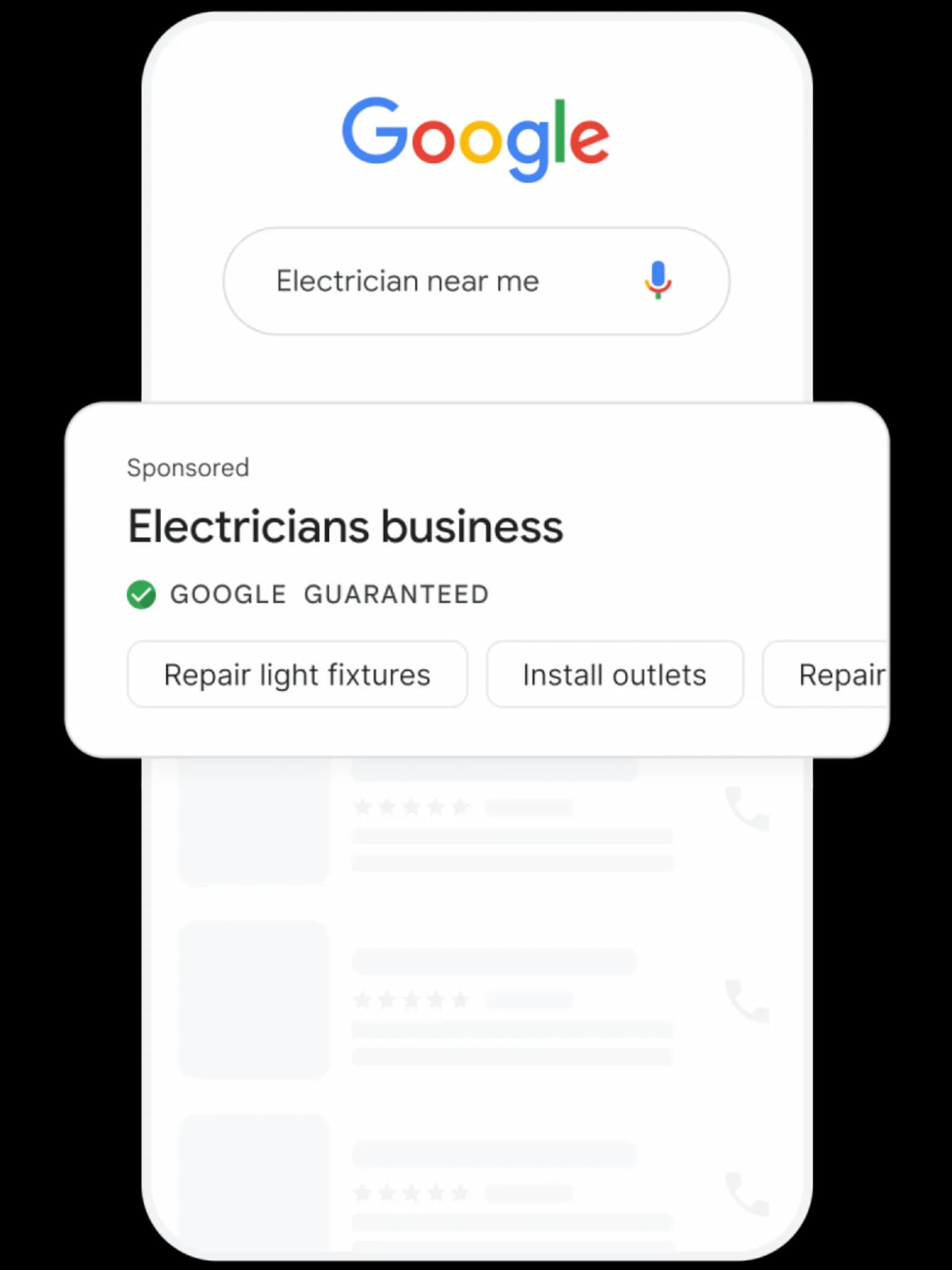
Local Services Ads
Google-screened placement above the Search results, billed per lead rather than per click, and gated behind license and insurance verification. For an installer that already carries the credentials, it is the cheapest qualified-lead surface in the account - and the one most competitors never finish onboarding.
Active demand
Branded + non-brand Search
Non-brand terms carry the demand; branded terms defend it. Aggregators and national lead resellers routinely bid on installer brand names, so we run a brand-defense campaign alongside the acquisition campaigns rather than assuming your own name is safe.
Mobile + after hours
Call-only campaigns
Homeowners researching at 7pm on a phone will tap a number long before they fill a four-field form. Call-only runs on its own budget with its own hours, its own bids, and a call-duration conversion threshold so a 12-second wrong number never gets counted as a lead.
The long consideration window
Demand Gen + remarketing
Solar's consideration window is measured in weeks, not minutes. Demand Gen and remarketing keep the proposal in view between the first quote request and the signature - sized as a supporting line item, never as the primary acquisition channel.
Lead Quality Is the Whole Game
Installers rarely have a volume problem. They have a qualification problem - a calendar full of consultations with renters, with roofs that need replacing first, with utility bills too small to justify a system, and with homeowners who were shopping four companies simultaneously because a reseller sold them all the same form. Every one of those costs a sales rep an afternoon.
So we treat qualification as a media problem, not a sales problem. Disqualifiers go into the headlines. Negative-keyword lists get built against DIY, employment, financing-only, and panel-purchase intent before launch, then pruned weekly from the search-terms report. And the bid algorithm is fed the downstream truth from your CRM instead of the top-of-funnel form.
Homeowner-only qualification
Renters, condo owners, and shaded or north-facing roofs cost you a truck roll and produce nothing. We push disqualifiers into the ad copy and the form itself - ownership, roof age, average utility bill - so unqualified traffic self-selects out before it reaches your sales calendar.
Call tracking with dynamic numbers
Every campaign, and where volume supports it every ad group, gets its own tracked number. Without that, a solar account is optimizing on form fills while the majority of its real pipeline arrives by phone and never touches the bid algorithm.
Offline conversion import
The conversion that matters is a signed install, not a submitted form. We push appointment-set and contract-signed stages from your CRM back into Google Ads so Smart Bidding learns which search terms produce a roof full of panels rather than which produce the most cheap leads.
After-hours answering
A solar lead that rings out is a solar lead your competitor closes. We audit answer rates by hour and day before recommending a budget increase - buying more calls into an unanswered phone is the most common way solar ad spend evaporates.
Budget Follows the Service Area, Not the Calendar
Budgeting for a solar account starts with a map, not a number. We take your license footprint, your crews’ realistic drive radius, and the utility territories where your proposals actually pencil, and we build the geo structure from that - usually radius targeting around each yard or office rather than metro-level targeting, with location settings set to presence rather than interest so you stop paying for people researching solar from another state.
From there, budget is allocated per territory rather than per campaign type, because territories differ enormously. One county has a favorable net-metering tariff, fast permitting, and three competitors; the county next to it has a utility fighting rooftop solar, a nine-week permit queue, and eleven competitors. Those two deserve different bids, different copy, and in some cases a decision not to advertise at all until the operational bottleneck clears.
Timing is policy-driven rather than seasonal. Solar demand moves when incentives change and when utilities announce rate increases - the two moments homeowners suddenly recalculate. We hold reserve budget for those windows instead of spreading spend evenly across twelve months, and we pull spend back when your install calendar is already booked out past the point where a new lead would go cold waiting. That last discipline is unusual in agency relationships and it is the one that protects your close rate.
Every account is owned by a senior strategist. WorkspaceCRM, our proprietary AI platform, watches search terms, call outcomes, and territory-level cost per appointment continuously and surfaces what changed - but the calls on copy, compliance, geography, and when to stop spending are made by a human who has run these accounts before. Start with a free PPC audit, see the rest of our PPC management services, or compare approaches across PPC by industry. Installers running adjacent trades often fold this into a broader contractor marketing program.
Managed Websites by 1Digital®
The Site Your Solar Ads Point At
Every solar click you buy lands somewhere, and a slow or unconvincing page undoes the targeting work before a homeowner ever reaches your calendar. WorkspaceCMS gives installers a managed site built for that landing moment - free on a 12-month plan, with hosting, updates and edits handled for you. Same team that runs the campaigns builds the page they point at.
- Tap-to-call and a consultation request sitting above the fold on mobile
- Fast-loading pages built for evening research on a phone
- Service-area and utility-territory pages that match how you target
- Form and call routing that lands leads in your CRM, not an inbox
Free build on a 12-month plan. Managed hosting and updates included.
 Explore SunWright Solar →
Solar PPC - FAQ
Should we run Local Services Ads or regular Google Ads first?
If you can complete Google’s license, insurance, and background screening, start with Local Services Ads. They sit above the standard results, they carry the Google Screened badge that matters enormously for a five-figure purchase, and you are billed per lead rather than per click - which puts the risk of an unqualified visitor on the platform instead of on you. LSAs alone will not fill a calendar, though; their inventory is capped by search volume in your service area. We run them as the efficient base and layer Search underneath to reach the volume LSAs cannot supply.
How do we stop paying for leads that lead resellers also sold to competitors?
You cannot stop resellers from bidding, but you can stop competing with them on their terms. Three moves do most of the work: bid on tightly geo-fenced local intent rather than broad national head terms, run a permanent brand-defense campaign so your own name is not being sold to a competitor, and write ad copy that names your company, your crews, and your local utility so the click self-selects for someone who wants a specific installer rather than a comparison sheet. The leads are fewer and cost more per click, and they close at a materially better rate.
What conversion should we optimize toward?
Not form fills. A form fill in solar is roughly the beginning of a sales process, and optimizing to it teaches the bidding algorithm to find people who like filling in forms. We instrument the funnel through to booked consultation, and where your CRM supports it through to signed contract, then import those stages back into Google Ads as offline conversions. Bidding then learns which search terms and geographies produce installs. It takes longer to accumulate signal, which is exactly why the first sixty days of a solar account should not be judged on cost per lead alone.
How much of our budget should go to call-only campaigns?
It depends entirely on your answer rate, which is why we audit that before recommending a split. Solar research skews heavily to mobile and to evenings, and a homeowner with a question about their utility bill will call rather than type. But calls only pay off if someone competent picks up: a call-only campaign pointed at a voicemail box converts at zero regardless of bid. We set a minimum call-duration threshold so short and misdialed calls do not count as conversions, then scale the channel in proportion to how reliably your phones are answered.
Can we advertise savings claims and tax-credit messaging?
Carefully. Financing terms, incentive eligibility, and payback claims are among the most scrutinized areas in advertising, by both platform policy and state consumer-protection regulators, and “free solar” style framing is a reliable route to disapprovals or worse. We keep claims specific, qualified, and tied to what your own proposals substantiate, and we keep incentive language current as programs change - stale tax-credit copy is both a compliance exposure and a credibility problem the moment a homeowner checks it.
Should we pause ads when the install calendar is full?
Usually yes, at least partially. Solar leads decay quickly - a homeowner comparing quotes will sign with whoever can schedule a site visit soonest, so buying leads you cannot reach for three weeks funds your competitors’ close rate. When your backlog stretches past the point where a new lead stays warm, we throttle spend, shift the remaining budget toward higher-margin system sizes or commercial work, and hold reserve for when capacity opens. It is the least popular recommendation an agency can make and one of the most profitable.
Request a proposal
Tell us your territories and your close rate
Share your service area, license coverage, current cost per booked consultation, and how calls are handled after hours. A senior strategist replies within one business day with a channel split and a pricing band.