

FOR RESTORATION & WATER DAMAGE COMPANIES
Water Damage Restoration PPC That Buys Booked Jobs, Not Clicks
Restoration paid media is not retail paid media. There is no cart, no feed, and no ROAS number to hide behind - there is a phone that rings at 2 a.m. and a truck that either rolls or does not. We build Local Services Ads, call-only, and Search campaigns around cost per qualified lead and cost per booked job, capped to the drive time your crews can actually hold, and scored on recorded calls rather than click volume.
Trusted by 400+ Brands · Certified Partners




Years in eCommerce
Of results, scale, and quality at the enterprise level.
Expert Team
Specialists across SEO, AI SEO, PPC, design, dev, and strategy.
US Core + Global Talent
US core team for clear communication; vetted global specialists for international client work.
Reputation Score
Rated 4.9/5 across 941+ verified client reviews.
The 1Digital® Difference
AI in our toolkit. Humans in the driver’s seat.
Our strategists, designers, developers, and writers are human. The proprietary AI we built makes them faster and sharper - not the other way around.
- Human strategy
- Human copywriting
- Our own AI tools
- Real growth
Why Paid Search Behaves Differently for Restoration Companies
Most industry PPC programs are built for catalogues: a shopper browses, adds to cart, and the platform reports revenue against spend the same afternoon. Restoration inverts every one of those assumptions. Demand is not created by a promotion - it is created by a supply line letting go, a hard freeze, a roof failing during a storm, or a sewer backing up. It cannot be stimulated, only captured, and it is captured in the minutes immediately after the event. Nobody browses restoration companies. They dial the first result that looks legitimate, and if that call is not answered by a human they dial the next one before the page finishes loading.
That collapses the funnel into a single, expensive moment, and it changes what a campaign is optimizing toward. There is no product revenue to divide by ad spend, so ROAS is the wrong instrument entirely. The number that governs a restoration account is cost per qualified lead and, one step further down, cost per booked job - because raw lead volume in this vertical is deceptive. A large share of restoration clicks come from renters who cannot authorize work, homeowners fishing for insurance advice, people outside the service radius, and job seekers. An account can double its lead count and lose money doing it.
Two more structural facts shape the media plan. First, spend is bounded by geography rather than by inventory. An eCommerce brand scales by adding SKUs and markets; a restoration company scales only as far as its trucks and crews can reach inside a credible response window, so the honest ceiling on a campaign is set by dispatch capacity, not by budget appetite. Second, this is a licensed, credential-screened trade. IICRC certification, state mold licensing where it applies, insurance and bonding are conditions of running Google Local Services Ads at all - and ad copy has to describe what you are licensed to do rather than promise claim outcomes, coverage or insurer approvals you do not control.
Seasonality lands on top of all of it. Baseline demand from appliance and supply-line failures runs year round, but the volume that decides a year arrives in concentrated waves - winter freeze events, regional storm and flood season, and the long tail of mold work that follows both. A campaign built to average monthly spend will be capped exactly when a market's demand triples, and idle in the quiet weeks between. We plan restoration budgets as surge capacity with a floor, not as a flat monthly line.
A wasted click
- Rings out after hours, or lands in a voicemail box.
- Comes from a renter or a researcher who cannot authorize work.
- Sits outside the radius a truck can reach in a credible window.
- Opens a slow page where the number is not tappable.
- Counts as a conversion because the call lasted 30 seconds.
A converting click
- Answered by a person who can dispatch, at the hour it comes in.
- Comes from a property owner with a loss you are licensed to handle.
- Falls inside the drive time your crews hold on a bad day.
- Opens the dialer in one tap, or a page that loads on cellular.
- Is scored booked, and pushed back as the conversion bidding chases.
Water Damage Restoration PPC, step by step
Pay for the clicks that become leads
Every click moves from the ad to your page to a lead, and some fall away at each step. The search terms report shows why: the water damage restoration searches that turn into calls earn more budget, and job seekers and freebie hunters are added as negatives.
- ›Search terms read by a senior strategist, not left to automation
- ›Negative keywords that stop paying for searches that never convert
- ›Budget moved toward the services and searches that book
Campaign mix
Four Channels, Four Different Jobs
Restoration accounts fail most often by running one undifferentiated Search campaign against a keyword set that contains two completely different buyers. We split the account by urgency first and service line second, then let each channel do the thing it is actually good at.
- Stage 01
Local Services Ads
Emergency backbone
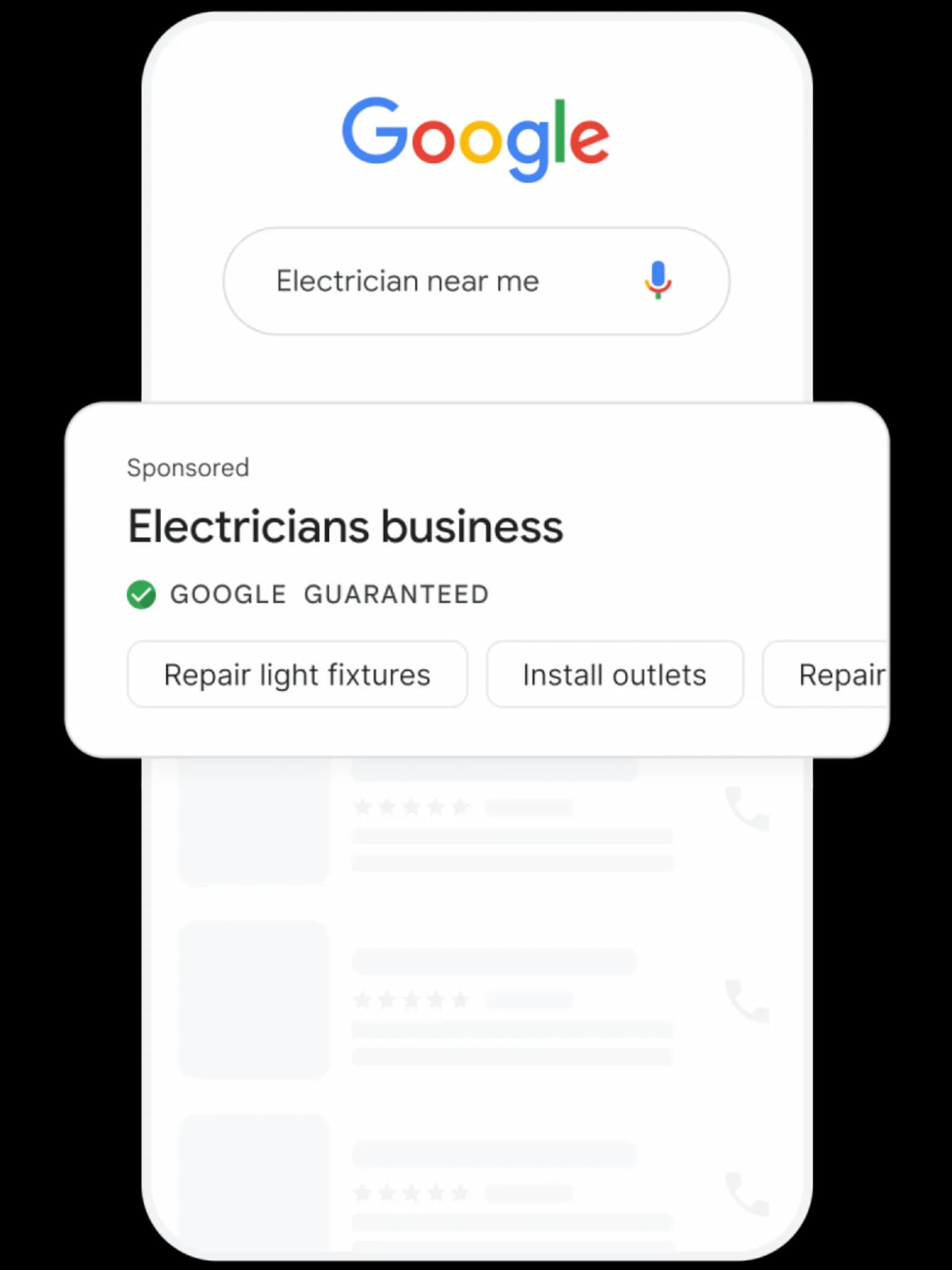
Sits above the Search results, is billed per lead rather than per click, and requires license, insurance and background verification before it can run. For restoration that gatekeeping is an advantage - it thins the field to operators who can actually pass it. We manage the badge, the service categories, the response window, and the dispute queue for leads outside your service types.
- Stage 02
Call-only Search
Crisis keywords
An emergency searcher does not want a landing page. Call-only ads remove the click-to-page-to-tap chain entirely and open the dialer from the SERP. We run them on the crisis half of the keyword set - burst pipe, flooded basement, sewage backup - with dayparting that matches who is actually holding the phone.
- Stage 03
Standard Search + landing pages
Considered demand
The considered half of the demand - mold inspection, fire damage rebuild, insurance claim help - is researched over days across several devices. That traffic needs a real page with credentials, process, and a form, and it converts on a different timeline than the emergency call. Separate campaigns, separate bids, separate success metrics.
- Stage 04
Remarketing & Demand Gen
Long windows & referrers
Used narrowly and deliberately. Nobody is nurtured into a burst pipe, so broad awareness spend is usually waste. Where it earns its place is reconstruction and mold work with long consideration windows, and staying visible to property managers, plumbers and adjusters who refer repeat work rather than convert once.
Emergency urgency →considered & repeat work
Lead quality
The Levers That Actually Move Cost Per Booked Job
In a lead-generation account the platform can only optimize toward the signal you give it. Feed it “phone call longer than 30 seconds” and it will happily buy you conversations with people who cannot hire you. We close that loop by scoring real call outcomes and pushing the qualified ones back into the account as the conversion the bidding algorithm chases.
Answer rate before bid strategy
Every unanswered ring is a paid lead handed to the next pin. Before we touch bids we measure answer rate by hour and by campaign, because a 60-second improvement in pickup usually beats a month of keyword pruning.
Call tracking with recorded outcomes
Dynamic numbers per campaign, recordings scored against real disposition - booked, quoted, out of area, wrong service, spam. Lead volume without disposition data is a vanity metric in this trade.
Radius honesty
We cap geography at the drive time your trucks can actually hold on a bad day, not at the map you wish you covered. Bidding on jobs you arrive late to buys one-star reviews at full CPC.
Negatives for the DIY and job-seeker slice
Restoration queries attract renters, students, insurance-policy researchers and people looking for work. That traffic is expensive and never books. Search-term review is weekly, not quarterly.
Storm-surge budget rules
Freeze events and severe storms move a market's demand in hours. Budgets, bid caps and pacing are set in advance so a surge is captured instead of throttled at noon on the day it matters.
Lead value by job ladder
A mitigation call and a reconstruction lead are not worth the same money. Targets are set per service line so the account can pay more for the leads that carry the bigger contract.
Budget, Service Area, and Knowing When to Stop Spending
The first budget conversation we have with a restoration owner is about capacity, not money. How many mitigation jobs can you start in a day, how far will you drive at 3 a.m., and who answers between midnight and six? Those three answers set the geography, the dayparting, and the ceiling. Buying emergency clicks in a ZIP code you reach in ninety minutes is not growth - it is buying a bad review at full price, and in a map-driven trade that review will cost you more than the job was worth.
From there we build the account as concentric rings. The core radius, where response is fastest and reviews are densest, carries the aggressive bids and the call-only inventory. Outer rings run at lower bids and lean toward form-fill and planned work - mold, contents, reconstruction - where an extra thirty minutes of drive time does not lose the job. Franchise and multi-territory operators get the same treatment per territory, so one market's surge does not quietly drain another's budget.
Paid media also does not stand alone here. The map pack and organic results sit directly beneath the ads on the same emergency query, and the review profile that qualifies you for a Local Services badge is the same profile that decides whether the searcher taps you or the pin below you. Restoration companies that run restoration SEO alongside paid pay less per lead over time, because the two channels compound on the same trust signals. A free PPC audit is the usual starting point - we look at your search terms, your call recordings and your geography before proposing a number.
Ad Copy Inside the Guardrails of a Licensed Trade
Restoration advertising touches insurance, health, and licensed work all at once, which narrows what a headline is allowed to say. Claim outcomes are not yours to promise - an ad that implies coverage, deductible waivers, or adjuster approval creates exposure for the company and, in several states, runs into rules governing who may advise a policyholder on a claim. Mold is tighter still: where states license assessment and remediation separately, the copy has to reflect what your license permits rather than blur the two.
What does convert, reliably, is specificity about response. Answered in person, arrival window, equipment on the truck, IICRC-certified technicians, direct billing experience, years serving the named town. Those are verifiable, they survive review by a cautious homeowner, and they carry into the Local Services profile and the landing page without rewriting.
Why 1Digital® Runs Restoration Paid Media Differently
Every account is owned day to day by a senior strategist - the person reading your call recordings is the person changing your bids. WorkspaceCRM, our in-house AI, handles the volume work underneath: search-term monitoring across urgency segments, anomaly detection when a freeze or storm moves a market overnight, and lead-disposition patterns that would take a human days to surface. The judgment calls - what a lead is worth, where the radius stops, which copy is safe to run - stay with people. See the rest of our PPC services for how the same team handles paid across other verticals.
Managed Websites by 1Digital®
The Ads Are Only Half The Job
A restoration click is bought at emergency prices, and it is spent the second the page opens. If the number is not tappable, the load is slow on cellular, or the service area is unclear, that money is gone before anyone reaches your dispatcher. WorkspaceCMS gives restoration companies a managed site built for exactly that moment - built free on a 12-month plan, then kept current by our team.
- Tap-to-call above the fold on every page, on the phone they are holding
- Fast mobile loads so a cellular connection in a flooded basement still converts
- Service-area pages that state the towns and drive times you actually cover
- Emergency and planned-work forms routed straight to the person on call
Free build on a 12-month plan. Managed hosting and updates included.
 Explore Pristine Clean Co. →
Request a proposal
Tell us about your service area and crews
Share your territories, service lines, and who answers after hours. A senior strategist replies within one business day with a pricing band and a draft channel plan.
Water Damage Restoration PPC - FAQ
Should we start with Local Services Ads or standard Google Search?
For most restoration companies, Local Services Ads first. They sit above the paid Search results, they are billed per lead rather than per click, and the license, insurance and background verification required to run them screens out a portion of the field. The catch is that verification takes time and the categories are coarse, so LSAs alone will not cover every service line you sell. We typically stand LSAs up as the emergency backbone, then add call-only and standard Search to reach the mold, fire and reconstruction demand LSAs handle poorly.
How do you measure success if there is no cart or revenue number?
Cost per qualified lead first, then cost per booked job. Every campaign gets its own tracking number, calls are recorded and scored against real dispositions - booked, quoted, out of area, wrong service, spam - and only the qualified ones are pushed back as conversions for the bidding algorithm to chase. Without that step, the platform optimizes toward call duration and cheerfully buys long conversations with renters and insurance researchers. Lead count on its own tells you nothing in this vertical; the disposition split tells you everything.
What happens to our campaigns during a freeze or a major storm?
Demand can move several times over within hours, and the default failure is a daily budget exhausting by mid-morning on the single most valuable day of the quarter. We agree surge rules in advance: which markets trigger, how far budgets and bid caps lift, and - critically - the capacity signal at which we throttle back down. Selling jobs you cannot start for a week is worse than not bidding, because the reviews follow you into the map pack. Surge planning is a capacity conversation with your dispatcher, not just a budget one.
Can PPC ads mention insurance claims or say we bill the carrier directly?
Carefully, and never as a promise of outcome. You cannot advertise that a claim will be approved, that a deductible will be waived, or that an insurer has authorized you, and in several states advising a policyholder on a claim is itself regulated. What is safe and effective is describing your own capability - experience with direct billing, documentation practices adjusters accept, and the certifications you hold. Mold copy gets tighter still where a state licenses assessment and remediation separately; the ad has to match what your license actually permits.
What ad budget does a single-market restoration company need?
The honest answer starts with capacity rather than a number. How many mitigation jobs can you start in a day, how far will a truck drive at 3 a.m., and who answers overnight - those three answers set the geography and the ceiling before money enters the conversation. From there we size spend to fill the schedule inside the radius you can defend, hold a reserve for surge weeks, and expand only when answer rate and booking rate hold at the current volume. We put a band on your specific market after reviewing search terms and call data.
Do we still need SEO if paid search is producing calls?
They compound, and dropping one raises the cost of the other. The map pack and organic listings sit directly under the ads on the same emergency query, so a searcher often sees you two or three times before dialing. More concretely, the review volume and rating that qualify you for a Local Services badge and lift your ad rank are the same signals that decide local rankings. Companies running restoration SEO alongside paid generally see paid cost per lead fall over time, because the trust work benefits both channels at once.