

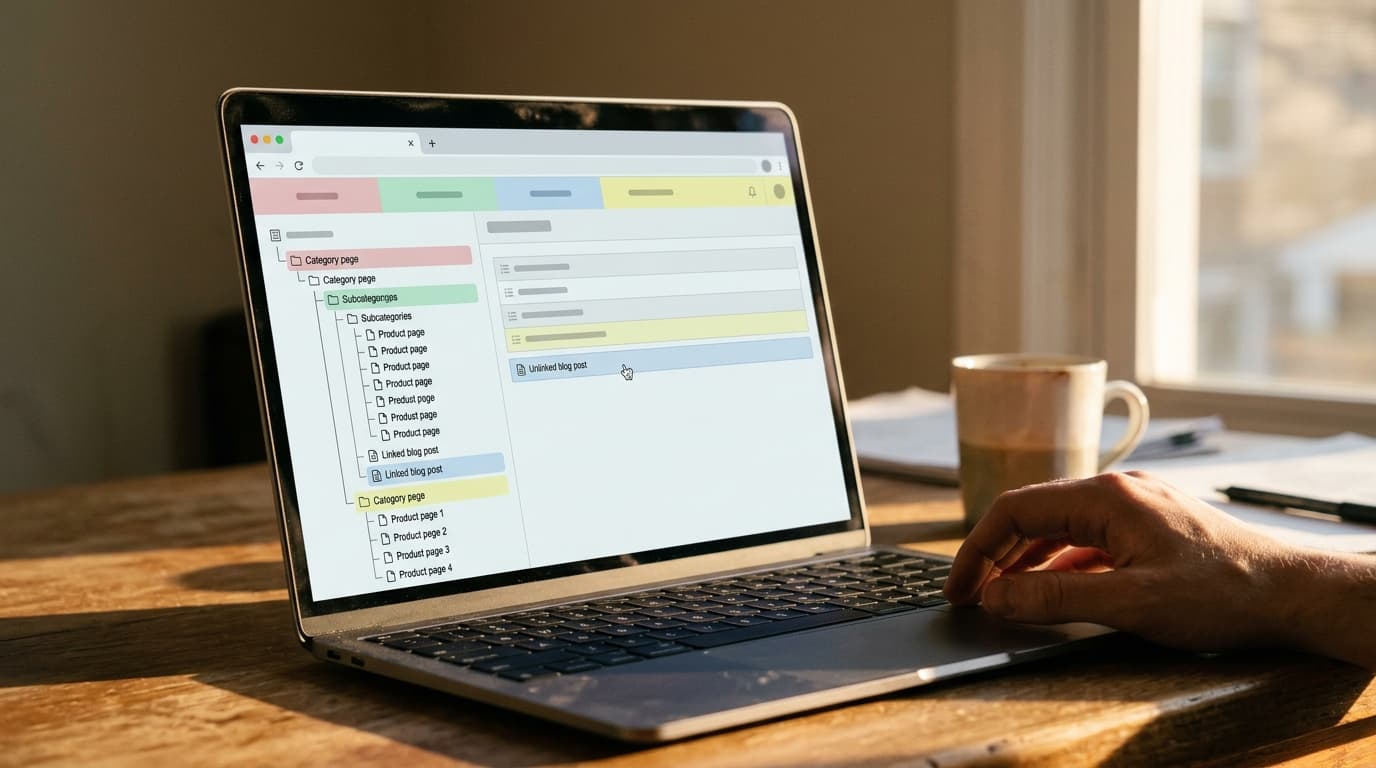
Topical authority is the measure of a search engine's trust in your website as a comprehensive expert for a defined subject. For ecommerce, this means your store's entire domain - from product pages to blog posts - answers every conceivable question a buyer might have about your niche and the products within it, establishing you as the definitive resource.
The Hype You Can Ignore
Every few years, SEO gets a new piece of jargon that's treated like a magical revelation. "Topical authority" is the current one. It’s collecting the same breathless think pieces that claim all old SEO is dead and you need to rewrite your entire strategy around this one concept. It is none of that.
Topical authority is not about publishing hundreds of blog posts. It is not a replacement for good technical SEO or a strong backlink profile. It is a formal name for a very old idea: being the best, most complete resource for your specific audience. The difference now is that Google's understanding of topics, or entities, is sophisticated enough to measure and reward this comprehensiveness directly.
Failure Mode: The Disconnected Blog
Most ecommerce stores that attempt "content marketing" get it wrong, and the failure is almost always the same. They treat their blog as a separate website that just happens to live on the same domain. They write about industry news, tangential lifestyle topics, or fluffy listicles that have a weak connection to the products they actually sell.
The mistake is thinking that any content is good content. It is not. When your blog about "5 Summer Style Trends" doesn't strategically link to your summer dresses category page and specific product pages, you've built an island. Google sees an informational asset over here and a commercial one over there, with no bridge between them. No authority is passed; no user is guided from curiosity to purchase. You end up with two weak sites instead of one strong one.
Authority is Architecture, Not Just Articles
Building topical authority is an act of site architecture first and content creation second. It requires structuring your site into logical hubs of expertise that mirror your product categories. The visible content is the final step; the invisible substrate of planning and linking is what makes it work.
The model is a hub and its spokes.
- The Hub: This is your central pillar page. For most stores, this should be your main product category page (e.g., "Men's Running Shoes") or a definitive, long-form guide that covers a major topic.
- The Spokes: These are the supporting pieces of content that address specific subtopics, questions, or product variations. This includes sub-category pages ("Trail Running Shoes"), blog posts ("How to Choose a Running Shoe for Flat Feet"), comparison guides ("Nike Pegasus vs. Brooks Ghost"), and even individual product pages.
Every spoke must link inward to the hub. The hub, in turn, links out to its most important spokes. This structure creates a dense, interlinked web of content that signals a deep and organized expertise on a topic. The product pages sell the item; the surrounding content sells the expertise.
A 3-Step Framework for Building Niche Authority
This isn't a vague strategic goal. It's a systematic process of auditing, mapping, and creating content that directly supports your commercial goals.
Step 1: Audit Your Topic Footprint
You can't build on a foundation you don't understand. The first step is to identify your core topics and map every existing URL on your site to one of them. Your primary product categories are your starting point. If you sell cookware, your core topics might be "Cast Iron Skillets," "Non-Stick Pans," and "Dutch Ovens."
For each core topic, list every question a potential customer might have. Use tools like Ahrefs or SEMrush to find "People Also Ask" questions, or just use common sense.
- Buying Guide Questions: What's the best cast iron skillet for a beginner?
- Comparison Questions: Cast iron vs. stainless steel?
- Usage Questions: How do you season a cast iron pan?
- Problem/Solution Questions: Why is my food sticking?
This audit produces a gap analysis. It shows you which questions you already answer and, more importantly, which ones you don't.
Step 2: Design Your Topic Cluster Map
The output of the audit becomes the input for your architecture plan. The goal is to create a topic cluster map - a blueprint for your content and internal linking.
For each core topic, you will designate a pillar page (your hub) and then map out all the supporting content (your spokes). Let's use the example of a store selling high-end running gear.
- Pillar/Hub Page: `/collections/trail-running-shoes`
- Cluster/Spoke Content:
- A blog post: "The 5 Best Trail Running Shoes for Rocky Terrain"
- A guide: "How to Clean Muddy Running Shoes"
- A comparison: "Hoka Speedgoat vs. Altra Lone Peak"
- Supporting product pages for each shoe mentioned
Our internal process generates this map as a literal spreadsheet. It lists the target keyword for each piece, the URL it will live at, the pillar page it must link to, and its priority in the editorial calendar. This is a strict policy, not a guideline. It turns an abstract SEO concept into a concrete production schedule.
Step 3: Create and Interlink with Precision
With the map in hand, execution becomes straightforward. You create the content needed to fill the gaps. The crucial step is the internal linking. It's what transforms a list of articles into an authority structure.
The rule is simple: every spoke page must link to its hub page using relevant anchor text. A blog post on "The Best Trail Running Shoes" must link back to the `/collections/trail-running-shoes` category page. This flow of link equity and topical relevance is what tells Google that your category page is the most important resource on this topic on your site.
The Honest Tradeoff: This Is a Slow-Burn Strategy
Here’s the part most agencies leave out. Building true topical authority is slow, deliberate work. It requires significant investment in high-quality research and writing (or video production). It is the opposite of a quick-win SEO hack.
You will not see results next month, or even next quarter. You are building a foundational asset. The honest version is slower but compounds; the fast, cheap version built on low-quality AI content gets you nowhere and risks penalties. The goal isn't to trick an algorithm. It's to build a resource so good that it becomes a competitive moat your rivals can't easily cross.
Closing the Loop: From Audit to Roadmap
This process should not end as a theoretical exercise. The topic cluster map created in step two becomes the content roadmap for your next two quarters. It hands off directly into your editorial planning, dictating exactly what needs to be created, updated, and interlinked to build measurable authority in your niche.
Topical Authority for Ecommerce: How to Dominate Your Niche FAQ
What is the difference between topical authority and domain authority?
Domain authority is a third-party metric (from companies like Moz and Ahrefs) that estimates a site's overall backlink strength. Topical authority is a concept describing Google's perception of a site's expertise and comprehensiveness on a specific subject, which is influenced by content structure, depth, and internal linking.
How long does it take to build topical authority for an ecommerce site?
For a new site in a moderately competitive niche, expect to see initial traction in 6-9 months, with significant authority developing over 12-18 months of consistent, high-quality content creation and strategic interlinking.
Can I use AI to create content for topical authority?
You can use AI for research and outlining, but relying on it for final drafts is a mistake. AI-generated content often lacks genuine expertise, nuance, and originality - the very qualities needed to establish authority. Every piece should be heavily edited and fact-checked by a human expert. The failure mode to avoid is publishing generic, unedited AI output that adds no unique value.
Do I need a blog to build topical authority?
A blog is the most common and effective tool, but it's not strictly necessary. You can also build authority through comprehensive guides, detailed FAQs, glossaries, and video content integrated into your site structure. The format is less important than the quality, depth, and strategic interlinking of the information.