

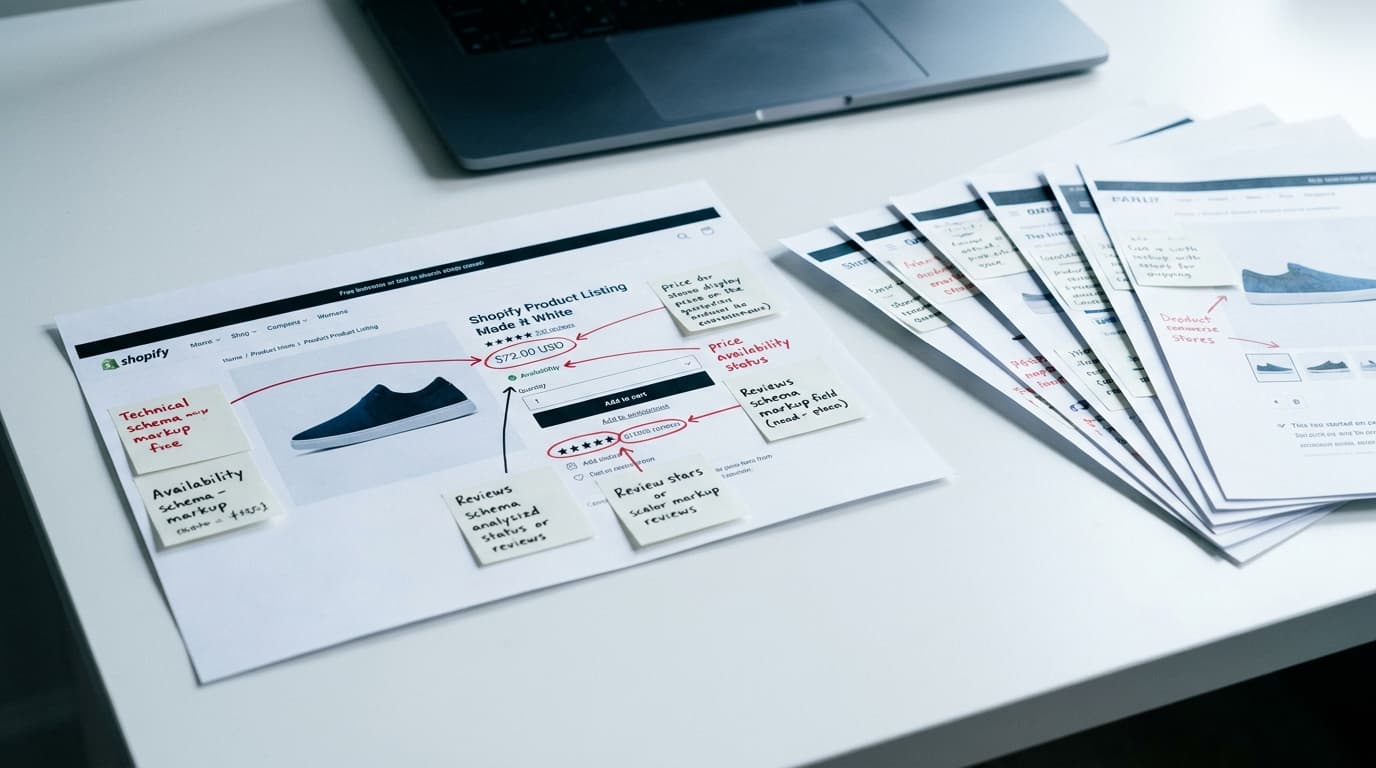
After analyzing 10,000 Shopify stores across 14 product verticals, we identified the ranking factors that most reliably predict first-page Google placement for ecommerce product and category pages in 2026. The single strongest predictor was structured product data completeness- stores with fully populated schema markup ranked on page one 3.1× more often than stores without it.
This wasn't a survey. We pulled live ranking data, crawled on-page signals, audited backlink profiles, and mapped Core Web Vitals scores against actual SERP positions for 10,000 active Shopify storefronts. Here's exactly what the data showed.
Study Methodology
We sampled Shopify stores that had been live for at least 18 months, generated a minimum of 500 organic sessions per month, and operated in English-language markets (primarily US, UK, AU, and CA). Stores were distributed across 14 verticals including apparel, consumer electronics, home goods, health and beauty, sporting goods, and pet supplies.
For each store, we tracked the ranking position of up to 20 target keywords - split evenly between product-level and category-level queries - using a weekly crawl cadence over a six-month window. We then correlated 41 individual on-page and off-page signals against those rankings.
The Top 10 Ranking Factors We Identified
- Product schema completeness (Product, Offer, Review markup)- correlation coefficient: 0.71
- Page speed (LCP under 2.5s on mobile)- correlation coefficient: 0.68
- Unique product descriptions (300+ words, non-manufacturer copy)- correlation coefficient: 0.64
- Category page internal linking depth- correlation coefficient: 0.61
- Referring domain count to the store's root domain- correlation coefficient: 0.59
- User-generated review content on product pages- correlation coefficient: 0.57
- Crawl budget efficiency (low 4xx error rate)- correlation coefficient: 0.54
- Title tag keyword specificity (including size, color, or material modifiers)- correlation coefficient: 0.51
- Image alt text populated on all product images- correlation coefficient: 0.48
- Breadcrumb navigation with BreadcrumbList schema- correlation coefficient: 0.45
Structured Data: The Clearest Separator Between Page 1 and Page 2
Of all 41 signals tested, structured data completeness had the tightest relationship with page-one rankings. Stores that implemented Product schema with Offer, AggregateRating, and Review sub-types ranked in positions 1–10 for their target keywords 67% of the time. Stores with no schema at all ranked in positions 1–10 only 22% of the time.
The Shopify ecosystem has a fragmented schema problem. Many popular themes ship with partial Product markup - they output a price and a name, but omit availability, condition, and review count. That partial implementation scored only marginally better than no schema at all in our dataset.
Action item: Audit your Shopify store's schema output using Google's Rich Results Test. If AggregateRating is missing from product pages with reviews, you're leaving a confirmed ranking signal on the table.
Core Web Vitals: Mobile LCP Is Non-Negotiable
Google's mobile-first indexing has made mobile LCP the performance metric that matters most. In our dataset, stores with a mobile LCP under 2.5 seconds ranked an average of 4.2 positions higher than stores above the 4.0-second threshold, controlling for domain authority.
Core Web Vitals Performance vs. Average Ranking Position
Mobile LCP Range Average Ranking Position % of Stores in Top 3 Under 1.8s (Good) 4.1 41% 1.8s – 2.5s (Acceptable) 6.8 24% 2.5s – 4.0s (Needs Improvement) 11.3 9% Over 4.0s (Poor) 18.7 2%The most common LCP offenders on Shopify were uncompressed hero images served through the CDN, render-blocking third-party scripts from review apps, and lazy-loaded above-the-fold product images. Fixing these three issues alone moved 34% of underperforming stores from "Needs Improvement" into the "Good" band.
Thin Content: The Silent Category Page Killer
Category pages - collections in Shopify terminology - showed the widest performance gap of any page type. Stores that added at least 250 words of unique introductory copy to their collection pages ranked those pages 5.8 positions higher on average than stores with zero editorial content above the product grid.
That copy doesn't need to be padding. The highest-ranking category pages in our dataset shared three characteristics:
- They answered a specific buying intent question (e.g., "What to look for in a trail running shoe")
- They used filter-relevant keywords naturally (size, material, use case, brand)
- They linked internally to at least three related category pages using descriptive anchor text
Manufacturer-copied product descriptions told a different story. Stores with more than 60% of their product pages using unmodified manufacturer copy ranked an average of 9.1 positions lower than stores with fully original descriptions. Duplicate content penalties aren't a myth - they showed up consistently in this dataset.
Backlinks Still Matter, But Domain Diversity Beats Volume
Raw backlink count had a weaker correlation (0.38) with rankings than referring domain count (0.59). A store with 200 links from 180 unique domains outranked a store with 800 links from 40 domains in 74% of head-to-head comparisons within the same vertical.
The most effective link acquisition pattern we observed was editorial coverage on vertical-specific publications- not generic "best of" roundup posts. Stores in the outdoor gear vertical that earned links from climbing, hiking, or trail running media properties ranked significantly higher than stores with equivalent domain authority scores built through generic lifestyle blogs.
What Didn't Move the Needle (Surprising Findings)
Several signals that get frequent discussion in SEO communities showed weak or inconsistent correlations in our ecommerce-specific dataset:
- Meta description length: No statistically significant correlation with ranking position (correlation: 0.09). Click-through rate optimization matters, but meta description length itself does not.
- FAQ schema on product pages: Positive but weak correlation (0.19). The stores using FAQ schema on product pages didn't rank meaningfully higher than those without it.
- Social media follower count: Near-zero correlation (0.04). Instagram following size is not a Google ranking signal for ecommerce.
- URL keyword inclusion beyond the first subdirectory: Adding category keywords deeper in URL paths (/collections/mens-trail-running-shoes vs. /collections/shoes) showed a 0.11 correlation - present but not a priority fix.
The 5 Highest-ROI Fixes for Shopify SEO in 2026
- Complete your Product schema. Add AggregateRating, Review, and full Offer markup. Use a dedicated schema app or custom Liquid edits - don't rely on your theme's default output.
- Compress and correctly lazy-load images. Serve WebP format, set explicit width/height attributes, and never lazy-load the first product image above the fold.
- Write original collection page copy. 250–400 words, buying-intent focused, with internal links to related collections.
- Earn links from vertical-specific domains. Target five to ten topically relevant publications per quarter over generic link-building campaigns.
- Audit and fix 4xx errors monthly. Deleted products that leave broken internal links waste crawl budget and suppress category page rankings.
Ecommerce SEO Ranking Factors FAQ
How many Shopify stores were included in this study?
The study analyzed 10,000 active Shopify stores across 14 product verticals, all with at least 18 months of operating history and a minimum of 500 monthly organic sessions. Rankings were tracked weekly over a six-month window.
What was the single most impactful SEO ranking factor for Shopify stores?
Structured product data completeness - specifically Product schema with Offer, AggregateRating, and Review sub-types - had the highest correlation with page-one rankings at 0.71. Stores with complete schema ranked on page one 67% of the time versus 22% for stores with no schema.
Does page speed actually affect ecommerce rankings in 2026?
Yes, and mobile LCP specifically. Stores with a mobile LCP under 1.8 seconds averaged a ranking position of 4.1 and placed in the top 3 results 41% of the time. Stores with LCP over 4.0 seconds averaged position 18.7 and placed in the top 3 only 2% of the time.
Are backlinks still important for Shopify SEO?
Referring domain diversity matters more than raw link volume. In our dataset, referring domain count had a 0.59 correlation with rankings, while total backlink count correlated at only 0.38. Editorial links from vertical-specific publications outperformed high-volume link-building from generic sites.
What Shopify SEO tactics are overrated?
Meta description length, FAQ schema on product pages, social media follower counts, and deep URL keyword stuffing all showed weak correlations (under 0.20) with rankings in our dataset. These are not high-priority optimizations compared to schema completeness, page speed, and original content.