

Enhance The Customer and Merchant Experience With Magento Updates
Magento is at the forefront of the eCommerce industry as one of the most popular eCommerce platforms for merchants to use for their storefront. It has over 250,000 merchants across the globe selling their products using the Magento platform. As a Magento store owner, you can make the most out of your business using the Magento platform. Magento clients include top companies like Burger King, Charlotte Tilbury, Peet’s Coffee & Tea, Coca-Cola, Ghirardelli, and Christian Louboutin. Magento is dedicated to staying ahead of customer trends and needs with continuous enhancements and Magento updates to the software and platform. They are committed to ensuring best in class innovation and boosting your sales while shrinking your costs.
As certified experts in Magento, we can attest to the fluidity and comprehensiveness of their updates. Magento is dedicated to enhancing both the client and customer experience through their platform, and there are some recent Magento updates to take advantage of in the upcoming year.
Magento Updates Software With Magento 2
Magento delivers on their dedication to the constant enhancement and streamlined experience for the Magento store owner with Magento 2! They know that every detail matters when it comes to an eCommerce store; it’s essential that the storefront is the best possible experience for the customer to give the business the best possible revenue. In Magento 2, these details are updated and enhanced to target and remove any friction in the Magento merchant and customer experience.

The first update in Magento 2 is aimed at better payment functionality across all fronts. The first update gives customers the option to save their PayPal information at checkout to bypass it in the future in the hopes of higher rates of conversion for visitors to customers. Another update geared towards boosting sales is allowing guest checkouts to still save their payment information within the site/browser. That way, they don’t have to have a registered account with your eCommerce business if they don’t want to, but they can experience a more streamlined checkout by using their previous payment information. Magento 2 also utilizes Braintree software to reduce chargebacks and support calls as well as protecting your business from high-risk customers. Magento 2 has a new process using Braintree to confirm a risk decision before shipping to a potentially high-risk customer.
Magento 2 also has improvements to performance and features. First of all, Magento admin is going to be much faster when managing products with hundreds of variations. SQL media queries have gone through an optimization process for Magento 2 to make your storefront performance even more quickly than before.
Magento Business Intelligence Essentials
Magento acquired RJMetrics last year, and since then they have been discussing analytics with some their merchants. They wanted to find out what merchants needed for analytics, and Magento delivered with their Business Intelligence Essentials.

Magento Business Intelligence offers you advanced analytics to better your Magento storefront. With Magento BI, you can make more informed decisions about your eCommerce business because you’ll be equipped with data to drive your choices. Magento BI Essentials allows you to acquire day-to-day data and metrics about your business such as top customers, revenue level, and AOV. You can separate your data into specifics like top performing categories or customer segments, and gain data on customer loyalty and repeat revenue. You can use the data to compile reports to send to the rest of your team or to send to the stakeholders in your business. The features included in Magento Business Intelligence Essentials are five pre-built dashboards that compile 75 different reports, summaries for your email, the ability to export raw data into Excel, gathered data from both Magento and Google analytics, and more!
If you want even more access to data, you can also get Magento Business Intelligence Pro. With BI Pro, you can customize your baseline offering, as well as customize your infrastructure for data acquisition to gain more data visibility. And you can gain even more data by being able to add unlimited data sources beyond Magento and Google Analytics.
Bluefoot CMS And Page Builder Module For Magento
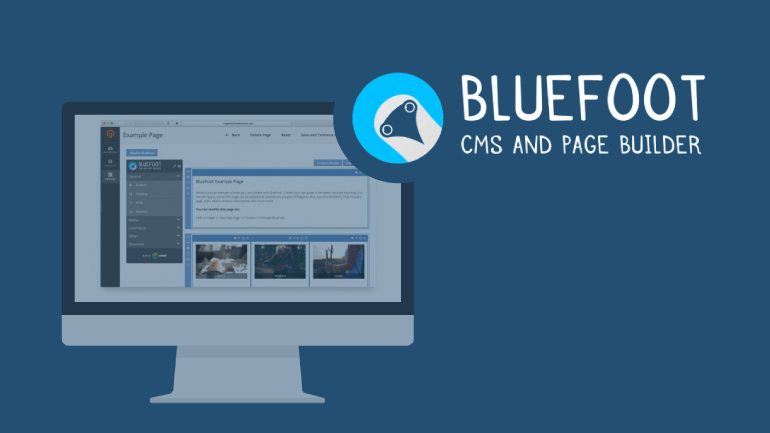
Recently, Magento has acquired the technology behind Bluefoot CMS and Page Builder to enhance the Magento experience. Magento’s belief and goal with this integration was that it would improve the merchant’s experience and empower them to have more creativity and control over a variety tools to manage their site layout.
There are four main updates to increase merchant control over the content and site design of their Magento storefront. First, increased drag and drop functionality. This makes it much easier to add things like headers, images, products, and more as content by using drag and drop. Second, easier product-content integration. With this, you can just drag and drop products into pre-existing or standard content elements (like blogs or promotional pages). Third, simple third-party content integration. This makes it much easier for the merchant to integrate third-party content like YouTube videos, Google Maps, Vimeo video, and more to the various pages of their store. And last but not least, static block integration. This allows the merchant to seamlessly integrate static blocks into content areas for easier design capabilities.
Magento Partner 1 Digital Agency
1 Digital Agency as a team of certified experts in Magento, all dedicated to providing you with a full service Magento experience. As a Magento partner, our team knows everything there is to know about Magento, including staying on top of all of their recent Magento updates. We have an extensive list of clients who we have helped with everything from the beginning stages of design and development for their Magento eCommerce storefront, to digital marketing to increase their customer base.
Our full Magento services include design and development (with experts in code and customization for the best Magento design), data migration, and digital marketing. Whatever you need accomplished for your Magento eCommerce store to reach its fullest potential and to meet all your business goals, we can help. Call us at 888-982-8269 or contact us to keep your Magento store updated and at its best.
Editorial note: this article was written in 2017, when "Magento 2" was a recent release and the platform referenced features from acquisitions of that era (an analytics product later folded into Adobe's reporting stack, and a visual page-building module later superseded by the native Adobe Commerce Page Builder). Magento was acquired by Adobe in 2018; the commercial edition is now Adobe Commerce and the free edition is Magento Open Source. The original commentary is preserved as a record of where the platform was, and the section below brings the guidance current so the article is still useful to a merchant evaluating the platform today.
Where the Magento Platform Actually Stands Now
The strategic point of the original post - that the platform keeps investing in checkout, payments, content control, and analytics - still holds; the specifics have moved on. The current decision a merchant faces is between Adobe Commerce (the licensed edition, with built-in B2B, advanced merchandising, native page building, and Adobe's analytics and personalization stack) and Magento Open Source (the free, self-hosted edition you extend yourself). The Bluefoot-era page builder discussed above is now native Page Builder in Adobe Commerce, and the RJMetrics-derived analytics has been absorbed into Adobe's reporting and intelligence tooling. The takeaway for a store owner is unchanged in spirit: the platform's value is real but only realized with deliberate implementation, not by adopting defaults.
What Actually Moves the Needle on a Magento/Adobe Commerce Store
Across the builds we've worked on, the recurring high-leverage areas are consistent regardless of which platform version you're on. Performance is first: Magento-family stores are powerful but heavy, and full-page caching, image optimization, and a disciplined extension footprint are what separate a fast catalog from a slow one - and page speed directly affects both conversion and rankings. Catalog and indexing structure is second: large catalogs need clean attribute and category architecture and well-managed indexers, or admin operations and storefront speed both degrade. Checkout is third: every version of this platform has invested in reducing checkout friction, and using those capabilities (guest checkout, saved payment, fewer steps) correctly is where conversion is won. Extension discipline is fourth and the most underrated - every third-party module is a dependency that can break on upgrade, so a smaller, well-chosen set beats a sprawling one.
The Upgrade Question, Honestly
The single most consequential decision for stores still running older Magento builds is upgrade planning. Major version upgrades in this ecosystem are real projects, not patch installs, because themes and extensions frequently need rework. The practical guidance is to treat an upgrade like a migration: audit the extension footprint first, budget for theme and integration rework, stage and test thoroughly, and preserve URLs and redirects so SEO equity carries over. Stores that defer this indefinitely accumulate security and compatibility risk that eventually forces a rushed, more expensive move.
Frequently Asked Questions
Is Magento the same as Adobe Commerce? Adobe Commerce is the licensed edition built on the same core; Magento Open Source is the free edition. Adobe acquired the platform in 2018; "Magento" now generally refers to the open-source edition.
Is the platform still worth it for mid-market merchants? Yes, where catalog complexity, B2B requirements, or deep ERP integration justify it - that has always been its sweet spot. Simpler single-product stores are usually better served by a hosted SaaS platform.
What's the biggest hidden cost? Maintenance and upgrades. The platform's flexibility comes with an ongoing engineering commitment that should be budgeted as a recurring cost, not a one-time build.
The platform keeps evolving - the names change, the investment in checkout, content, and analytics does not. As a certified partner, the Magento and Adobe Commerce team at 1Digital® Agency handles design, development, data migration, upgrades, and digital marketing so your store stays current and performant. Call 888-982-8269 or contact us to keep your store at its best.