
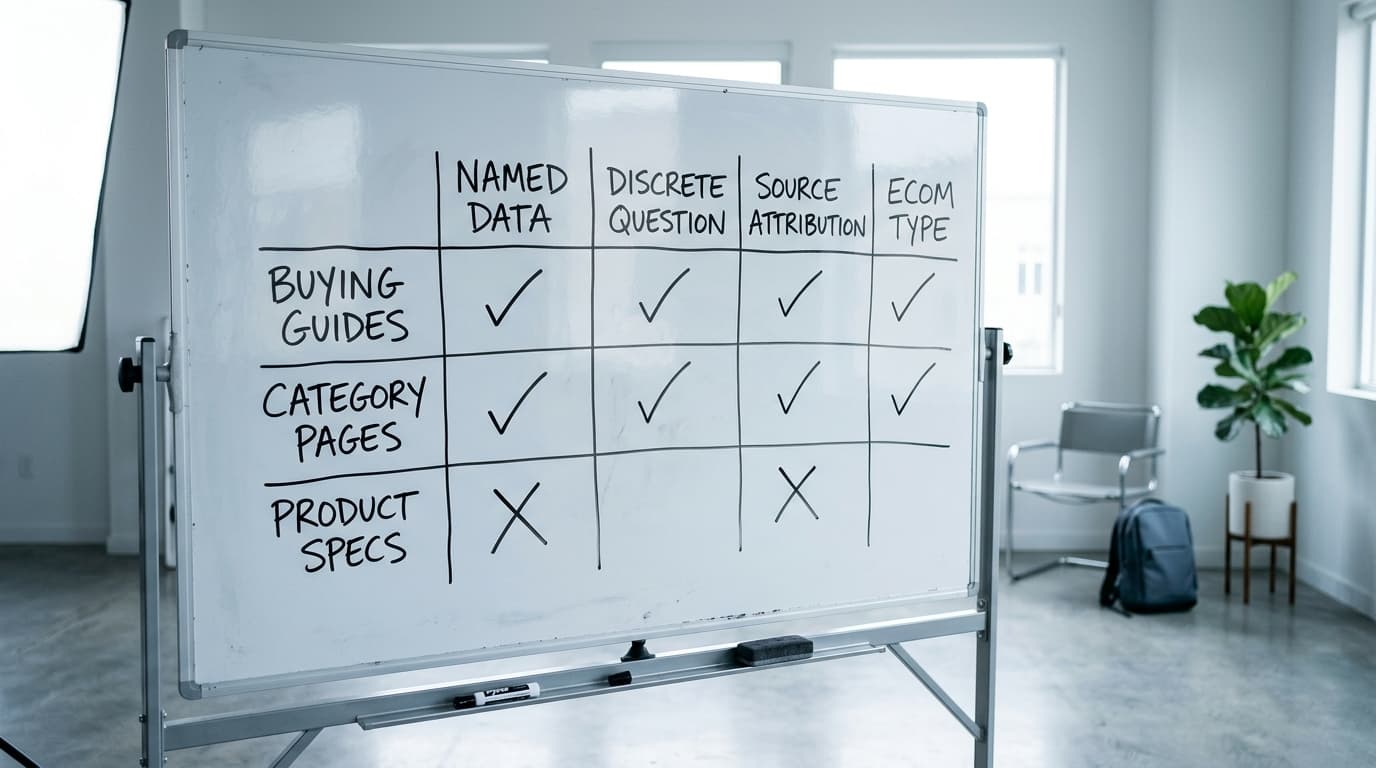
AI systems cite content that is specific, structured, clearly sourced, and answers a discrete question within the first 200 characters of a passage. For ecommerce brands, this means product pages, buying guides, and category content built around vague marketing language are almost never pulled into AI-generated answers, while pages anchored in named data, comparison structures, and explicit attribution regularly appear in generative engine results.
Generative engine optimization (GEO) is now a distinct discipline from traditional SEO. Where traditional SEO rewards pages that accumulate backlinks and keyword density, GEO rewards pages that function as self-contained factual units. This post reverse-engineers the citation patterns of large language models to give ecommerce teams a concrete checklist they can act on today.
How LLMs Decide What to Cite
Large language models retrieval-augmented generation (RAG) pipelines, and AI search layers such as Perplexity and Google AI Overviews operate on a shared logic: they retrieve candidate passages, score them for relevance and confidence, and then synthesize an answer. The citation decision happens at the scoring stage, not the synthesis stage. A passage wins a citation slot when three conditions align.
First, the passage answers the query with minimal inferential leap. If a user asks "what is the average return rate for apparel ecommerce," a passage that opens with "Apparel ecommerce return rates averaged 24% in 2024, according to a National Retail Federation report" scores immediately. A passage that opens with "Returns are a challenge every fashion retailer faces" requires the model to do interpretive work before extracting signal, which reduces citation probability.
Second, the passage contains at least one verifiable named entity: a brand name, a publication, a year, a percentage, or a product specification. Named entities anchor the passage in a knowledge graph that the model can cross-reference against its training data. Generic claims like "many shoppers prefer fast shipping" carry no verification handle and are treated as noise.
Third, the passage is structurally separable. LLMs parse HTML semantics. A claim wrapped in a <p> tag inside a well-labeled <section> or preceded by a clear <h2> is easier for a retrieval pipeline to extract as a discrete unit than the same claim buried inside a long, unparagraphed block of text.
The Six Content Characteristics That Drive AI Citation
A 2025 Princeton and Georgia Tech analysis of AI Overview citation patterns found that pages cited by generative search engines shared six measurable characteristics at significantly higher rates than uncited pages. The findings directly apply to ecommerce content strategy.
| Characteristic | Why It Drives Citation | Ecommerce Application |
|---|---|---|
| Specific numerical claims | Gives the model a quotable, verifiable data point | Size guides with exact measurements; shipping timelines with hours not "fast" |
| Named source attribution | Allows cross-referencing against training data | Cite supplier certifications, testing labs, or third-party studies by name |
| Structured comparison content | Tables and lists are parsed as discrete claim units | Product comparison tables with spec rows; vs. pages for competing SKUs |
| Clear question-answer pairs | Matches query intent without inferential leap | FAQ sections on product pages; buying guide subheadings phrased as questions |
| Original research or proprietary data | Unique information unavailable elsewhere; high uniqueness score | Internal survey results; aggregated customer review data published as findings |
| Schema markup (JSON-LD) | Provides machine-readable metadata that retrieval systems trust | Product, Review, FAQPage, and HowTo schema on relevant page types |
Original Research: The Highest-Leverage Ecommerce Asset
Original research is the single content type that combines uniqueness, named data, and source authority in one package. For ecommerce brands, "original research" does not require a formal academic study. It means publishing data that only you possess and that answers a question your audience is asking in AI search.
Concrete examples: A mattress retailer that surveys 1,200 customers about sleep position and mattress firmness preference, then publishes the results as "2026 Sleep Preference Survey: 62% of side sleepers rated medium-soft firmness as optimal," owns a citation-ready asset. An apparel brand that aggregates its own return data by product category and publishes "Our 2025 return analysis across 48,000 orders found that size inconsistency drove 71% of returns in the denim category" creates a passage no competitor can replicate and that an LLM has strong incentive to cite because it is the only source.
The mechanism is straightforward. LLMs assign high citation weight to information that is absent from or underrepresented in their training corpus. Proprietary data by definition meets this criterion. A brand publishing its own customer data effectively creates a citation monopoly on that specific claim.
Structured Data and Schema: The Technical Layer
Semantic HTML and JSON-LD schema markup work as signals to retrieval systems that a piece of content has been deliberately organized for machine consumption. FAQPage schema in particular directly maps to the question-answer citation pattern. When a product page implements FAQPage schema with five questions and five complete answer strings, each question-answer pair becomes an individually extractable citation unit rather than a single large document.
For ecommerce, the highest-priority schema types by citation impact are: Product (price, availability, brand, GTIN), Review and AggregateRating, FAQPage on product and category pages, HowTo for care instructions or assembly guides, and BreadcrumbList for topical hierarchy signaling. Review schema matters specifically because AI systems treat aggregate rating data as a proxy for real-world validation, which increases trust scoring for adjacent factual claims on the same page.
One practical mistake to avoid: implementing schema without matching visible on-page content. Retrieval pipelines cross-check schema values against rendered text. A product page that marks up an AggregateRating of 4.7 in schema but shows no visible review count or star display will be flagged for inconsistency and downscored.
How to Rewrite Existing Ecommerce Pages for AI Citability
Auditing a page for AI citability takes about 15 minutes per page if you apply a consistent checklist. Start with the opening paragraph. Does it contain a specific, named, numerical claim within the first two sentences? If not, the page is unlikely to be cited for any informational query. The fix is to lead with a data point: not "Our standing desks are built to last" but "Our standing desks carry a 10-year frame warranty, independently tested to 50,000 height-adjustment cycles by SGS Group."
Next, scan for question-shaped subheadings. A buying guide subheaded "Benefits of a Standing Desk" is harder for a retrieval system to map to a user query than one subheaded "How Much Should You Spend on a Standing Desk?" The former is a topic. The latter is a question with a discrete answer, and discrete answers get cited.
Then check for attribution. Every claim derived from an external source needs a named attribution, not a vague "studies show." If you reference a third-party test, name the lab. If you reference industry data, name the report and the year. If you conducted an internal survey, state the sample size. These details are not just credibility signals for human readers; they are verification handles for LLM citation scoring.
Finally, confirm that at least one table or structured list exists on any page targeting a comparison or "best" query. A category page titled "Best Ergonomic Office Chairs Under $500" with only prose descriptions will be outcompeted by a page that includes a comparison table with columns for lumbar support type, seat depth range, weight capacity, and warranty length. The table makes every row a discrete, extractable claim.
Measuring AI Citation Performance
Measuring GEO performance is less straightforward than tracking organic rankings, but several proxies are reliable. Monitor your brand name and product names as cited sources inside AI Overview results using manual query testing across priority keywords. Tools like Semrush's AI Overview tracker and Authoritas's SERP visibility suite both track AI citation frequency as a distinct metric as of 2026. Set up branded mention monitoring via tools like Brand24 or Mention configured to capture citations in AI-generated content syndicated across news aggregators.
A practical baseline: run 20 of your highest-converting informational queries through Perplexity, Google AI Overviews, and ChatGPT search. Record which competitor pages are cited. Analyze those pages using the six characteristics above. The gap between their content structure and yours is your GEO roadmap.
AI-Citable Ecommerce Content FAQ
Does page authority still matter for AI citation, or only content structure?
Both matter, but the weighting has shifted. A 2025 analysis of AI Overview citations found that pages with strong topical specificity and structured formatting appeared in AI results even with domain authority scores below 40, while high-authority pages with vague content were frequently skipped. Authority is a tiebreaker, not a primary driver, for AI citation specifically.
How many FAQ schema items should a product page include?
Three to eight question-answer pairs is the practical range. Fewer than three limits your citation surface area. More than eight risks diluting topical focus and can trigger schema quality warnings in Google Search Console. Each answer should be a complete, standalone statement of at least 40 words that can be understood without reading the rest of the page.
Does original research need to come from a formal study to be citable?
No. LLMs cite any primary data with a named source, stated sample size, and a specific finding. An ecommerce brand that publishes aggregated order data, customer survey results, or product testing findings with those three elements meets the bar. The key is that the data must be genuinely unavailable elsewhere. Summarizing a Nielsen report is not original research; publishing your own return rate data by product category is.
Will adding structured data hurt my regular SEO rankings while helping AI citability?
No. JSON-LD schema is additive. It adds machine-readable metadata without altering visible page content or URL structure. Google's documentation explicitly confirms that correct schema implementation is a ranking-neutral or positive signal for traditional search, while functioning as a positive signal for generative result inclusion. Implementing FAQPage and Product schema carries no downside risk.
How quickly do changes to content structure affect AI citation rates?
For retrieval-augmented systems like Perplexity that crawl in near-real time, structural changes can affect citation within days of reindexing. For systems like ChatGPT that rely on periodic training updates, the lag is longer, but AI search layers using live retrieval (ChatGPT search, Gemini with web access) respond on a similar timeline to Perplexity. Prioritize the live retrieval systems first for measurable feedback cycles.