
DTC food and beverage brands on Shopify need a distinct SEO strategy: one that balances transactional product pages, educational content, and strict regulatory language while competing against both retail giants and other direct-to-consumer challengers. The core framework covers keyword research built around purchase intent, technical schema for food products, content that answers how people actually shop for food online, and link-building that leverages the food media ecosystem.
Why Food and Beverage SEO Is Different From General Ecommerce SEO
Food search behavior splits into three distinct intents that rarely overlap: people searching for a recipe, people researching a dietary need, and people ready to buy a specific product. Most DTC food brands only optimise for the third intent and leave the first two as acquisition opportunities for competitors.
Regulatory constraints add a layer most ecommerce categories don't face. Health claims on product pages must align with FDA guidelines. A collagen protein brand can say "supports a healthy lifestyle" but cannot say "repairs joints." That constraint forces careful keyword selection: targeting "best collagen powder for athletes" is fine, while "collagen powder for joint repair" creates compliance risk at the product page level.
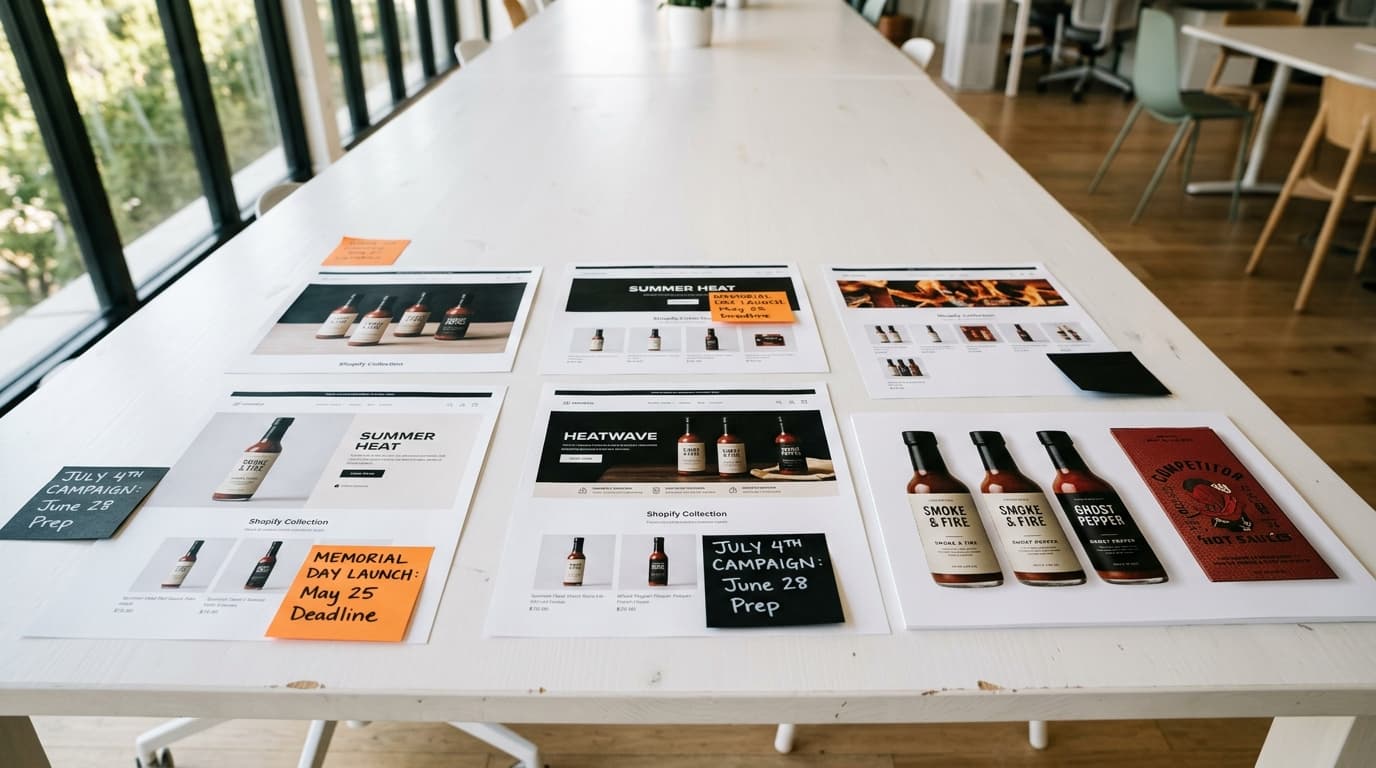
Freshness and seasonality also affect crawl priority. A brand selling hot sauces for summer grilling needs its "BBQ hot sauce" collection indexed before Memorial Day, not after. Shopify's default crawl scheduling doesn't account for seasonal urgency, which means proactive sitemap management and internal linking spikes matter more in food than in categories with flat demand curves.
Keyword Research for Food Products: Intent Mapping Over Volume
Start keyword research by mapping four tiers of intent, each tied to a different page type on your Shopify store.
- Ingredient-led informational queries ("what is adaptogen coffee") target blog posts or landing pages that introduce a concept before any purchase pressure.
- Problem-aware queries ("low sugar energy drink without artificial sweeteners") map to collection pages or comparison landing pages.
- Product-category queries ("oat milk creamer subscription") map directly to collection or product pages with transactional intent.
- Brand comparison queries ("Liquid Death vs OXBAR sparkling water") open opportunities for editorial content that positions your brand in the decision-making moment.
For volume benchmarks: ingredient-led queries typically show 1,000–10,000 monthly searches with keyword difficulty scores under 40 in most tools, making them achievable for brands with domain ratings below 30. Product-category queries cluster in the 500–5,000 range with much higher difficulty because retailers like Amazon, Target, and Whole Foods dominate. Brand comparison queries are often low-volume but carry conversion rates 3–5x higher than category terms because the searcher is already past the discovery stage.
Use Shopify's built-in analytics alongside a tool like Semrush or Ahrefs to identify which product pages already receive organic clicks. Those pages deserve priority in your optimisation queue because they signal existing topical authority Google has already assigned to your domain.
On-Page SEO for Shopify Food Product Pages
Shopify's product page structure defaults to a single title tag, meta description, body description, and image alt text. That's the baseline. High-performing food product pages add four additional layers.
Sensory and use-context language in the description body. Food buying online is handicapped: the customer cannot smell, taste, or touch the product. Descriptions that name specific tasting notes ("dark cherry and toasted oak finish"), usage occasions ("weeknight dinner marinade"), and texture cues ("creamy, not chalky, texture") satisfy the semantic gap and rank for long-tail sensory queries no competitor thinks to target.
FAQ schema embedded in the product page. Questions like "Does this hot sauce contain gluten?" or "Is this coffee mold-tested?" are searched more often than most brands realise, and answering them in structured FAQ schema wins featured snippet placement at zero additional content cost.
Nutritional and ingredient transparency signals. Google's Helpful Content guidance rewards pages that serve the full informational need of a query. For food, that means listing complete ingredient panels, certifications (USDA Organic, Non-GMO Project Verified, Certified B Corp), and sourcing provenance directly on the product page, not buried in a separate "About" section.
Review schema with aggregate rating markup. Shopify apps like Okendo and Judge.me both support review schema output. A product page showing a 4.8/5 rating from 312 reviews in the SERP snippet increases click-through rates by approximately 15–25% compared to unrated listings, based on schema testing data from multiple DTC categories.
Technical SEO: The Shopify-Specific Issues Food Brands Hit First
Shopify creates duplicate URL structures for products that live in multiple collections. A hot sauce appearing under both "/collections/all" and "/collections/gift-sets" generates two crawlable URLs. Shopify applies a canonical tag pointing to the product's primary URL, but if your internal links route to the collection-scoped URL, you split link equity. Audit internal links with Screaming Frog and standardise them to the canonical product URL.
Faceted navigation for dietary filters (vegan, keto, nut-free) creates a combinatorial explosion of indexed URLs on larger catalogs. Use Shopify's URL parameters feature or a third-party app to noindex parameter-based filter pages while keeping user-facing filtering intact. This prevents crawl budget dilution, which is a real concern once a catalog exceeds 200 SKUs.
Core Web Vitals performance directly affects ranking and matters especially on mobile, where a 2025 Google study confirmed over 70% of food and grocery searches originate. Shopify themes with large hero images and unoptimised app scripts routinely fail Largest Contentful Paint benchmarks. Run PageSpeed Insights on your homepage and top product pages quarterly, and defer non-critical app scripts to improve LCP scores to under 2.5 seconds.
For food specifically, implement Product schema with the following properties: name, brand, description, image, offers (including price, availability, and priceCurrency), and aggregateRating. If your product carries certifications, add additionalProperty nodes for each certification. Google's Rich Results Test will confirm valid markup before you deploy.
Content Strategy: Ranking Above Retail Giants on Educational Queries
Retailers win on transactional product terms through domain authority accumulated over decades. DTC brands win on specificity. A blog post titled "How to Choose a Hot Sauce by Scoville Rating" written by a brand that sells three distinct heat levels will outrank a generic Amazon buying guide because the brand's content depth, product linkage, and author expertise combine into a topical authority signal no retailer can easily replicate at scale.
Build content clusters rather than isolated posts. A core "pillar" page on, say, "adaptogens in coffee" links to satellite posts on specific adaptogens (lion's mane, ashwagandha, chaga), recipes, and sourcing explainers. Each satellite links back to the pillar and to relevant product pages. This internal link architecture tells Google that your domain is the authoritative source on that topic, which lifts the entire cluster including the commercial product pages at its center.
Publishing cadence matters less than topical completeness. Two fully built-out clusters of 8–10 pages each will outperform 40 thin, isolated blog posts in both rankings and organic traffic compounding over a 12-month period.
Link Building for Food Brands: The Media and Community Channels That Actually Work
Food media is relationship-driven in a way that pure ecommerce niches are not. Outlets like Bon Appétit, Food52, The Kitchn, Eater, and hundreds of regional food publications regularly link to DTC brands in roundup and "best of" editorial formats. Getting into those roundups requires outreach with a clear hook: new product launch, founder story, sustainability angle, or limited-edition drop tied to a cultural moment.
Dietitian and nutritionist creators represent an underutilised link source. Many maintain authoritative blogs with domain ratings between 40–60. A gifting and review program targeting 20–30 registered dietitians in your category generates editorial links that carry strong topical relevance signals, which matters as much as raw domain authority for food-specific queries.
Podcast appearances generate backlinks from show notes pages that often sit on high-authority podcast platform subdomains. A 30-minute interview on a food entrepreneurship or wellness podcast typically yields 1–3 referring domains at no cost beyond the time investment.
DTC Food Brand SEO FAQ
How long does it take for SEO to drive revenue for a DTC food brand?
Most DTC food brands see measurable organic traffic growth within 3–4 months of on-page and technical optimisation. Revenue impact from content clusters typically follows at the 6–9 month mark, once Google indexes and ranks the supporting satellite pages. Competing on high-difficulty product-category terms against major retailers takes 12–18 months of consistent effort.
Should Shopify food brands create separate pages for each product flavor or variant?
Yes, when search volume justifies it. If "mango habanero hot sauce" gets 500+ monthly searches, it deserves its own product page rather than a variant tab on a parent page. Use Shopify's product duplication workflow and write unique descriptions for each. Where variant-specific search volume is under 100 monthly searches, keep variants consolidated under one page to avoid thin-content penalties.
Which Shopify apps support the technical SEO needs of food brands?
Okendo or Judge.me handle review schema. Schema Plus for SEO adds structured data beyond what Shopify natively generates. TinyIMG or Crush.pics automate image compression to improve Core Web Vitals. Plug In SEO audits redirect chains and meta data gaps. None of these replace a technical SEO audit, but together they close the most common Shopify-specific gaps.
How do dietary and allergen claims affect keyword targeting?
Target claim-based keywords ("gluten-free granola," "top-8 allergen-free snack") aggressively in meta titles and collection page headings, because they carry high purchase intent from shoppers with non-negotiable dietary requirements. Verify that every claim is substantiated by your formulation and certified if required by FDA or USDA guidelines before publishing. Unsubstantiated claims create both legal exposure and potential manual action risk from Google's quality rater guidelines around YMYL (Your Money or Your Life) content categories.
Does a Shopify blog improve SEO compared to a separate WordPress subdomain?
Keep the blog on the same root domain (yourstore.com/blogs/) rather than a subdomain. Subdomain content accrues authority separately in Google's systems, meaning a blog.yourstore.com generates links and topical signals that don't fully transfer to your main store. The Shopify native blog is SEO-sufficient for content clusters and performs equivalently to WordPress for ranking purposes when content quality is equal.