

FOR SENIOR LIVING & ASSISTED LIVING COMMUNITIES
Senior Living SEO Company: Fill Beds With Trusted Local Search
Families researching assisted living or memory care rarely search alone - an adult child typically drives the decision, comparing reviews, licensing status, and availability across three or four communities within a 20-minute radius before ever calling. We build SEO programs around that real search behavior: locally-anchored service pages, review-and-reputation systems, and compliant, trust-first content that helps your community show up when it matters and reads as credible once it does.
Free Build
Ready to get your Senior Living websitebuilt - free?
1Digital® builds your senior living site on WorkspaceCMS.ai at no cost - AI-first, SEO-first, live in a few days to a few weeks*. Flat monthly plans from $89/mo.
We Design It
Questionnaire-driven, AI-first, free
You Approve
Review before launch
Go Live
In days to weeks, no cost
No setup fees · 12-month commitment · 4.9★ from 941+ reviews
* Timing depends on how quickly we receive your questionnaire answers and content.
Trusted by 400+ Brands · Certified Partners




Years in eCommerce
Of results, scale, and quality at the enterprise level.
Expert Team
Specialists across SEO, AI SEO, PPC, design, dev, and strategy.
US Core + Global Talent
US core team for clear communication; vetted global specialists for international client work.
Reputation Score
Rated 4.9/5 across 941+ verified client reviews.
Ask AI for a business like yours. Are you in the answer?
ChatGPT, Claude, and Perplexity only recommend sites they can read - and most can't read yours. Scan it free and see exactly where you stand.
Free · no signup · scores the 15 signals AI uses to find you · ~20 seconds
How Senior Living SEO Reaches the Family Decision-Maker
The senior living search journey is almost never a single-session decision. Families typically compare several communities across independent living, assisted living, and memory care options before committing, and the person doing the googling is frequently an adult child researching on behalf of a parent, not the resident themselves. That changes what "relevant" content looks like: pages need to answer caregiver questions (level-of-care differences, licensing and state survey history, staffing ratios, pricing structure) in plain language, not clinical jargon, and they need to do it with the kind of specificity that builds trust fast, because families are often researching under time pressure after a health event.
We build senior living SEO programs around three pillars: local pack and Google Business Profile dominance for community-specific and "near me" queries, since the U.S. Census Bureau projects the 65-and-over population will approach 71 million by 2030 and most searches skew hyper-local; review velocity and reputation management, since third-party review signals carry outsized weight in a category where families can't tour every option in person first; and compliant, source-cited content that respects the sensitivity of the decision without making outcome or care-quality claims we can't stand behind. Every recommendation is written to hold up under a state licensing board's or an ombudsman's scrutiny, not just Google's.
- ›Local SEO and Google Business Profile management tuned for multi-community and single-community operators
- ›Review-generation and reputation programs across Google, A Place for Mom, and Caring.com
- ›Level-of-care content architecture (independent living vs. assisted living vs. memory care) that matches how families actually search
- ›Compliance-conscious copy reviewed against state licensing and marketing-claim standards
- ›Pricing-transparency pages that reduce phone-tag with families comparing several communities
- ›AI-answer visibility work so your community surfaces in ChatGPT and AI Overview comparisons of local options
Senior Living SEO, step by step
Climb the searches your buyers make
Here is a typical senior living search playing out. Expert writers and strategists build the service and location pages that move your business up the results, and the clear answers that get it cited in Google's AI Overview above them.
- ›Pages written by people who know the search behind the sale
- ›Structure and schema that AI Overviews can read and quote
- ›Rankings tracked search by search, not as one blended average
The Senior Living market
What we cover in Senior Living SEO
Named sub-verticals and buyer segments inside the Senior Living category that we map keyword strategy and content programs to:
Last updated: October 2026
Senior Living by the numbers
71 million
projected US population aged 65+ by 2030
Source: US Census Bureau, 2023 National Population Projections
Senior Living SEO - buyer questions
Common questions in the Senior Living vertical
Who is actually searching for senior living communities online?
Most inquiries originate from an adult child or family caregiver, not the future resident, often after a triggering event.
A fall, a hospital discharge, or a diagnosis that makes independent living unsafe typically starts the search, so content needs to answer caregiver-specific questions rather than assuming industry familiarity.
How important are online reviews for a senior living community?
Extremely important, and different in kind from most local-service reviews.
Families weigh reviews as a proxy for day-to-day quality of care and staff responsiveness they can't fully verify from a listing page.
What's the difference between SEO for independent living, assisted living, and memory care pages?
Each level of care answers a different search intent and family concern, so collapsing them into one generic page underperforms.
Independent living searches skew toward lifestyle and amenities; assisted living toward ADL support and cost; memory care toward safety and secured environments, often searched under time pressure.
Can senior living marketing make claims about care quality or outcomes?
Care-outcome or medical claims should be avoided in content for senior living clients.
Those claims cross into territory regulated by state health departments and, where skilled nursing is involved, CMS. Content should instead focus on licensing status, staffing ratios where disclosed, and amenities.
How does local SEO work for multi-location senior living operators?
Multi-location operators need a Google Business Profile and location page for every individual community.
Google's local algorithm weights proximity and location-specific signals heavily, so a scalable location-page template that still surfaces genuine differences per community performs best.
Senior Living & Assisted Living SEO - FAQ
Who is actually searching for senior living communities online?
Most inquiries originate from an adult child or family caregiver, not the future resident, and they're frequently researching after a triggering event - a fall, a hospital discharge, or a diagnosis that makes independent living unsafe. That means content needs to answer caregiver-specific questions (what's included in the monthly fee, how staffing works overnight, what a typical day looks like) rather than assuming the searcher already understands industry terminology. We structure pages so a stressed, time-pressed family member can compare your community to two or three others in a single visit.
How important are online reviews for a senior living community?
Extremely important, and different in kind from most local-service reviews. Families weigh reviews as a proxy for something they can't fully verify from a listing page - day-to-day quality of care and staff responsiveness - so review volume, recency, and how a community responds to negative reviews all factor into both Google's local ranking and the family's own shortlist. We build ongoing review-generation workflows (not one-time pushes) and help communities respond to reviews in a way that's transparent without making care-quality guarantees.
What's the difference between SEO for independent living, assisted living, and memory care pages?
Each level of care answers a different search intent and a different family concern, so collapsing them into one generic "senior living" page underperforms. Independent living searches skew toward lifestyle and amenities; assisted living searches skew toward specific ADL (activities of daily living) support and cost; memory care searches skew toward safety, secured environments, and staff training, often searched under real time pressure. We build distinct, clearly differentiated pages for each level of care your community offers, cross-linked so families can self-navigate as needs change.
Can senior living marketing make claims about care quality or outcomes?
We deliberately steer away from care-outcome or medical claims in any content we produce, since those cross into territory regulated by state health departments and, for some communities, CMS if skilled nursing is involved. Instead we focus on what's factually verifiable and marketing-appropriate: licensing status, staff-to-resident ratios where disclosed, amenities, pricing structure, and third-party review signals. This keeps content both more defensible and, in our experience, more trusted by skeptical family researchers than vaguer quality claims would be.
How does local SEO work for multi-location senior living operators?
Multi-location operators need a Google Business Profile and location page built for every individual community, not a single corporate page trying to rank in every market - Google's local algorithm weights proximity and location-specific signals too heavily for a hub-and-spoke structure to work well. We build a scalable location-page template that still leaves room for what's genuinely different about each community (specific amenities, specific staff, specific state licensing details) so pages don't read as duplicated boilerplate across markets.
How long does it take to see results from senior living SEO?
Local pack and Google Business Profile improvements can show measurable movement within 60-90 days since they respond quickly to review velocity and profile completeness. Organic content rankings for competitive level-of-care terms typically take 4-8 months, longer in dense metro markets with many established operators. Because the sales cycle itself often runs weeks from first search to move-in, we prioritize the local-pack and reputation work first - it's the fastest lever tied directly to phone calls and tour requests.
Get a free proposal
Talk to our Senior Living marketing team
Tell us about your business and goals. A senior strategist replies within one business day with a pricing band and a draft plan. No long-term contracts.
4.9/5 from 941+ reviews
Managed Websites by 1Digital®
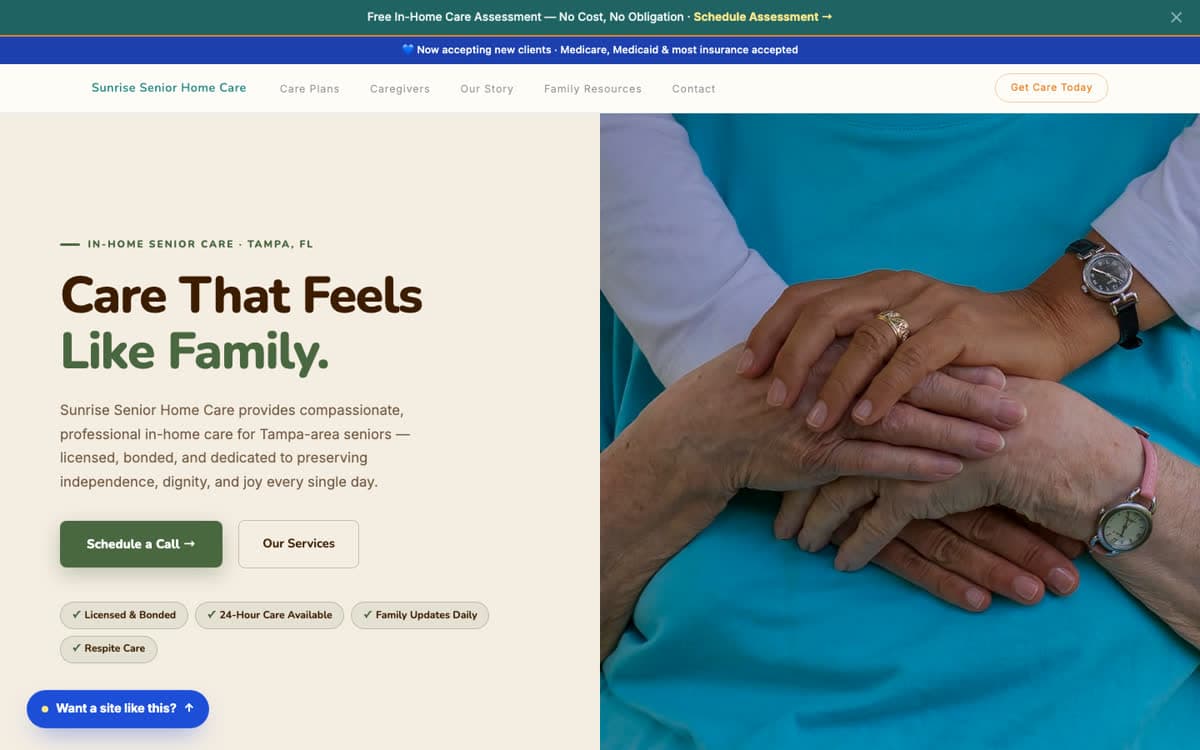
A Managed Website Built for Senior Living Businesses.
- Caregiver-focused content answering the questions adult children actually ask
- Level-of-care pages (independent, assisted, memory care) built on separate paths
- Review-request program built to keep pace with family-driven research
- Multi-location Google Business Profile and location pages for every community
- Built so AI assistants can read and cite you when families ask LLMs about senior living communities
Lighthouse
Visible in Google · ChatGPT · Claude · Perplexity
Powered by
Your Free Senior Living Website Is One Call Away.
1Digital® builds your site on WorkspaceCMS.ai at no cost - AI-first, SEO-first, live in a few days to a few weeks*. Unlimited managed edits via ticket. Flat pricing. No tech skills needed.
Essentials $89 · Growth $199 · Premium $449 · Ultra $749/mo
15+ yrs · Google Partner · 4.9★ · 941+ reviews · Live in days to weeks*
* Timing depends on how quickly we receive your questionnaire answers and content.