Loading…
Your Full-Service Digital Agency & AI Strategy Partner
Real strategists. Real AI tools. Real growth. — 1Digital® since 2012
Workspace by 1Digital® — the agency platform we built. Coming to select agencies. Join the early-access list →

B2B PPC Management
Boost your online presence and drive high-quality leads to your business with our specialized B2B PPC services.
Trusted by 400+ Brands · Certified Partners




Of results, scale, and quality at the enterprise level.
Specialists across SEO, AI SEO, PPC, design, dev, and strategy.
US core team for clear communication; vetted global specialists for international client work.
Rated 4.9/5 across 941+ verified client reviews.
Reviewed by the 1Digital® PPC TeamLast updated:
B2B PPC is a different sport than DTC PPC. The buyer is a 5-to-10-person committee — engineer evaluating, procurement approving, legal vetting, finance budgeting. ACVs run $10K–$500K+. Cycles run 3–9 months. That reality breaks generic Smart Bidding: optimize for form fills and you get tire-kickers; optimize for closed-won and the algorithm learns who actually signs purchase orders. We build B2B PPC programs paired with B2B eCommerce SEO so LinkedIn, Google Search, and Microsoft Ads compound into real pipeline.
The pipeline-tied measurement layer is what makes it work. Offline Conversion Import (OCI) sends MQL → SQL → Opportunity → Closed-Won stages from your CRM (Salesforce, HubSpot, Microsoft Dynamics) back into Google Ads, Microsoft Ads, and LinkedIn Campaign Manager — so the bid strategies train on revenue, not lead volume. Layered on top: ABM account lists ingested as LinkedIn Matched Audiences and Google Customer Match, intent signals piped in from G2, Bombora, 6sense, or Demandbase, and W-shaped (or position-based with opportunity-stage kickers) attribution so every touch in a 9-month cycle gets credit.
The 1Digital® Difference
Our strategists, designers, developers, and writers are human. The proprietary AI we built makes them faster and sharper — not the other way around.
Where B2B PPC pays off
Long sales cycles, RFQ-driven intent, and account-level targeting — our B2B PPC runs across the campaign types that surface qualified leads, not bargain hunters.

Search & RFQ Intent
Industry, SKU, and bulk-order keywords that flag real buyers

LinkedIn & ABM
Account-level targeting across procurement and operations roles
Retargeting & Nurture
Multi-touch re-engagement tuned for long B2B sales cycles
Campaign results
Case Snapshot
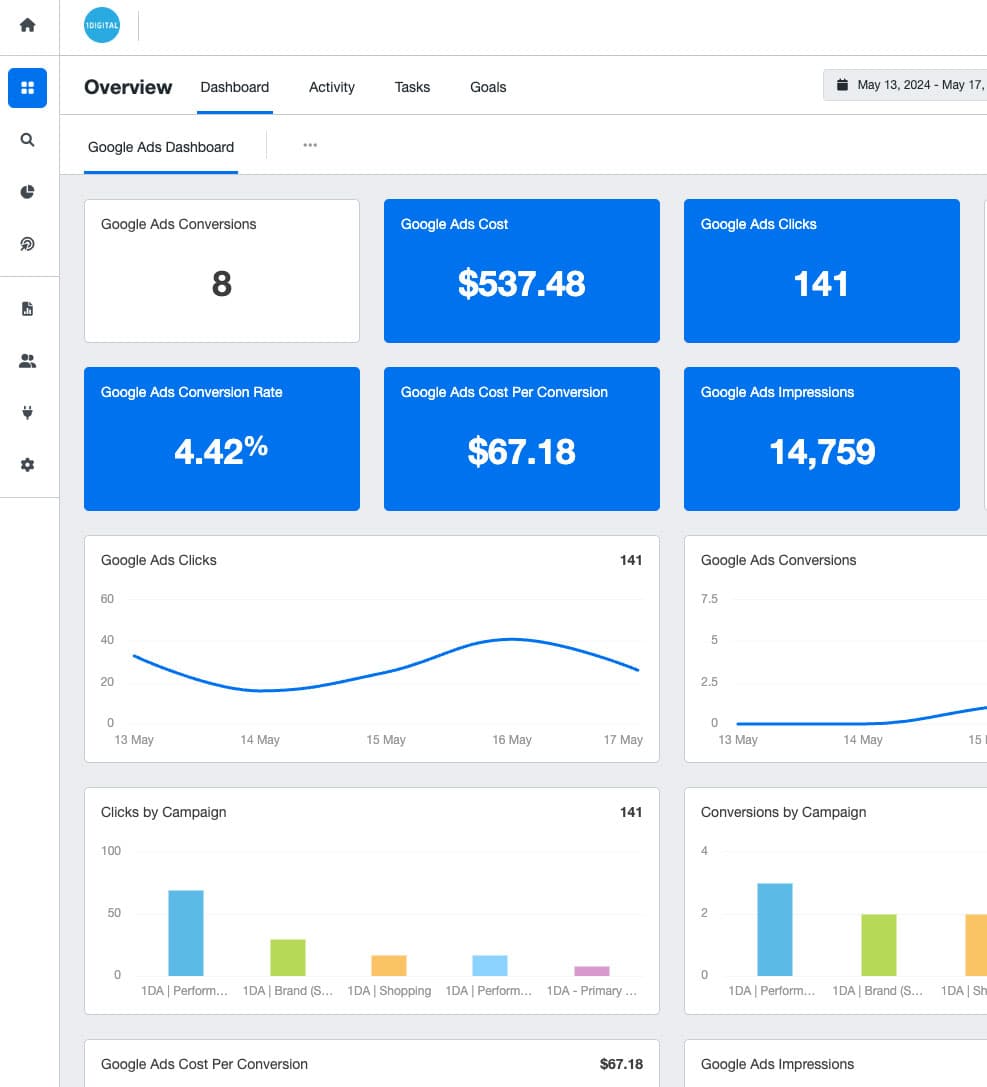
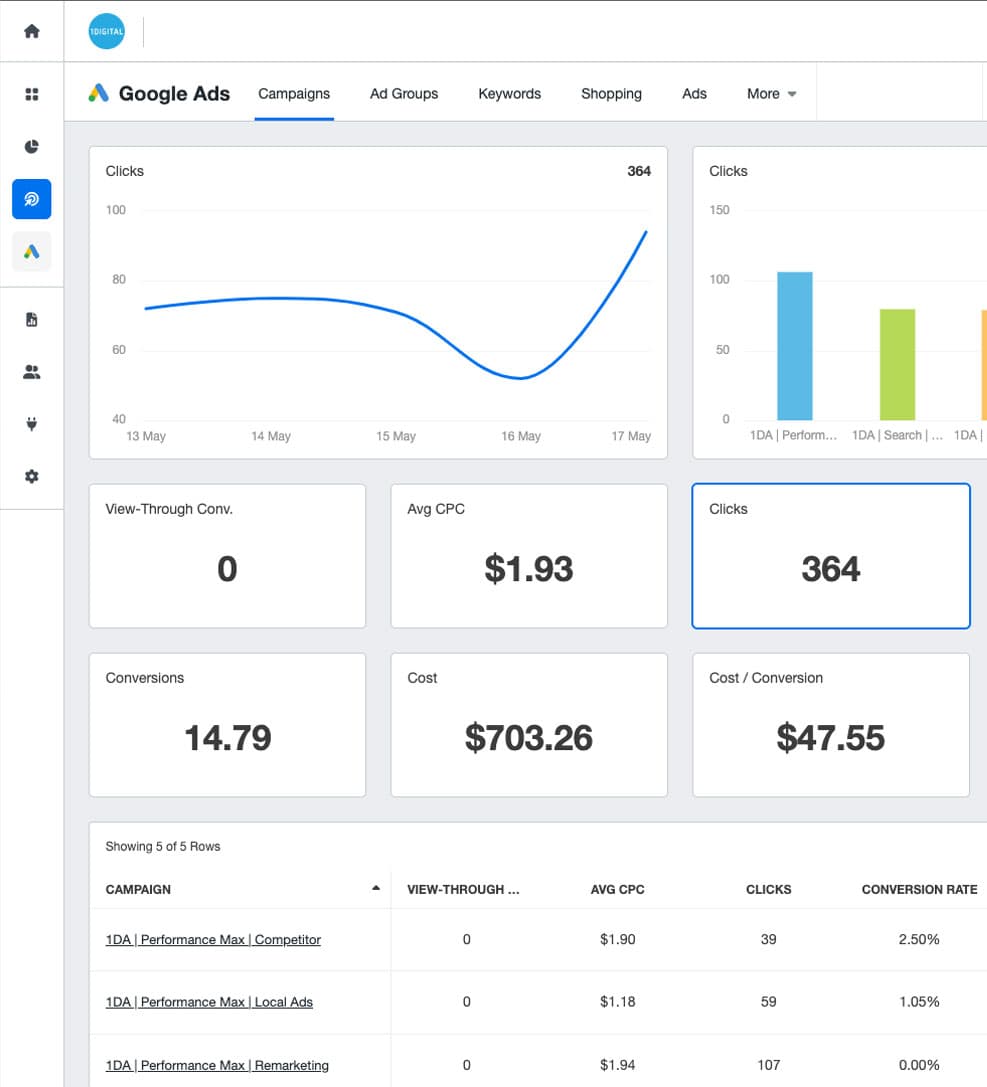
One anonymized B2B distributor came to 1Digital® in 2020 looking to grow paid revenue. We rebuilt the Google Ads account around Shopping, Display, and Performance Max — layered with offline conversion import so the bid strategies trained on closed-won data, not just lead-form fills.
620%
Revenue increase over 24 months on paid channels.
47%
Share of that growth attributable to 1Digital®’s PPC work.
17.9%
Net new paid revenue contribution post-launch.
Past results are not a guarantee of future performance. Specific outcomes vary by industry, budget, market dynamics, and execution.
Why 1Digital®
14 years of B2B PPC experience. Google Partner. 400+ brands. 4.9/5 across 941+ verified reviews. Senior strategists, transparent reporting, and pipeline-tied measurement on every account.
LinkedIn Conversation Ads, Document Ads, Thought Leader Ads, Sponsored Messaging, and Lead Gen Forms — paired with Google Search ABM and Microsoft Ads for buying-committee coverage.
Closed-won data piped from Salesforce, HubSpot, or Dynamics into Google Ads, Microsoft Ads, and LinkedIn Campaign Manager — Smart Bidding trains on revenue, not MQLs.
Target account lists ingested as LinkedIn Matched Audiences and Google Customer Match. Account-level reporting through Demandbase or 6sense, not just lead-level dashboards.
G2, Bombora, and 6sense buyer-intent signals routed into LinkedIn and Google audiences — capture demand the moment a target account surges, not weeks later.
Separate pages for engineer, procurement, and VP personas — each tied to the right gated asset (datasheet, ROI calculator, peer case study) and the right conversion action.
A senior B2B PPC strategist owns your account. Workspace surfaces query waste, intent surges, and creative fatigue; humans set strategy and approve every budget call.
A senior strategist will review your Google Ads, Microsoft Ads, LinkedIn, GA4, and conversion-tracking setup — then deliver a written audit covering wasted spend, structural fixes, tracking gaps, and a prioritized roadmap. No charge, no obligation.
Many B2B distributors and manufacturers also run an online ordering portal or D2C arm. Our eCommerce PPC management team handles Google Shopping, Performance Max, and paid social with the same revenue-tied measurement — so paid spend across business-buyer and consumer channels stays coordinated.
Pair B2B PPC with
B2B paid compounds when it runs alongside organic and the rest of the PPC stack. Most accounts we manage layer at least two of the below.
Spec-led taxonomy, part-number rankings, and AI-engine citations for procurement-driven research. Pairs directly with B2B PPC for full-funnel pipeline.
The parent PPC service — Google Ads, Microsoft Ads, paid social — for accounts that span B2B and DTC or want a single-strategist umbrella view.
Shopping, Performance Max, and paid social for the D2C arm or online ordering portal many B2B distributors also run.
Sponsored Products, Brands, Display, and DSP for B2B sellers operating on Amazon Business alongside their direct channel.
Feed hygiene, custom labels, and Merchant Center diagnostics for B2B catalogs running Shopping or PMax alongside lead-gen campaigns.
A senior strategist reviews your Google Ads, LinkedIn, OCI setup, CRM integration, and attribution model — written audit, no obligation.
Request a proposal
Share your store URL, platform, and goals. A senior strategist replies within one business day with a draft scope and price band.
OCI uploads CRM stages (MQL → SQL → Opportunity → Closed-Won) and deal values from Salesforce, HubSpot, or Microsoft Dynamics back into Google Ads, Microsoft Ads, and LinkedIn Campaign Manager. Smart Bidding then learns which click IDs (GCLIDs, MSCLKIDs, LinkedIn UUIDs) produced revenue — not which produced form fills. We typically upload weekly, weight conversions by stage (Opportunity = 5x MQL, Closed-Won = 25x), and give the algorithm 6–8 weeks of closed-loop data before letting it bid aggressively on Maximize Conversion Value. Without OCI, Smart Bidding optimizes toward whoever fills the most forms — which in B2B is rarely whoever signs the largest contract.
It starts with a named account list from your sales team — typically 200–2,000 target companies. That list ingests into LinkedIn as a Matched Audience (uploaded directly or via Demandbase / 6sense sync). On top, you layer job-function filters (Engineering, Operations, Finance, IT), seniority (Manager+ for influencers, Director+ for decision-makers, VP+ for economic buyers), and company-size or industry refinements. Then you split campaigns by persona: Conversation Ads to engineers, Document Ads (datasheet downloads) to procurement, Thought Leader Ads to VPs. Account-level reporting in Demandbase or 6sense shows which target accounts engaged, with which content, in which order — not just lead counts.
Every paid touchpoint stamps a UTM and GCLID/MSCLKID/LinkedIn UUID into the CRM. We instrument conversion events at four stages: MQL (form fill or content download), SQL (sales-accepted, BANT-qualified), Opportunity (entered pipeline with $ value), and Closed-Won. Stage-to-stage conversion rates surface where paid leads stall — a healthy B2B pipeline runs roughly 25–35% MQL→SQL, 25–40% SQL→Opportunity, 20–35% Opportunity→Closed-Won, varying by ACV and category. Channel breakdowns in the same view show whether LinkedIn ABM is producing higher SQL rates than Google Search non-brand, even at higher CPL.
Gated content (datasheets, ROI calculators, peer benchmarks, on-demand webinars, analyst reports) wins at top and mid-funnel where the buyer is researching and not ready for sales. Direct CTAs (demo request, free trial, RFQ) win at bottom-funnel where intent is already qualified. In our accounts the rule of thumb: top-of-funnel LinkedIn Sponsored Content runs 3–6x higher CTR with gated offers; bottom-funnel Google Search non-brand converts 2–4x higher with direct CTAs because the buyer typed in a buying-stage query. The economics shift further when ACV is $100K+ — gated content captures the buying committee earlier, even if the engineer who downloaded the datasheet is not the one who signs.
No fixed split — it follows the buyer journey for the category. A representative starting allocation for a $500K-ACV B2B SaaS: 40–50% LinkedIn (ABM + persona targeting), 25–35% Google Search (high-intent non-brand, RFQ-stage queries, competitor conquest), 10–15% intent platforms (G2 buyer-intent retargeting, Bombora surge-account targeting, 6sense in-market audiences), 5–10% Microsoft Ads (LinkedIn audience targeting + lower CPCs on the same buying-stage queries), 5% experimental (Reddit Ads B2B, podcast sponsorships, niche trade publications). Reallocate quarterly based on stage-weighted ROAS, not CPL.
First-touch and last-touch both lie in B2B — first-touch over-credits awareness, last-touch over-credits the demo request. The honest models are W-shaped (40% first touch, 40% Opportunity creation, 20% last touch, remaining 0% spread across middle interactions) or position-based with opportunity-stage kickers (custom credit weights at each pipeline stage). Data-driven attribution in GA4 works in theory but rarely has enough volume on B2B-sized datasets. We typically run two models in parallel — W-shaped for budget decisions, last-non-direct for channel-level optimization — and reconcile monthly.
Account-level reporting rolls every touchpoint (impression, click, content download, page visit, intent surge) up to the company, not the individual contact. Tools: Demandbase, 6sense, or Bombora aggregate this natively; HubSpot ABM and Salesforce Marketing Cloud Account Engagement (formerly Pardot) do it via account scoring. We report on account engagement scores trending up over a 60-day window, target-account coverage (what % of your named ABM list saw at least 3 ad impressions this month), and account-to-opportunity rate (target accounts that became Opportunities). A single MQL means little; an account where 4 different stakeholders engaged different content over 6 weeks is a real pipeline signal.
Yes, when ACV justifies it ($50K+). Engineers want spec sheets, integration docs, technical proof points, and a sandbox or trial. Procurement wants pricing transparency, contract terms, vendor stability signals (SOC 2, ISO, customer logos at scale), and an RFQ form. VPs want business outcomes — ROI math, peer case studies, analyst validation, and a calendar link to a strategy call. Same product, three different landing pages, three different CTAs. LinkedIn campaigns route each persona to their page via job-function and seniority filters. CRO testing happens within persona, not across — comparing an engineer page to a VP page is comparing apples to airplanes.
LinkedIn is firmographic and personagraphic — it knows job title, company size, industry, seniority, function, member skills, and group memberships. Use it for ICP definition: \"Manufacturing companies, 500–5,000 employees, Director of Operations or Plant Manager, US/Canada.\" Google Search is intent-driven — it knows what someone typed. Use it to capture in-market behavior: \"erp software for mid-market manufacturing,\" \"netsuite vs sap business one.\" The bridge is Customer Match: take your named account list (or a synced 6sense / Demandbase in-market segment), upload as a Google Customer Match audience, and bid up on those accounts when they search. ICP firmographics live in LinkedIn; ICP-account-intent lives in Google.
Floor for a serious B2B PPC program (LinkedIn + Google Search + OCI + ABM tooling) is $10K–$15K/mo in media spend, plus management fee. Below that, LinkedIn impression volume is too low to learn and Google Search non-brand can't compete on the buying-stage queries. Mid-market accounts ($150K–$500K ACV) typically run $25K–$75K/mo in media; enterprise accounts run $100K+. First-90-day spend priority: (1) OCI setup and CRM-to-platform plumbing, (2) LinkedIn ABM on the top 200 named accounts, (3) Google Search bottom-funnel non-brand and competitor conquest, (4) gated content production for top-of-funnel. Intent platforms and persona landing pages come in months 4–6 once baseline conversion data exists.
MQLs and SQLs land in weeks 2–8 once campaigns are stable. Opportunities (real pipeline) land in months 3–6 because B2B sales cycles are long. Closed-Won revenue with statistical significance lands in months 6–12. Anyone promising B2B PPC ROI in 30 days is either (a) cherry-picking a single deal, (b) measuring on form fills instead of revenue, or (c) running a non-B2B motion (transactional SaaS, low-ACV, no buying committee). The trade-off for the long ramp: B2B paid compounds — the OCI-trained Smart Bidding model, the persona LP library, the account intent history, and the closed-loop attribution all get better with each closed deal.