

For BigCommerce B2B Edition Brands
BigCommerce B2B SEO Agency
Elite BigCommerce Partner since 2012. Customer-group-aware catalog SEO, price-list-safe Product schema, quote-only PDP patterns, Multi-Storefront B2B topology, and the indexable/gated boundary - all engineered as one program.
Ask AI for a business like yours. Are you in the answer?
ChatGPT, Claude, and Perplexity only recommend sites they can read - and most can't read yours. Scan it free and see exactly where you stand.
Free · no signup · scores the 15 signals AI uses to find you · ~20 seconds
TL;DR
B2B SEO Is Half-Public Catalog, Half-Gated Portal
Most B2B Edition implementations treat SEO as an afterthought to the buyer portal. The result: anonymous Google sees price-list discounts in JSON-LD, gated SKUs leak into the sitemap, quote-only PDPs rank for the wrong intent. We architect the indexable / gated boundary first - public catalog ranks, authenticated portal carries noindex, schema reflects only publicly visible pricing, and the marketing surface converts buyer intent into "Request Access" not "Add to Cart" when that's the right action.
BigCommerce B2B SEO, tracked search by search
Watch each search your store wants move toward page one
Rankings are tracked one search at a time, not as a blended average. Here are the searches a BigCommerce B2B store like yours chases, each one moving toward page one as the category and product pages behind it are fixed and rewritten.
- ›Searches chosen from what your buyers actually type
- ›BigCommerce B2B pages rewritten around each of those searches
- ›Progress reported per search, so you see what moved
eCommerce Website Plans for b2b
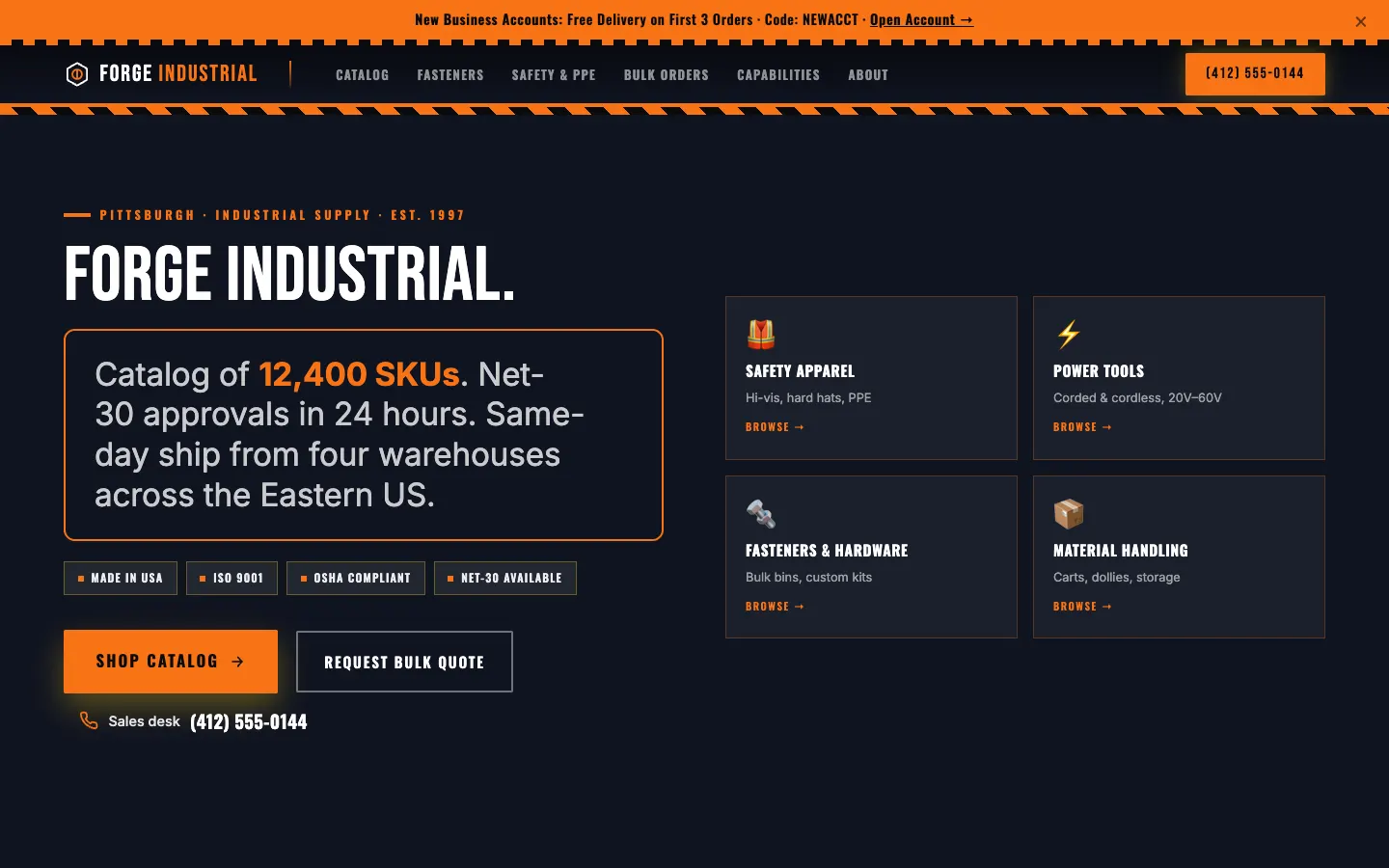
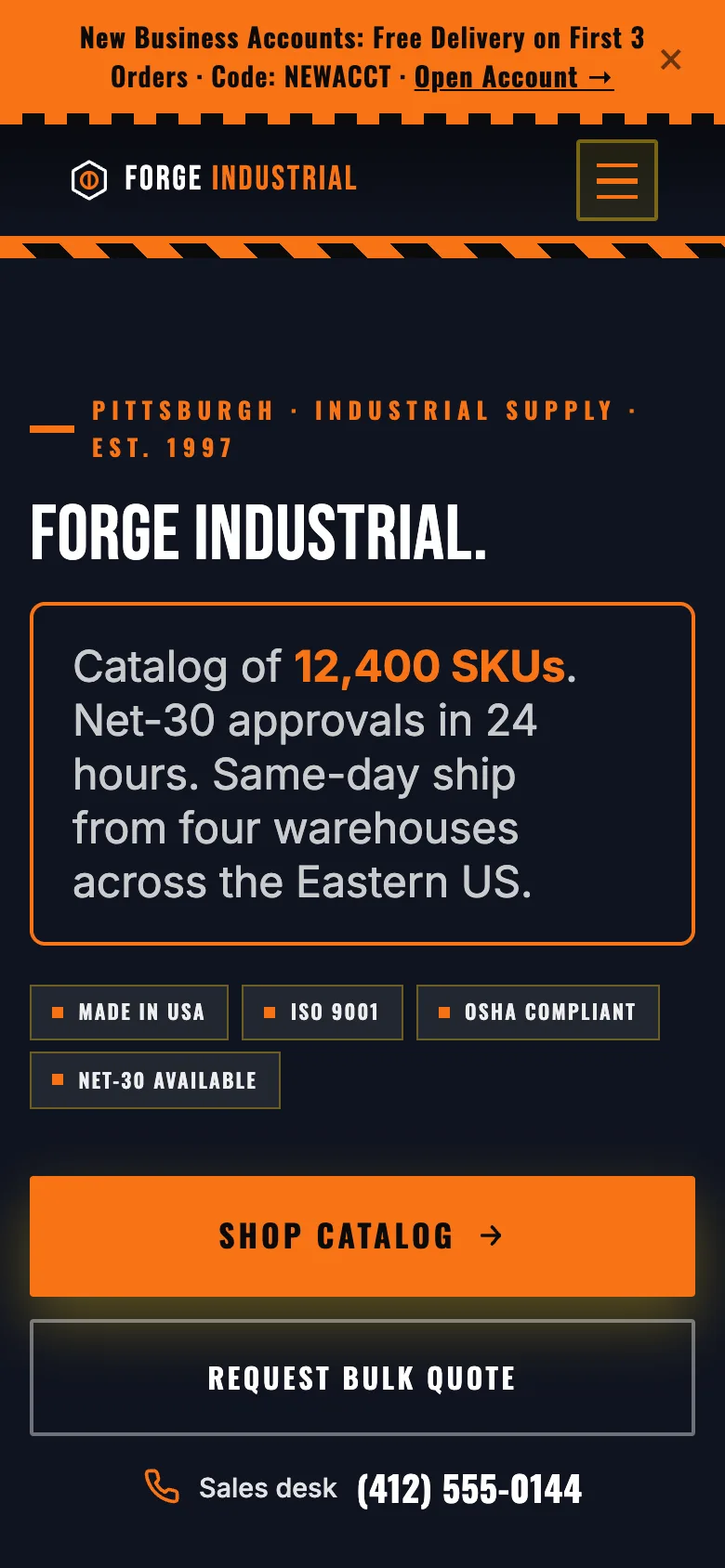
A b2b storefront like this, designed free and run for you
On your Shopify or BigCommerce store, from $499 a month. Forge Industrial Supply is a demo store built on WorkspaceCMS.
B2B surfaces we own
What B2B Edition SEO Covers
- ›Customer-group-aware indexation - public products vs. group-gated SKUs.
- ›Price-list-safe Product / Offer schema - public price only, never per-group discounts.
- ›Quote-only PDP patterns - schema, content, FAQ for buyer intent.
- ›Company hierarchy gating - noindex policies on authenticated routes.
- ›Multi-Storefront B2B topology - hreflang, canonical pinning, per-storefront sitemap.
- ›Big Open Data Layer (BODL) - clean GA4 + GSC instrumentation for B2B journeys.
- ›Faceted-nav governance - promoted filter landing pages, canonical pins elsewhere.
- ›Stencil and Catalyst rendering - handlebars template logic vs. Next.js RSC boundaries.
- ›llms.txt and AI-engine citation tracking - ChatGPT, Perplexity, AI Overviews, Gemini, Copilot.
Who this is for
B2B Brands We Serve
- ›Distributors with deep catalogs, customer-group pricing, and quote workflows.
- ›Manufacturers running DTC + B2B from one BigCommerce account.
- ›Wholesale brands moving from PDF catalogs and email-quote to digital portal.
- ›Industrial, MRO, and food-service catalogs with spec-heavy product data.
- ›Healthcare and regulated B2B with compliance and license-gated SKUs.
- ›Multi-brand or multi-region B2B running on BigCommerce Multi-Storefront.
The boundary
Drawing the Indexable / Gated Line
The single highest-leverage decision on a B2B Edition SEO program is where you draw the boundary between what Google indexes and what lives behind authentication. Get it wrong, and either (a) gated SKUs leak into SERPs and 404 for unauthenticated visitors, or (b) the public catalog is so thin that buyer-intent traffic never finds you. We make this concrete: every category, product, and content route gets a published policy - indexable, noindex+follow, or behind-auth. Customer-group context, price-list visibility, and quote-only status all feed the decision. The output is a route policy doc that lives in the repo and gets enforced by template logic, not by tribal knowledge.
Cluster context
Where This Sits
B2B Edition SEO is a specialized cut of BigCommerce SEO from a BigCommerce Elite Partner - see BigCommerce experts for the broader platform competency. For platform-agnostic B2B SEO strategy, B2B eCommerce SEO. Going headless on BigCommerce? Catalyst SEO. Cluster hub: SEO by platform. Cornerstone reference: ecommerce SEO agency.
BigCommerce B2B SEO - FAQ
What is BigCommerce B2B Edition SEO?
BigCommerce B2B Edition layers buyer-portal functionality (company hierarchies, customer groups, price lists, quote workflows, requisition lists, sales rep impersonation, draft orders) on top of standard BigCommerce. SEO has to span two surfaces: (1) the public-facing catalog and content that ranks in Google and AI engines and (2) the authenticated buyer portal that doesn't. We architect the indexable / gated boundary, structure marketing-surface SEO around B2B buyer intent, and emit appropriate meta-robots per route so anonymous Googlebot sees public catalog only.
Are you a BigCommerce Elite Partner with B2B specialization?
Yes - 1Digital® Agency is a BigCommerce Elite Partner (the top partner tier) and BigDev Certified, with continuous BigCommerce work since 2012. We've shipped B2B Edition rollouts, customer-group-driven catalog SEO, quote workflows, and multi-storefront B2B configurations across distributors, manufacturers, and wholesale brands. Trusted by 400+ brands with a 4.9/5 rating across 941+ verified reviews.
How do customer groups affect SEO?
Customer groups in B2B Edition gate price visibility, catalog access, and shipping options per company segment. SEO consequences: (1) per-group prices must not bleed into anonymous Product schema - the public Product / Offer schema reflects either MSRP or a representative price, never a customer-group-specific price; (2) gated SKUs (visible only to specific groups) carry noindex per route via Stencil template logic or Catalyst metadata; (3) public categories with mixed gated/public products list public products only to anonymous crawlers. We use BigCommerce's customer-group context APIs to emit conditional schema and meta-robots per request.
How does price-list visibility interact with Product schema?
Price lists assign per-customer-group or per-company pricing. For SEO, the rule is that JSON-LD Offer.price must always be the publicly visible price - never an authenticated-only price list. Two patterns: (1) emit Offer schema with the public catalog price; price-list discounts appear only in authenticated UI and are absent from indexable HTML; (2) for catalogs where MSRP is the public price and all real pricing is gated, emit Offer with priceSpecification noting the price is "subject to authentication" so the schema accurately represents the public-facing price model. We default to pattern (1) and only use (2) for genuinely MSRP-only catalogs.
How do you SEO quote-only products?
Quote-only products (no add-to-cart, "Request a Quote" CTA) are common in B2B for high-ticket, custom-spec, or regulated SKUs. SEO patterns: (1) emit Product schema without Offer.price; instead use Offer.priceSpecification with "QuoteOnly" semantics or omit Offer entirely; (2) page content focuses on buyer-intent specs (capacities, dimensions, certifications, compliance) and links to quote-form CTA; (3) FAQ schema covers "what's the lead time", "what's the MOQ", "do you ship to my country" - the questions buyers actually ask. We've ranked quote-only PDPs against catalog-priced competitors by leaning into spec depth and intent-matched content.
What about Multi-Storefront B2B catalogs?
BigCommerce Multi-Storefront lets one BigCommerce account run multiple storefronts on different domains, sharing or splitting catalogs. For B2B, the common patterns are: (1) one storefront per brand or region with shared catalog; (2) one DTC storefront + one B2B storefront from the same catalog; (3) per-distributor storefronts under one parent brand. SEO topology: hreflang where storefronts serve different regions, canonical pinning to prevent cross-store cannibalization when content is identical, and per-storefront sitemap with appropriate robots policies. We architect the canonical-and-hreflang topology per Multi-Storefront configuration.
How is faceted nav handled for B2B catalogs?
B2B catalogs typically have deeper specs than DTC (voltage, gauge, certifications, compliance, material grade). Faceted nav generates more parameter combinations, and most should not be indexed. Pattern: canonical-pin filter URLs to the base category; selectively promote high-intent combinations (e.g. "stainless-steel + food-grade + 304-series") to indexable landing pages with their own meta, content, breadcrumb schema, and an in-page H1 that matches the filter. Customer-group-aware filters add complexity - visible facets change per group, so canonical strategy must respect group context.
Does BigCommerce B2B SEO include Stencil or Catalyst?
Both. Stencil (Cornerstone + Handlebars) is the classic templated stack; Catalyst is the Next.js + React headless stack. Stencil B2B SEO covers handlebars template logic for customer-group-aware rendering, Page Builder section schema, and Big Open Data Layer (BODL) instrumentation. Catalyst B2B SEO covers Next.js metadata, GraphQL Storefront API caching, RSC vs client component boundaries for gated content, and Makeswift-driven content schema. We ship on both stacks.
Do you handle company hierarchies and account-level SEO?
Company hierarchies (parent company → subsidiaries → branches → users) are an authenticated-only surface in BigCommerce B2B - Google doesn't see them, by design. SEO impact is indirect: the marketing surface must convert top-of-funnel buyer intent into a "Request Access" or "Apply for Account" CTA that leads to the gated hierarchy. We build the public-side content engine - landing pages by industry vertical, by spec, by region - and tune the gated portal for buyer experience without indexation.
What does a BigCommerce B2B Edition SEO engagement look like?
Phase 1: indexable/gated boundary audit, customer-group-aware schema review, price-list and Offer schema sanity check, quote-only PDP indexation review, Multi-Storefront topology, faceted-nav indexation, BODL data layer health, Core Web Vitals on Stencil or Catalyst. Phase 2: corrective work - meta-robots per route, canonical pinning, schema rebuild, faceted-nav rules, landing-page promotion for buyer-intent filter combinations. Phase 3: buyer-intent keyword mapping, content briefs (industry, spec, compliance angles), AI-engine optimization with llms.txt, and citation tracking across ChatGPT Shopping, Perplexity Shop, Google AI Overviews, Gemini, Microsoft Copilot.