

As a premier eCommerce SEO expert, we know a thing or two about how SEO works, including best practices and what search engines are looking for when they crawl your website. Pay attention to some of these features when you are building your website. They may not seem important, but they can have quite an impact on your search engine optimization.
H1 Tags
H1, or header 1 tags, are one of 6 different HTML tags that mark text as a header on a web page. H1 tags are more important than others because they are one of the first things a search engine will evaluate when crawling a page.
If you have already developed a keyword strategy but fail to include targeted keywords in the H1 tags on your web pages, you are leaving a lot on the table.
First, of course, you need to do keyword research and develop subsequent keyword and marketing strategies, but with that information, you can create perfectly optimized H1 tags for every page on your website. For example, the H1 tag for our client’s blog post, pictured below, can be seen with the tag highlighted in green with the text of the title following:

One thing to note is that the other header tags are important, too, just not as important as your H1 tags. If you can only devote so much time to optimization, make sure you update your H1 tags first.
Meta Titles
A meta title is similar to an H1 but not the same; H1 tags are written in HTML as via the tag in the image above whereas the meta title is coded via a separate tag. These tags sometimes match, but not always – though they do always impact your SEO.
You should infuse your meta titles with relevant keywords and ensure that none of them are duplicates. The title tag should not be too long, as Google only allows a little bit of space to the meta title display, about 70 characters. If you type “eCommerce SEO agency” into Google, the SERP page will show you the following among the rankings:
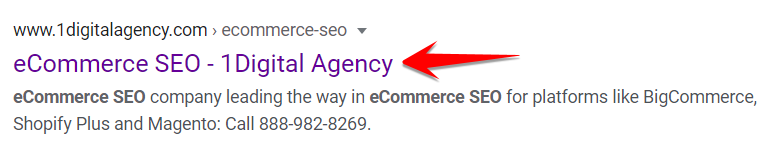
The arrow indicates the meta title, and if you click on the link and look at the tab at the top of your page, you will see the following, which also shows you how the meta title appears.
When optimizing your meta titles, use relevant, targeted keywords, create unique titles for every page, and keep the length beneath the character limit.
Meta Descriptions
A meta description is a brief summary of what a given page contains, as evidenced by the portion within the red box of the image below.

The meta description provides insight into what the page is about. It is short, concise, and includes your target keyword. It also gives potential readers some insight into what we offer – namely, services for data migrations to platforms like BigCommerce, Shopify, and Magento.
Meta descriptions, like meta titles, can only be so long. In 2020, the best length for a meta description should be somewhere around 150 words and should do two things. On one hand, it should contain genuine, relevant information to help viewers make an informed decision about whether to click a link or not and, on the other, it should contain keywords that you want to target.
Onsite Content
Besides these little features that can impact the SEO value of your online store, the content you feature on your eCommerce website will impact your SEO as well. As Google crawls your website, it isn’t only looking at the code. It’s also scanning the content.
This content includes everything from product page descriptions to category page content to blog posts and everything in between – including the alt text for the images you include on your website.
Your content should do two things – it should provide valuable, original information to visitors, and it should contain a good mix of target keywords to attract the attention of search engines.
Link Building
Everything we mentioned up to this point concerned onsite optimization, and all of these points represent an opportunity to increase the SEO value of your website. However, there is one huge impactor of SEO that occurs off your website – backlinks.
The value of backlinks to SEO is central. High-quality backlinks are one of the main ways Google ascribes authority to your website, and an assortment of backlinks can greatly improve your rankings.
The question is, how do you get backlinks? Some businesses trade for them and others generate them slowly over time as visitors and customers link to their site for the value of the information the website provides.
However, waiting for these organic results can take a long time. As a part of our SEO process, we develop backlinks for businesses to increase site authority and push more organic traffic to your website.
Keep all of this in mind as you are updating your website, but don’t be afraid to ask for help. Just knowing what keywords to target and how and where to use them is a full-time job. You also have to be wary of keyword stuffing, where to place content and how to disavow toxic links while at the same time generating new ones.
That’s why proven SEO campaigns like those entailed by our eCommerce SEO services have generated such great, long-term results for eCommerce businesses in so many industries. If you’re interested in generating higher traffic, sales, revenue and conversion rates for your eCommerce site, get in touch with a rep from our eCommerce SEO agency today at info@1digitalagency.com or by calling 866-462-3588.
Getting the On-Page Elements Technically Right
The five elements above are the right framework; what separates a page that ranks from one that doesn’t is the specifics of implementation. A few corrections and precise targets sharpen the advice:
- One H1 per page, describing the page’s single primary topic. Use H2/H3 to structure subtopics. The H1 should contain the page’s target term naturally - not a keyword-stuffed string. Multiple H1s dilute the signal.
- Title tags: write for the click, not just the crawler. Keep the meaningful content within roughly 60 characters / ~600 pixels so it isn’t truncated in results, front-load the primary term, and make every title unique. Google frequently rewrites weak titles, so a clear, specific title is also defensive.
- Meta descriptions are a click-through lever, not a ranking factor. Editorial note: the original text suggested a meta description of “around 150 words”; that is a typo for characters - the practical target is roughly 150–160 characters, and the description does not directly influence rankings but materially affects click-through rate from the results page. Treat it as ad copy for the listing.
Onsite Content: Search Intent and E-E-A-T
“Valuable, original content with target keywords” is correct but incomplete by modern standards. Two additions matter most. First, match search intent: a query like “best [product] for [use case]” expects a comparison, not a single product page - ranking now depends on giving the format the searcher wants. Second, Google evaluates content against E-E-A-T (Experience, Expertise, Authoritativeness, Trustworthiness), which means first-hand experience, clear authorship, and citations now influence whether content is treated as authoritative - especially for commercial pages. Keyword presence is necessary but no longer sufficient.
Link Building Without the Penalty Risk
The article is right that backlinks remain central, but the line “some businesses trade for them” needs a sharp caveat: buying or trading links at scale violates Google’s spam policies and risks a manual action or algorithmic suppression. Sustainable link acquisition in 2024+ means earning links through genuinely linkable assets - original data, tools, definitive guides - plus digital PR and relevant industry placements. Equally important is the defensive side the article mentions only in passing: periodically auditing the backlink profile and disavowing toxic or spammy links so a competitor’s negative-SEO attempt or a legacy bad-link history doesn’t drag rankings down.
A Prioritized Order of Operations
If time is limited, the highest-return sequence is: fix title tags and H1s across templates first (fast, high impact, low risk), then resolve content–intent mismatches on revenue pages, then technical hygiene (canonicals, internal linking, Core Web Vitals), and only then invest in earned links - because links amplify pages that already deserve to rank but cannot rescue ones that don’t match intent. That ordering is the operational backbone of our SEO process and eCommerce SEO services.