

Lead generation campaigns are difficult at best and harrowing at worst, especially since it can be hard to draw solid conclusions about the costs of acquisition depending on the number of respondents a campaign receives, or how long it takes them to convert.
It’s not like simple SEO or organic social media marketing, where you can clearly see the channels through which leads come in and whether or not they convert right there. If you have higher organic conversions, SEO is doing its job; if your top traffic source is Facebook or Instagram, and sales increases, social media marketing is doing its job.
But there’s a bit more nuance when the end goal isn’t necessarily a sale, and when you’re looking at trying to get respondents to sign up for a service, a trial, or a test. Fortunately, our experience positioned us perfectly to deliver when the goal was just that – lowering cost-per-acquisition to get leads to sign up for a clinical trial study.
Setting the Stage
One of our clients came to us looking for solutions with respect to lowering the cost of gathering leads for a special clinical trial.
To keep things as direct as possible, this client was going to run a clinical trial that, without getting too lost in the details, required women with a specific medical issue (that for the purpose of this case study will remain undisclosed) to agree to participate in subjects of a clinical trial.
There’s rarely a shortage of options for gathering leads; of course, one can rely on organic metrics, but without established organic visibility for related keywords, that’s a miss, and you don’t need to be a digital marketer to recognize that no significant portion of the market (or any portion of the market at all) actively searches for ways they can get involved in clinical trials.
That proposition is one in which the agent or research center running the trial is at a disadvantage because the onus is on them to find the leads and entice them to sign up. There are lots of ways to go about it – email marketing, for instance, can be effective if you have an established footprint and have contact information for leads that you know are qualified, but it is limited to existing contacts.
That leaves largely paid search and social media marketing tactics. Paid search, like SEO, is questionable, because it requires the lead him or herself to search for something adjacent to keywords associated with the clinical trial. That is cumbersome, inaccurate at best and highly likely to turn up either no leads or just a bunch that are not interested or qualified.
That leaves us with paid social media marketing approaches, which unlike paid search, is more passive. Rather than requiring the prospective lead to search for something, paid social media marketing simply looks at the engagement of the target audience, considering their interests, activity, accounts they follow and likenesses to other audience members, and then serves up the ad.
With the right targeting, paid social media marketing can be the most effective channel by far to gather qualified leads for a clinical trial, which is exactly the approach we took for this client through Meta.

Refining the Approach with Advanced Targeting
Some of the issues associated with this campaign, which would be shared in common with all lead generation campaigns surrounding clinical trials would be:
- Ensuring budgetary constraints were met, since capturing leads for a clinical trial costs money, it doesn’t make money.
- Ensuring that leads were enticed satisfactorily that they would not just sign up for, but complete the requirements associated with the trial.
- Minimizing wasted spend associated with pursuing unqualified or uninterested leads.
- Making sure that all seats/positions associated with the study were filled in the required time frame.
These were just a few of the challenges, among others, but the fact of the matter is that unlike a normal lead generation campaign, in which the leads are expected to pay for themselves through future conversion value, in gathering leads for a clinical trial it’s critical to ensure that budgetary needs are considered because any money spent doesn’t necessarily have the promise of being regenerated down the line, even when qualified leads are captured. Either qualified leads are captured and the trial study is completed satisfactorily, or it isn’t and the initiative is a loss.
Overall, the campaign required users to interact with our ads such that they were taken to a screener form that would determine whether or not, interested or not, they could proceed with the trial.
The main technique we refined in order to keep cost per acquisition low was advanced targeting. Fortunately, Meta offers some highly advanced criteria that enable very precise audience segmentation and targeting. This enabled us to refine our approach such that our ads only ever reached potentially interested leads in the first place. By and large we accomplished this through age-based targeting but our overall approach was holistically more refined. By cutting out the unqualified and those that wouldn’t sign up anyway, we helped minimize wasted ad spend.
In addition, we also utilized a large number of creatives to keep the campaigns fresh. By doing so, we were not only able to ensure a maximum amount of engagement through our intended target audience, but also to leverage only the creative assets that proved most effective as the campaign progressed, sort of like a soft-core A/B testing model. We added in this approach once the campaign reached its halfway mark so that we had enough data to substantiate the effort.
All in all, we filled every role well in advance of the maximum time frame allotted for the success of the study, but on top of that, we were successful in keeping down the cost-per-acquisition of the Meta lead generation campaign.
The Results: Lowered Cost-Per-Acquisition (CPA) and Beyond
When we first began running this campaign for this client, their targeting looked like this:

Right away one of the optimizations we made for them was advanced segmentation based primarily on age, as you can see below:

Ultimately, this targeting (along with some other proprietary campaign optimizations) had a significant impact on overall cost-per-click and thereby cost-per-acquisition, as you can see from here:
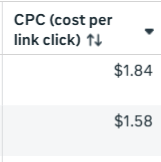
To here:
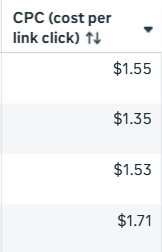
With cost-per-click trending downward and overall less as the campaign ran on.
Ultimately, this achieved the client’s campaign goals of acquiring the desired number of sign-ups to the trial, in the desired window of time, on a more affordable basis.
Looking for Lead Generation That Pays Off?
For many lead generation campaigns, cost associated with acquisition is a primary concern, especially if it’s not expected for those leads to result in conversions that will support the cost of the campaign.
For more information on how an effective lead generation marketing strategy can benefit your model, get in touch with our specialists today and we will explore your options.