

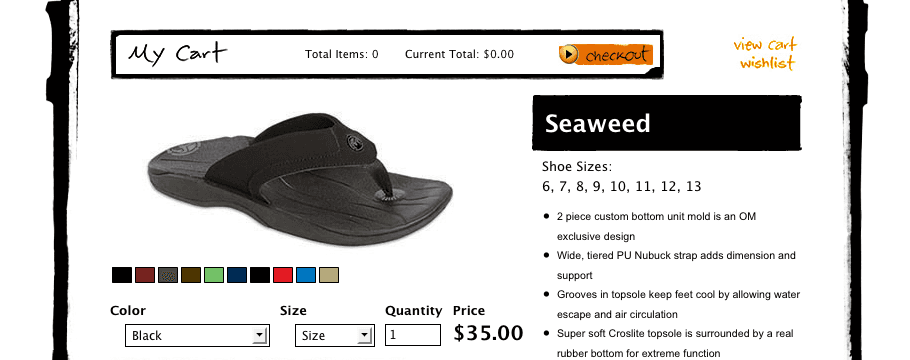
No blank product pages. This rule is ignored most often by gift stores and clothing retailers with deep catalogs. Adding a thousand products won't generate revenue if the descriptions are absent. A high-res image may be worth a thousand words to a human, but to a search crawler an image with no supporting text is worth close to zero - it cannot read the photo, and alt text alone is thin fuel for ranking a commercial page that needs to compete.
Beat the Boilerplate Word Count
Here is a concrete diagnostic you can run today. Count every default word on a blank product page - menu, sidebar, header, footer, related-products carousel, anything that repeats unchanged on every product. That number is the floor your unique description has to clear before the page has more distinctive content than template. If your chrome is 300 words and your description is 40, the page reads to a crawler as roughly 88% boilerplate. The fix is not padding; it is writing enough genuinely useful, product-specific copy that the unique portion clearly outweighs the repeated portion. A page that is mostly template, repeated across thousands of near-identical URLs, is the exact pattern search engines are built to discount.
More Unique Content Helps - Up to a Point
More unique content is generally better for SEO, with an obvious caveat: too much copy hurts conversions and starts to read as keyword-stuffed to crawlers. Nobody, human or bot, wants an ocean of text dumped on a product. Write a substantive description and constrain it to what actually helps a purchase decision: what the product is for, who it is right for, materials and dimensions, compatibility and sizing, what is in the box, care and warranty, and the one or two questions customers most often ask before buying. That set of facts is naturally unique per product and is exactly what both shoppers and search engines reward. A useful target for most categories is enough copy to answer the real pre-purchase questions and no more.
Throw Away the Manufacturer Description
Did the manufacturer supply a description? Good - then discard it. Pasting the manufacturer's blurb is one of the fastest ways to get filtered, because the identical text already appears on dozens or hundreds of competing retailers. Search engines select a canonical source for duplicated content and suppress the rest; you do not want to be one of the suppressed, and you usually will be if you are smaller than the brand or a marketplace. Always write your own. The same principle applies within your store: near-identical descriptions across color or size variants compete with one another, so canonicalize variants to a single parent product or use canonical tags so your strongest version is the one that ranks.
The Honest Option for Catalogs Too Large to Cover
For a store with a titanic, fast-changing inventory, writing unique copy for every SKU on day one may genuinely be impossible. The pragmatic answer is triage, not fabrication. Prioritize by revenue and search demand: the products and categories that drive sales or have real search volume get thorough, unique descriptions first; the long tail gets queued. Genuinely low-value or transient SKUs you cannot cover yet are better kept out of the index than published thin. The practical levers are a noindex directive on pages you cannot yet make unique, canonicalizing variants to a parent, or simply not publishing a product until it has real copy. The objective is to avoid looking like a site that auto-generated thousands of near-empty pages to inflate its footprint - precisely the behavior Google's policies on scaled, low-value content target, and exactly the impression a store with a few rich pages and a long tail of empty ones gives.
A Repeatable Workflow
Make description quality a process, not a one-time cleanup. Templatize the structure- a fixed set of sections every writer fills - without templatizing the words. Give writers the spec sheet and the top three customer questions for each product so they have raw material instead of a blank box. Review a sample for cross-product duplication before publishing. And re-audit every time you bulk-import a supplier feed, because feed imports are the single most common source of pasted manufacturer text re-entering a catalog that was previously clean. Treat product copy as inventory that needs maintenance, not a field you fill once and forget.
Frequently Asked Questions
How long should a product description be? Long enough to clear your boilerplate word count and answer the real pre-purchase questions for that product - not a fixed number. A simple commodity needs less than a technical or high-consideration product.
Is the manufacturer description ever acceptable? As raw source material to rewrite, yes. Published verbatim, no - it is duplicated across the web and will usually be suppressed in favor of a larger competitor.
What about AI-generated descriptions? Useful as a first draft to edit, dangerous if published unreviewed at scale, because unedited bulk output recreates the thin, near-duplicate pattern this whole article warns against. Always have a human verify facts and uniqueness.
This is detailed, ongoing work, and at catalog scale it is a real investment - which is why many stores hand it to specialists. For help building unique, conversion-focused product content that ranks, see our ecommerce SEO services and our content marketing team, or run a free ecommerce SEO audit to find your thinnest pages first.