


Do you ever feel like you hear a lot about the online customer experience but never enough advice on how to make concrete improvements? Here is a list of direct ways to improve your site’s user experience. Perhaps you already considered some of these factors but need a re-evaluation. It’s time to dig a little deeper and consider why you do the things you do and how they can benefit the customer.
1. Product knowledge and niche markets.
What exactly do you sell and why? For small ecommerce businesses, it is important to know your product and become a niche source for what you’re selling. Maybe you are an online clothing store. What makes your online selection different from the brands you can find on larger sites like Amazon? Chances are you will not be able to compete with the prices of a large commerce giant, but that is where your strength lies. Maybe you offer a variety of styles or smaller lesser known designers.
2. Engaging and dynamic blogging.
While blogging may be last on your to-do list if you are product and sales oriented, it is actually a very integral part to the overall traffic your site generates. Presumably you are already an expert and have an affinity to the products you are selling. Well, why not share your knowledge with your customer base? Infographics, visual images and diagrams about your products can also be helpful to the reader. Blogging should not be about selling a product, but rather offering information about that product or service. Show how your product could benefit the customer in a real life situation.
3. Interactive category pages.
Creating interactive category pages is great way to showcase your customer service chops. Although you may have not given it much thought in the past, making your site more interactive and fun can add to the overall user experience. It may be what differentiates you from another e-commerce store with similar products. For example, you can add hover over text to a product. The allows the customer access to more useful information without leaving the page.
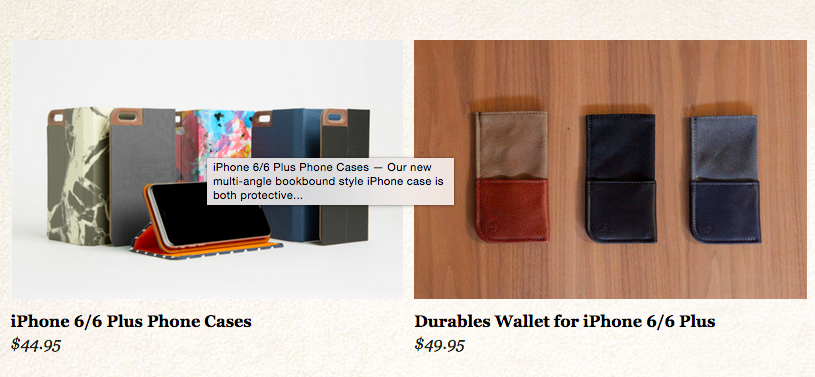
Source: DodoCase
4. Offer free help.
If you sell leather maybe it’s important to include a leather care section or link to a credible source about leather care. Linking out to other credible sources is not necessarily a bad thing. Offer multiple ways that the customer can get in touch with you if they have further questions.
5. Customer reviews and feedback.
. Reviews are a solid way to reassure potential customers that they are making the right choice by purchasing from your site. If you are looking for a way to receive customer feedback, try trading your customer’s feedback and time for special promotions. You may even want to do some giveaways with bloggers or reputable sources in exchange for valuable online reviews. In this case, just be careful they are not backlinking to your site but citing you with no-follow links instead.
6. Product pages with detailed descriptions.
As a smaller retailer you should definitely put in the time to make unique and interesting product descriptions. The advantage you have over larger retailers is that your inventory is more manageable and niche. For example, if you have many types of the same product but one style is more expensive, make an effort to explain why. Why does this warrant a higher price? Perhaps there is a special function or design element. This could be displayed visually in a video format or infographic on your blog and linked to and from your product page. If you want just to stick to words, don’t be afraid to write a lot. You can include rich content including poems to support designs, inspiration and product specification. With all that effort, the product and story behind it become inherently more interesting. It not only helps create a deep connection between the reader and product but is great for SEO too.
The Takeaways.
7. Make local and niche search work for you.
A small store cannot outspend a marketplace giant on broad terms, but it can win the specific, lower-competition searches its products actually answer. Target long-tail, intent-rich queries ("hand-stitched leather camera strap for mirrorless," not just "camera strap") in your product titles, descriptions, and category copy - the traffic is smaller but far closer to buying and far cheaper to rank for. If you also have a physical presence or service area, claim and complete a Google Business Profile; for many small retailers local search is the single highest-return channel and one the big players cannot dominate the way they dominate generic terms.
8. Reduce checkout friction.
All the product-page craft in the world is wasted if the checkout leaks. The proven reductions are concrete: offer guest checkout, keep the form to the minimum fields, show total cost including shipping early rather than springing it at the end, support the wallets shoppers already trust (Apple Pay, PayPal, Shop Pay), and make sure the entire flow works flawlessly on a phone, where most browsing now happens. Each removed step measurably recovers carts a small store cannot afford to lose.
9. Build retention, not just first sales.
For a small ecommerce business the economics favor repeat customers heavily, because acquiring a new one is expensive and a niche audience is finite. Capture emails with a genuine incentive, then run the few automations that earn continuously: a welcome series, an abandoned-cart sequence, and a post-purchase flow with usage tips and a relevant cross-sell. A modest, well-run retention program often returns more than the equivalent effort spent chasing new traffic.
10. Measure what actually drives revenue.
The original tips improve the experience; instrumentation tells you which improvements paid off. Set up analytics and Search Console from the start and watch a short list: which sources bring buyers (not just visitors), where the checkout loses people, which products and content pages convert, and conversion rate by device. A small team cannot act on everything, so the goal of measurement is focus - fix the one step that is leaking the most, confirm the number moved, then move to the next. Treated as a loop rather than a launch, these ten tips compound instead of plateauing.
Besides having a great looking site that is easy to navigate, there is a lot of weight riding on the customer experience. You can achieve virtual customer service, even when you are not available, through the use of words on your product page and helpful articles on your blog. Even if you are not available 24 hours a day, the information you write and display can offer a lot of help to the customer and usher them along in the decision process. There is no way to accurately recreate a brick and mortar experience in which all of your senses are being influenced and you are having a face-to-face customer service interaction. Online, however, you can supply niche product options and provide a wealth of information. Overall, the goal is to convey that you are there to help and have a proven track record with other customers.