

FOR AUTO PARTS SELLERS
Auto Parts SEO Agency: ACES/PIES Fitment, YMM Architecture & Install Content
Auto parts SEO is fitment data done right or it doesn't work. Clean ACES/PIES data, proper YMM (year/make/model) URL architecture, and authoritative install content separate the winners from RockAuto's traffic shadow. We build it on Shopify Plus, BigCommerce and Magento. 1Digital® has worked with parts sellers since 2012.
Ready to get your Auto Parts CMSbuilt - free?
1Digital® builds your auto parts CMS front-end on WorkspaceCMS.ai at no cost - AI-first, SEO-first, live in a few days to a few weeks*. Shopping cart and checkout integration is custom-quoted. Your free build credit applies toward any package.
No setup fees · 12-month commitment · 4.9★ from 941+ reviews
* Timing depends on how quickly we receive your questionnaire answers and content.
Trusted by 400+ Brands · Certified Partners




Years in eCommerce
Of results, scale, and quality at the enterprise level.
Expert Team
Specialists across SEO, AI SEO, PPC, design, dev, and strategy.
US Core + Global Talent
US core team for clear communication; vetted global specialists for international client work.
Reputation Score
Rated 4.9/5 across 941+ verified client reviews.
Ask AI for a business like yours. Are you in the answer?
ChatGPT, Claude, and Perplexity only recommend sites they can read - and most can't read yours. Scan it free and see exactly where you stand.
Free · no signup · scores the 15 signals AI uses to find you · ~20 seconds
How Auto Parts SEO Wins With Fitment Data First
Auto parts is the most fitment-intensive vertical in ecommerce. A shopper searches '2014 F-150 5.0 brake rotors front' and expects a page that confirms fitment, shows compatible parts, and rules out incorrect SKUs immediately. Search behavior is dominated by YMM queries, OEM part-number queries, install and how-to queries (which feed top-of-funnel demand), and price-comparison queries against RockAuto, AutoZone and Amazon. Without clean ACES/PIES data, none of it works.
1Digital® builds auto parts SEO programs around three pillars: ACES/PIES data hygiene wired into a proper YMM URL architecture, install and how-to content that captures top-of-funnel demand competitors ignore, and Google Shopping feed compliance (some auto parts categories face placement restrictions). We work on Shopify Plus, BigCommerce and Magento - and Magento is genuinely the right answer more often in this vertical than in most. WorkspaceCRM tracks citation share on fitment and install queries.
- ›ACES/PIES fitment data hygiene wired into clean YMM URL architecture
- ›Year/make/model category and PDP structure for high-intent fitment queries
- ›Install guides and how-to content that captures top-of-funnel demand
- ›OEM and aftermarket cross-reference content for part-number queries
- ›Google Shopping compliance for categories with placement restrictions
- ›WorkspaceCRM citation tracking vs RockAuto, AutoZone, Summit Racing and Amazon
Auto Parts SEO, step by step
Climb the searches your buyers make
Here is a typical auto parts search playing out. Expert writers and strategists build the category and product pages that move your store up the results, and the clear answers that get it cited in Google's AI Overview above them.
- ›Pages written by people who know the search behind the sale
- ›Structure and schema that AI Overviews can read and quote
- ›Rankings tracked search by search, not as one blended average
The Auto Parts market
What we cover in Auto Parts SEO
Named sub-verticals and buyer segments inside the Auto Parts category that we map keyword strategy and content programs to:
Last updated: October 2026
Auto Parts by the numbers
$540 billion
projected US automotive aftermarket size in 2025
Source: Auto Care Association, 2025 Auto Care Factbook
Auto Parts SEO - buyer questions
Common questions in the Auto Parts vertical
Why is ACES/PIES data critical for auto parts SEO?
ACES and PIES are the industry-standard data formats that map parts to vehicle applications (ACES) and describe product attributes (PIES), making them the foundation of every fitment-driven auto parts SEO program.
Auto parts retailers without clean ACES/PIES data cannot build the fitment-filtered URLs and structured product pages that Google rewards in this vertical. Inaccurate fitment also drives return rates above 20%, which damages merchant signals on Google Shopping. 1Digital® integrates ACES/PIES feeds from suppliers like SEMA Data Co-op and WHI Solutions into BigCommerce and Shopify catalogs so every SKU has indexable, vehicle-specific landing surfaces.
How do auto parts retailers compete with RockAuto, AutoZone, and Amazon on Google?
Mid-market auto parts retailers beat national chains on long-tail, specialty, and technical queries - not head terms.
RockAuto and AutoZone dominate searches like 'brake pads' but rank weakly on '2007 Duramax LMM head gasket kit ARP studs' or 'NP241 transfer case rebuild parts.' Specialty sites win by publishing deep technical guides, OEM cross-references, and forum-engaged content that earns links from enthusiast communities. The economic model works because long-tail buyers convert at 5-8x head-term rates and tolerate full margin pricing in exchange for fitment accuracy and expertise.
Does Google Shopping work for auto parts, and what are the restrictions?
Google Shopping works for most auto parts categories but enforces strict fitment-data requirements and prohibits certain items.
Merchants must submit accurate product_type, vehicle compatibility, and MPN/GTIN data or feeds get suspended. Categories like aftermarket airbags, certain emissions defeat devices, and some performance ECUs are restricted under Google's dangerous-products policy. Compliance hinges on clean PIES-based feed mapping and disclaimers on emissions-related products. Properly optimized auto parts Shopping feeds deliver 3-5x the ROAS of unmanaged feeds because fitment-accurate impressions filter out unqualified clicks.
What ecommerce platform is best for a large auto parts catalog?
BigCommerce and Adobe Commerce (Magento) are the dominant platforms for large auto parts catalogs (50K+ SKUs) because they handle complex faceted navigation, ACES fitment integration, and B2B price tiers natively.
Shopify Plus has closed the gap with apps like PartsLogic and Convermax but still struggles with very deep catalogs and multi-warehouse inventory. 1Digital® migrates and optimizes auto parts retailers across all three platforms and typically recommends BigCommerce for catalogs above 100K SKUs due to its API throughput and native catalog handling.
How important are installation guides and how-to content for auto parts SEO?
Installation guides and DIY how-to content are the highest-converting top-of-funnel asset class in auto parts SEO.
Queries like 'how to replace timing chain on 5.3 Vortec' attract buyers actively shopping for the exact parts needed and earn natural links from forums, YouTube descriptions, and enthusiast blogs. Content paired with internal links to fitment-filtered category pages produces measurable revenue attribution. The format also performs well in AI Overviews and ChatGPT citations because it answers specific procedural questions with extractable, step-by-step facts.
Auto Parts SEO - FAQ
Why is ACES/PIES data so important for auto parts SEO?
ACES (fitment) and PIES (product attributes) are the industry-standard data formats that map every SKU to every compatible year/make/model/engine/trim combination. Without clean ACES/PIES data, you cannot build accurate YMM pages, cannot prevent customers from buying the wrong part, and cannot compete with RockAuto on the bread-and-butter fitment queries that drive this vertical. We audit ACES/PIES data quality, fix gaps and conflicts, and wire the data into URL structure, schema and on-page content. This is the foundational layer - everything else compounds on top of it.
How should YMM (year/make/model) URLs be structured?
Hierarchically and consistently: /year/make/model/engine/category/part-name as a typical pattern, with breadcrumb schema and clear faceted-search canonicals. The trap is allowing every facet permutation to be indexed, which floods the index with low-value pages. We index high-volume YMM combinations and category intersections, canonicalize the long tail, and use clear internal linking from generic part pages down to specific fitment pages. Done right, YMM architecture captures both head and long-tail fitment queries without crawl budget waste.
How do you compete with RockAuto, AutoZone and Amazon?
On install content, niche specialization, and trust. RockAuto wins on price-driven head queries but loses on install guidance, application specialization (performance, off-road, restoration), and trust-stage content. AutoZone owns local. Amazon has third-party seller trust problems on parts. We position specialty parts sellers on install and how-to content (top-of-funnel that competitors largely ignore), application niches with genuine expertise, and trust signals around fitment guarantees and return policies. AI engines particularly reward install content with extractable step-by-step structure.
Are there Google Shopping restrictions on auto parts?
Yes, on specific categories. Tires, certain emissions-related parts, salvage and reconditioned parts, and aftermarket parts that modify safety systems face Shopping policy restrictions or outright bans. We audit feeds against current Merchant Center policy, segment restricted categories, and shift organic and direct-traffic strategy where Shopping isn't available. The constraint actually increases the value of organic SEO in those subcategories - because paid competition is structurally lower, organic wins are durable.
Does install content actually drive revenue or just traffic?
Both. Install and how-to content captures top-of-funnel demand ('how to replace front rotors on 2014 F-150') that competitors largely cede, then converts a meaningful share of that traffic into related parts purchases through internal linking and contextual product modules. It also builds long-term E-E-A-T and AI citation authority - install content is heavily cited in AI Overview answers because it's extractable and procedural. Specialty parts sellers who invest in install content consistently outperform those who don't, even at lower direct rank.
Which platform is best for an auto parts catalog?
Magento (Adobe Commerce) more often than in other verticals - auto parts catalogs typically have hundreds of thousands of SKUs, complex fitment relationships, dealer and wholesale tiers, and ERP integrations that overwhelm lighter platforms. BigCommerce handles mid-size catalogs well. Shopify Plus is suitable for smaller specialty parts brands with curated catalogs but strains at full-line distributor scale. 1Digital® is a Magento Partner, BigCommerce Elite Partner and Shopify Plus Partner - and parts is the one vertical where we most often recommend Magento despite the higher ops overhead.
Get a free proposal
Talk to our Auto Parts marketing team
Tell us about your business and goals. A senior strategist replies within one business day with a pricing band and a draft plan. No long-term contracts.
4.9/5 from 941+ reviews
Managed Websites by 1Digital®
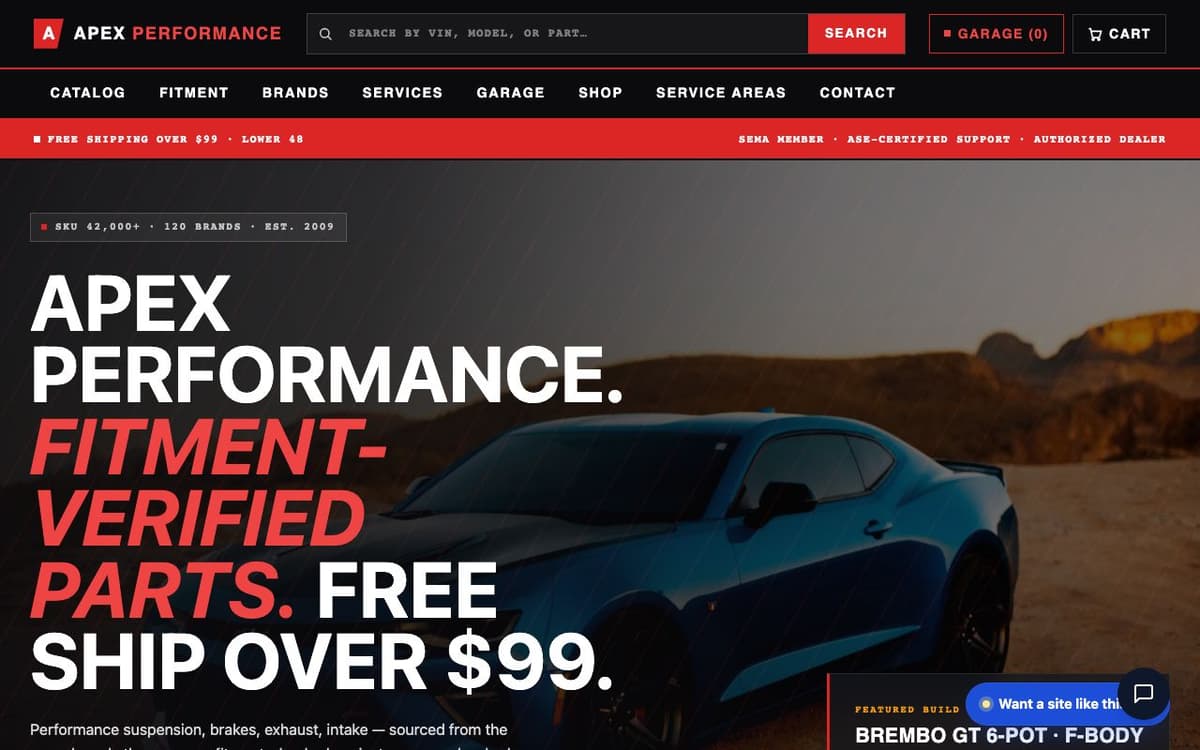
A Managed Website Built for Auto Parts Businesses.
- VIN-verified fitment lookup on every product page
- Free shipping threshold ladder and install-shop locator
- Fleet and contractor portal with Net-30 quoting
- Performance category pages with schema for Google Shopping
- Built so AI assistants can read and cite you when buyers ask an LLM for parts or service
Lighthouse
Visible in Google · ChatGPT · Claude · Perplexity
Powered by
Your Auto Parts CMS Is One Call Away.
1Digital® builds your auto parts site’s CMS front-end on WorkspaceCMS.ai at no cost - AI-first, SEO-first, and ready for Google and every major LLM from day one. Shopping cart and checkout integration is custom-quoted. Your free build credit applies toward any custom package.
15+ yrs · Google Partner · 4.9★ · 941+ reviews · Live in days to weeks*
* Timing depends on how quickly we receive your questionnaire answers and content.