

Enterprising eCommerce entrepreneurs sometimes have questions about what the differences are between national and local SEO, or even how one can discern between the best local SEO services and those that hardly (if at all) differentiated from national SEO services.
The best way to illustrate this is with a closer look at one of our clients for whom we saw considerable local growth as a result of the implementation of our time-tested and proven local SEO strategies.
The Unique Market Conditions
The client in question operates in a restricted industry and serves only a local market, from two locations, both of which are in the same state and not particularly far from each other.
Being in a restricted industry is one thing; it limits the scope of digital marketing to organic only, the bulk of which should be pursued through search engine optimization.
Serving only a local market is another. Targeting keywords that would be good for eCommerce companies that served the whole country would be counterproductive. Getting visibility for those keywords on the other coast would categorically be a win in SEO. There’s just one little problem. National visibility won’t help this client. Only local visibility targeting the right location-specific keywords will.
The client also operates two websites, one for each location, as indicated. That required that while optimization for some of the same keywords might be acceptable (cannibalization notwithstanding) to excel in each of their respective markets, each would need campaign-specific local keywords.
One particular challenge associated with this campaign was that each website already had reasonably decent overall visibility for keywords in their industry, but not for the locations that they served. This means they were getting clicks and traffic to their websites, but not necessarily from members of their target market, and so revenue was lagging. That was one of the most critical elements of launching this campaign; we couldn’t just attract attention for cannabis-related keywords. We needed to cast a net that would catch those interested potential customers, but only those who were physically in each of their target markets.
That being the case, we were able to come up with a custom strategy for this local campaign (or rather, one for each website that differed only in one key way that will be shortly explained) intended not just to boost local visibility, but to better position the brand for success, and to generate revenue.
The Process

In addition to the completion of competitor audits and website audits for both client websites, along with an industry analysis, we began each campaign by addressing technical errors existing on both websites.
From there, we could lay the groundwork for the campaign by identifying local keywords that would not just improve visibility given the restricted industry, but which would focus on improving visibility in their target markets, which, in this case, were Richmond and Virginia Beach, and the surrounding areas.
By identifying keywords that were broadly targeted towards their respective industry (which for both websites was the same) we could then drill down by qualifying those keywords further with location-specific additions.
To be specific, the client in question operates a cannabis delivery service. This made generic keywords like “edible delivery” practical, but keywords like “dispensary in Virginia,” or even “Richmond dispensary” (for the Richmond location) more practical.
With these keywords, our SEO strategists were able to make (or at the very least recommend) granular changes to each of the websites in accordance with the strategy laid out for it. The combination of industry-specific and location-specific keywords would ensure not just that contextual authority would be built for each website within the cannabis industry, but that we would be targeting long-term visibility for the location-specific (or qualified) keywords targeted.
Once the target keywords were selected, we could start making optimizations for key target pages, optimizing headers, category page content, and other on-page ranking factors.
Simultaneously, our copywriters drafted a series of offsite posts used for building links, along with high-value, content-rich onsite posts (primarily blogs) that built topical authority and which hinged on a series of keywords not just relevant to their industry but to each location, respective of which website each piece would eventually be posted on.
In addition to this content stream, our technical team worked behind the scenes to create a variety of business listings for each domain that work not just to improve the overall authority and legitimacy of each website, but which could be optimized for local presence.
The Results
As with any SEO campaign, local or otherwise, there is more than one way to gauge success. Preliminarily, we could look at cumulative shifts in keyword ranking, as indicated by the screenshot below (albeit for only one of the websites).
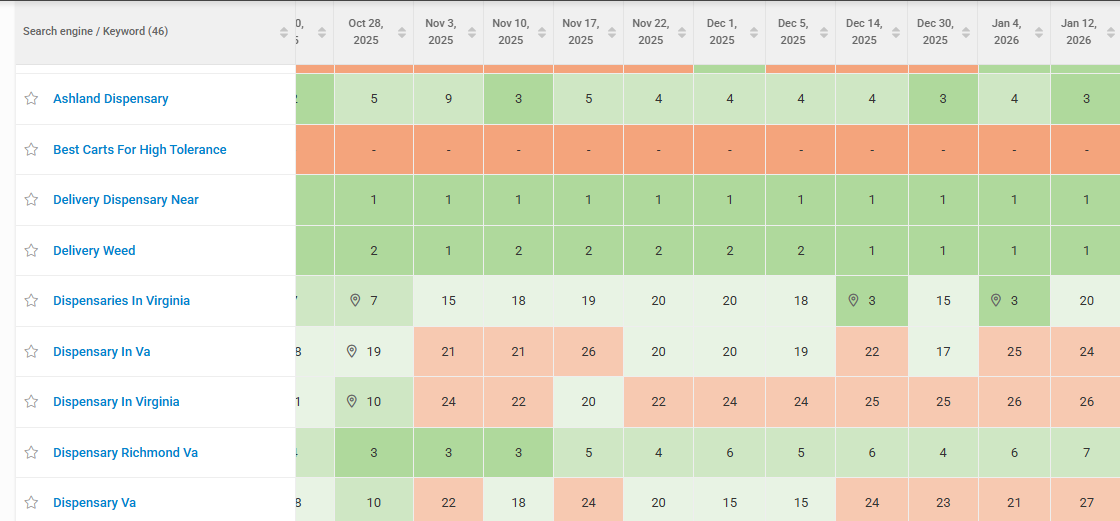
As you can see, there’s a good mix of keywords, some of which are specific only to the industry, and others which more closely target the location and surrounding areas. Some keywords were strong from the start, as indicated by their green coloration across the rows; otherwise have experienced positive shifts in ranking.
Another way to assess the health and performance of an SEO campaign is by taking a closer look at average position, impressions and overall clicks, especially when comparing two periods. The screenshot below is from one of the website’s Google Search Console accounts, and shows these increases.
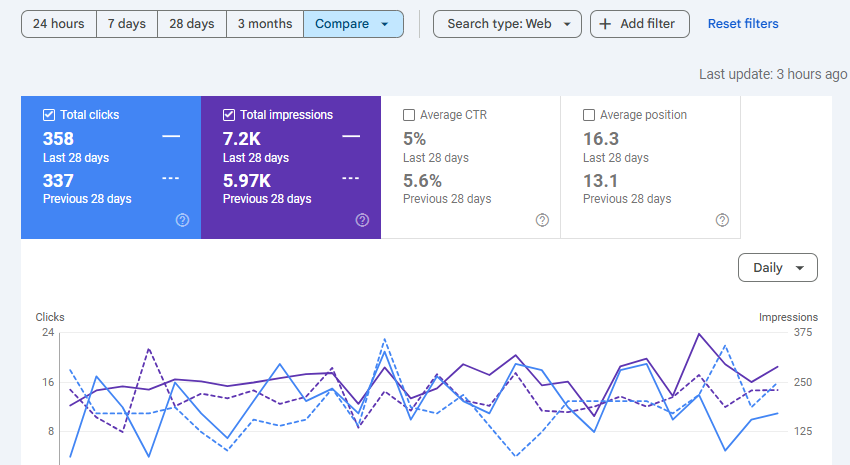
The time period is relatively short (it compares the past 28 days with the previous period as of the time of this publication), but as you can see, metrics are mostly positive. Average position is slightly down, but that can be easily explained by the fact that the website likely came into ranking for new keywords. More importantly, impressions and clicks were up from the previous period.
And then of course there is the bottom line. That is the proverbial bottom line, which is revenue. If we look at GA4 performance for just one of their websites, and compare revenue from the last 90 days (at the time of this publication) with revenue from the same period last year, you get a fairly clear picture of the results we generated.
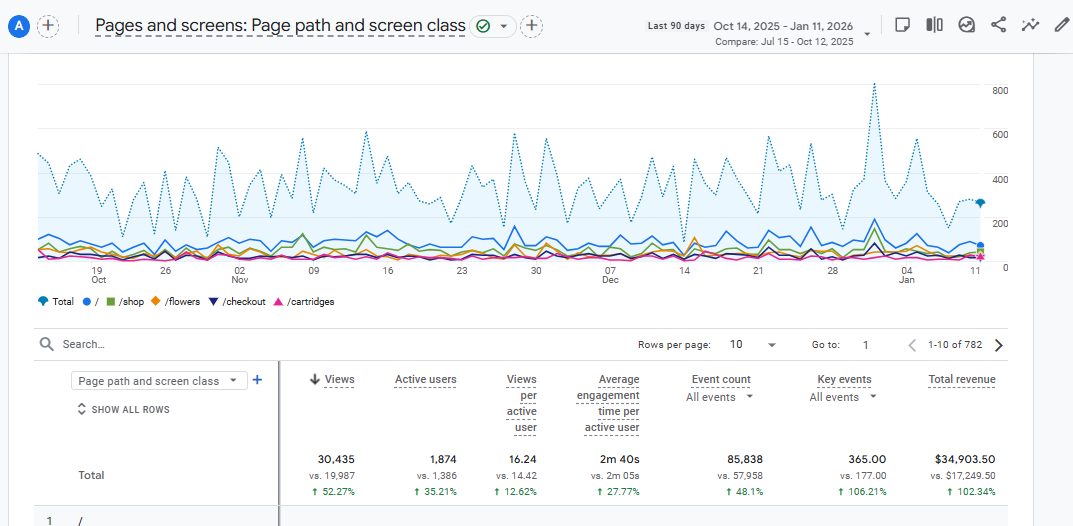
The picture says it all. Revenue is up over 100% overall when compared to the same period last year. It more than doubled, mostly as a result of improved targeting as executed through our local SEO efforts.
As important as the revenue metric is, you can also see that all other success indicators captured through this view of GA4 also improved significantly over the given time frame. Importantly, views and average engagement time were both up, by 52% and 27%, respectively.
So, even when you zoom out and lose sight of the granular details associated with the best local SEO services, the metrics tell the story. Impressions, clicks, overall organic traffic, engagement, and revenue all improved as a result of improved organic keyword rankings for those target keywords.
The Difference Between “Good Enough” and the Best Local SEO Services
A detailed breakdown of how the best local SEO services work is one thing; an exploration of the data, as shown in the latter half of this case study is another. The key message here is that there is a difference between effective national and local SEO, and that to truly succeed in your given corner of the market, it’s sometimes necessary to add layers of targeting through a local campaign. It can be all the difference between growth in impressions and growth in impressions and organic revenue.