

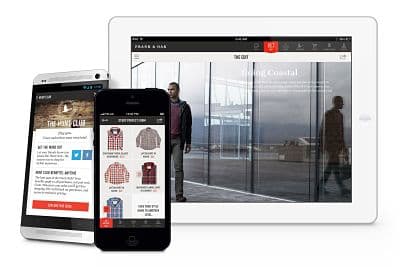
Historically, men haven’t been in league with their female counterparts when it comes to shopping activities. Frequency, average duration of session, average spent per session, total spent… Whatever the metric, women were leading. Okay, maybe men would have won the efficiency column (session duration/money spent), but only out of an aversion to the activity. However, it seems that mobile commerce is beginning to reverse that trend, oddly enough. Retailers like Frank & Oak (pictured above) quickly moved beyond any head-scratching and got in front of the trend by catering to their mobile users.
But we’d like to know. Why mobile? Have men changed, or is the reason more complicated? What is it about mobile commerce that men are responding to? A study from Business Insider provides us with valuable data on the subject, and I have a few theories of my own that might explain it.
Gamification of the shopping experience
Mobile apps and devices have made it convenient to track items and respond to updates from sites like eBay. Although auctions typically require the ongoing attention of the bidder, users no longer have to be in front of a computer during the closing minutes of an auction to win a bid.
As men are more likely to play (and purchase) video games, it might come as no surprise that a gamified process like auctioning attracts men more than women. The study found, among the 18-34 age group, that 43% of men used auction sites, whereas only 31% of women did so.
Price shopping
Men are price shoppers. Of course, this is not to say that women are not price conscious. In fact, women are slightly more avid couponers than men according to the same BI study, but men are more likely to shop around for price on their phones. One way I can think to explain this is by comparing Pinterest and Amazon. Pinterest, much more popular among women, capitalizes on the search for ideas, while Amazon, a go-to for men, is the place to find low prices.
The bottom line
Retailers want to know who is driving mobile sales. At 22% vs 18% on smartphones, and 20% vs 17% on tablets, men lead women in both categories. If these numbers come as a surprise to you, it may be time to reconsider your mobile strategy.
Thoughts and theories
As a survivor of many shopping trips planned by important women in my life, a part of me wonders if a big influence driving men to mobile shopping is the need to fight boredom while waiting for our women to shop. After all, I can think back to more than a few occasions that were remedied with mobile shopping.
I remember the first time a mobile ad led me directly to a purchase. An awesome pair of shoes caught my thumb on my Twitter feed. A great price and the warning “limited availability” called me to action. One click took me straight to the checkout page, and the transaction was complete within a few minutes. I made it a point to share that URL on multiple social media channels – not because of the product, but because of the convenience of the transaction. New shoes weren’t even on my radar at the time! Side note: the shoes didn’t work out, but I had free return shipping!
In short, it isn’t men’s newfound desire to shop that’s driving mobile sales, but their same aversion. Men want to spend their nights and weekends, time typically sacrificed for in-store errands, doing other things. So they do that shopping on their phones whenever they have the time. That’s my take on it anyway. Retailers, marketers and app developers should take notice and design their mobile sites to accommodate the new shopping habits of men.
The durable insight beneath the trend data
The specific figures here come from an older Business Insider study and the named retailer example has aged, but the structural insight is sound and still actionable: mobile did not change who shops - it changed when and how they shop by removing the friction that kept certain buyers out. The "men shop more on mobile because it fills dead time and rewards price-comparison and gamified buying" framing is really a statement about removing barriers, and that applies far beyond one demographic.
What this means for how you build the mobile experience
- Optimize for interrupted, low-attention sessions. A large share of mobile shopping happens in fragmented moments - a commute, a waiting room, a couch. The store has to make a fast decision easy: persistent cart, saved payment, one-screen product essentials, and the ability to resume later without losing progress.
- Make price comparison frictionless on your own terms. Price-driven shoppers will compare regardless; the question is whether they do it on your product page or by leaving. Clear pricing, transparent shipping, and visible value signals (warranty, returns, reviews) keep the comparison from sending them elsewhere.
- Borrow the mechanics of "gamified" buying. Tracked items, restock and price-drop alerts, time-bound offers, and progress toward free shipping all add the small feedback loops that the article's auction example illustrates - they convert browsers who are not in a deliberate shopping mindset.
- Capture social-to-purchase in one motion. The author's anecdote - an ad on a feed to a completed purchase in minutes - is the entire modern social-commerce funnel. The merchants who win it have product pages that load instantly, accept wallet payments, and never force account creation before the sale.
A mobile-conversion checklist drawn from this
- One-tap or wallet payment so a spontaneous purchase completes in seconds.
- Guest checkout - account creation is offered after the sale, never required before it.
- Wishlist / save-for-later with notification hooks for the non-ready buyer.
- Shipping cost and delivery expectation visible before the final step.
- Fast, distraction-free product pages tested on a real phone on a normal connection.
Editorial note: the demographic statistics in the original come from a dated third-party study and the featured retailer reference has aged; they are retained as the historical observation that prompted the analysis, while the guidance above generalizes the still-valid behavioral insight.
The takeaway is not "men shop more" - it is that removing friction unlocks demand that was always there. We build mobile experiences around exactly that. See our eCommerce web design and conversion optimization work, or get in touch.