


Bigcommerce and Shopify are two well-known and highly-regarded eCommerce platforms. Both are capable of powering a great looking, high-converting website that functions without a hiccup. Just because they’re both great doesn’t mean they offer the same benefits/features. We break down some of the key differences between the two and what they could mean for your business here.
Price
Both platforms offer different levels of service depending on how much you want to spend. All prices listed paid on a monthly basis.
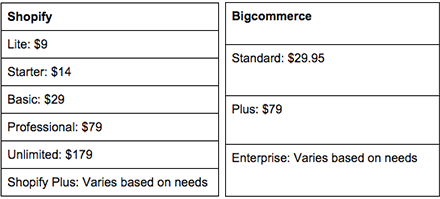
Both platforms offer similar functionality at the $29 price point. You can list as many products as you want on Shopify and Bigcommerce with the $29 plan. However, Bigcommerce offers gift cards, unlimited file storage, real time shipping quotes, and a built-in review system. In exchange for this, Shopify offers 0% transaction fees if you use their Stripe-powered “Shopify Payments” option while Bigcommerce charges 1.5%. Shopify does charge for other payment gateways.
While Shopify’s cheaper options are appealing from a budget standpoint, they are extremely limited compared to more expensive options from both platforms. Lite only allows you to use your Facebook page or a Shopify call-to-action to sell products. Starter does allow you to start a standalone store, but you are limited to 25 items and in your ability to edit the CSS and HTML on your site.
In general, you gain more functionality the more you pay. It is important to note that Bigcommerce doesn’t charge transaction fees on their Plus or Enterprise options, while Shopify still will unless you use their proprietary payment gateway. Real time carrier shipping is available on Bigcommerce’s $79 plan but only on Shopify’s $179 plan.
Please note that Bigcommerce Enterprise and Shopify Plus are meant for corporations or other large companies and are not designed for the majority of clients
Templates
| Bigcommerce | Shopify | |
|---|---|---|
| Free | 16* | 31 |
| Paid | 41* | 132 |
*Not all of Bigcommerce’s templates are responsively designed, something you need to be aware of when selecting. Responsive design is incredibly important today, as approximately half of all eCommerce traffic comes from mobile devices.
Both platforms allow you to customize templates, although not all of Bigcommerce’s templates permit edits.
Payments
Both platforms allow you to use a wide array of payment gateways with all of the common systems supported on both. Shopify allows you to use Paypal or Shopify Payments and Bigcommerce Paypal, Stripe, or Square as an “out of the box” payment solution. These are easy to integrate within your store and don’t require fiddling around with code trying to make sure everything works.
Blogging
Both platforms have blogging apps that you can use right off the bat without too much hassle. These are fine for basic blogging needs, but for more control users may want to integrate it with a 3rd-party platform like WordPress.
Abandoned Cart Recovery
Shopify and Bigcommerce both offer abandoned cart recovery options on their plans costing $79 and up. They will email customers who put items in their cart and left without checking out so you can try to draw them back. Shopify only lets you send one but Bigcommerce lets you send as many as you want. Depending on whether you use this feature wisely or abuse it, Bigcommerce’s abandoned cart recovery can be better or worse than Shopify’s.
Mobile Options
Both platforms allow you to create websites that are responsively designed. Shopify has a phone app that allows you to manage your store on the go. Bigcommerce did in the past but does not offer one currently. Some Android users report success controlling it through the web browser, but this is neither supported nor recommended by Bigcommerce.
Point of Sale Systems
Shopify offers a clean and easy solution for anyone who wants to take their eCommerce store into the physical realm. They allow you to hook up a card reader, provided for free, to an iOS device and process payments that way. They also offer additional options like a label printer and a till for people who want to take it one step further. Bigcommerce can do these things as well, but you have to use 3rd-party software, making it harder to bring together.
Conclusion
SEO and URL Control
A difference the original comparison does not cover, and one that matters a lot for organic traffic, is how much control each platform gives over technical SEO. Both let you edit title tags, meta descriptions, and URL slugs and both auto-generate sitemaps. The historical practical distinctions are around URL structure and faceted navigation: Shopify enforces fixed path prefixes (for example /products/ and /collections/), while BigCommerce allows more flexible URL structures and has generally given more native control over faceted/filtered category URLs, which is significant for large catalogs prone to duplicate-content and crawl-budget issues. For a catalog of any real size, evaluate how each platform handles filtered URLs and canonical tags before committing - it is harder to fix after launch than to plan for up front.
App Ecosystem and Total Cost of Ownership
Headline subscription price is the least useful number for comparing these platforms, because real cost is driven by what you have to add on. Shopify's app store is the larger ecosystem, so almost any need has an off-the-shelf app - but those apps carry their own monthly fees that stack up, and Shopify applies transaction fees if you do not use Shopify Payments. BigCommerce builds more features into the core product (faceted search, gift cards, reviews historically included at lower tiers) and does not charge platform transaction fees, which can mean a lower total monthly cost for a feature-rich store even if the base plans look similar. Compare the fully-configured monthly cost - base plan plus the specific apps and payment fees your store will actually incur - not the sticker price.
How to Actually Decide
Rather than declaring a universal winner, map the decision to your situation. Lean Shopify if you want the largest app and theme ecosystem, an integrated point-of-sale for physical retail, and the smoothest setup, and you are comfortable using Shopify Payments to avoid transaction fees. Lean BigCommerce if you have a large or complex catalog, want more built-in features without stacking apps, need flexible faceted-navigation/URL control for SEO, and want to keep your existing payment processor without a platform fee. Write down your must-have features, your realistic catalog size, your payment processor, and your in-house technical capacity first; the right platform usually becomes obvious once those are explicit.
Editorial note: the pricing table, plan names, template counts, and the "Bigcommerce Enterprise / Shopify Lite / Starter" tiers in the original body reflect 2015 plan structures and are now out of date - both platforms have since renamed and re-priced their tiers (for example BigCommerce's enterprise offering is now "BigCommerce Enterprise"/B2B Edition and Shopify's top tier is "Shopify Plus"), and exact current pricing should be checked on each vendor's site. The platform-selection guidance above (SEO/URL control, total cost of ownership, decision criteria) is evergreen and is what should drive the choice rather than the dated figures.
It would be inaccurate and unfair to both platforms to say that one is better outright. Both are very powerful tools that are capable of powering a successful ecommerce store. However, both have their quirks and one may be better suited to your needs. If you aren’t sure which one is best for you then give us a call! We’ll discuss what you need out of your eCommerce store and make a recommendation based on what we think will work best for you.