

If you’ve covered the basics of running an ecommerce business, you will have read about SEO. SEO, or search engine optimization, is a set of activities performed to increase your rankings in an internet search. This is important because the higher the ranking, the higher the visibility. Higher visibility can bring you more traffic through clicks.
Picture the world wide web as a series of rest stops on an information highway. Each rest stop is a unique document. Search engines “crawl” or seek out destinations in the form of links. Links are what allow the “crawlers” or “spiders” (Get it? world wide web) to reach billions of pages.
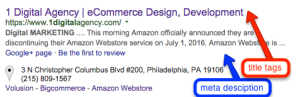
Search engines also use their “crawlers” and “spiders” to look for key technical elements on your page. For on-page optimization, your site should have title tags, a meta description, images and header tags all optimized according to chosen keywords. Technically speaking, your site should include a hierarchy of text links, a simple URL address and ALT attributes too. Each page should be designed with the viewer in mind and should strive to help them answer their query. Here is an example of how 1Digital Agency has used title and meta tags:
As mentioned, SEO is the mechanics of achieving a higher ranking. However, part of what search engines look for is far more than technical features. For search engines, the overall objective is to deliver accurate and unique human information to other humans. You could call it an H2H exchange of information. For example, SEO looks at the popularity of a site. Search engines will rank high traffic sites higher, based on the assumption that the traffic is an indication that real people are finding the content useful. Therefore, you should make sure your site is a source of unique and useful information. Your site should also include contact information which will make it even easier for an H2H interaction to occur.
In addition to technical elements and content, link strategy and social media can be useful SEO tools. Link building is a great way to get your content out there. Finding an authoritative source to link to your site will help with SEO because it gives credit to your site. It helps to build your online “rapport” because search engines, again, favor popular aka quality shared content. Creating visually informative content or infographics can help engage people on social media and different sites. Strong visuals paired with useful information is more likely to be shared. Although search engines don’t credit social media referrals as much as a link, it is still a viable avenue for sharing information and building traffic. See article: How to be a social media butterfly and get notice by google for more info.
Currently, internet usage via mobile devices has surpassed desktop usage. For SEO, it is now more important than ever to have your site optimized for mobile and other devices. By mid April 2015, Google will actually penalize sites that are not mobile friendly. Google wants to ensure that all the results that display when searched through a phone are easy for the users to navigate. Along with responsive web design, it is important for SEO that your site has fast loading times and is easy to navigate.
Professionals that manage SEO campaigns analyze the statistics of a number of different factors related to the SEO process. They start with a competitive analysis. This means they focus on targets and establish a strategy. In competitive analysis, potential SEO competitors are identified, validated and compared. Digital marketers also employ a variety of traffic monitoring metrics in order to gauge your site’s SEO vitals. There are many different metrics that can be monitored, including referral traffic changes, keyword rankings and mobile device usage.
To recap, SEO is based on how search engines crawl the internet for information, whether this is through non human or human search tactics. To capitalize off of these mechanics, you must look at the greater goals of search engines. Search engines are actually very social and want to ensure people are finding answers and are having optimal interactions. By researching the industries and competitive landscapes of websites, good digital marketers are able develop appropriate strategies to increase search rankings.
Keyword Research: Start With What People Actually Type
Before any on-page work, you need to know which queries are worth ranking for. For a beginner the practical method is simple: list the products and categories you sell, then expand each into the phrases a buyer would actually search - not just "running shoes" but "trail running shoes for flat feet" and "are zero-drop shoes good for beginners." Free tools (Google's autocomplete, the "People also ask" and "related searches" blocks, Search Console once you have traffic) reveal real phrasing. Favor specific, intent-rich terms over broad ones: a long, specific query has less competition and a visitor much closer to buying, which is exactly the traffic an ecommerce store wants.
Map Keywords to the Right Page Type
A common beginner mistake is pointing every keyword at the home page. Match the query to the page that best answers it: broad category terms ("women's hiking boots") map to category pages, specific product terms map to product pages, and informational questions ("how to break in hiking boots") map to blog posts that then link to the relevant category. This alignment with search intent is what modern search engines reward, and it also builds the internal link structure - guide links to category, category links to product - that helps both crawlers and shoppers move through the site.
Earn Authority and Track What Matters
The article's point about authoritative links and useful content still holds, with one modern emphasis: links should be earned by being genuinely worth citing (original guides, supplier and manufacturer listings, real press), not bought or traded, because low-quality link schemes now carry downside risk rather than upside. To know whether any of it is working, set up Google Search Console and an analytics tool from day one and watch a small number of signals: impressions and average position for your target queries, click-through rate from search, organic sessions to category and product pages, and conversions from organic traffic. Those four tell you whether the SEO work is translating into customers, which is the only outcome that matters.
Editorial note: this article originally stated that "by mid-April 2015 Google will penalize sites that are not mobile friendly." That rollout happened years ago and mobile-friendliness is now a baseline requirement evaluated through mobile-first indexing and Core Web Vitals, not an upcoming change - the sentence should be read as historical context.
Want more info? Contact an account manager for a personal explanation.