
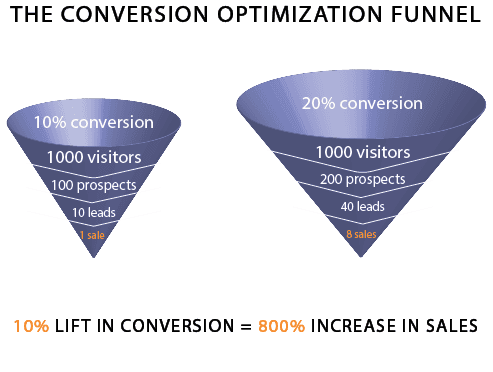
In digital marketing, the headline goal is usually a competitive search ranking, because top rankings drive more traffic to a site. There is a long list of activities designed to increase that ranking, and for eCommerce merchants the hope is that the increased traffic ultimately increases sales or conversions. But traffic is only half the equation, and it is the more expensive half to grow. The other half — converting the traffic you already have — is routinely treated as an afterthought when it should be a standing routine.
That second discipline is conversion rate optimization (CRO): making strategic, evidence-based adjustments to the site so a larger share of existing visitors complete the action you want. Done consistently, CRO compounds, because every future visitor — including all the new ones SEO and ads bring — converts at the improved rate. A one-point conversion improvement applied to a year of traffic is often worth more than the campaign that produced the traffic.
What CRO Actually Includes
CRO is an umbrella term, often confused with A/B testing alone. A/B testing is the measurement tool CRO relies on, but the discipline is broader and includes:
- Usability analysis — finding where the interface itself causes hesitation or error
- Landing page optimization — matching the page to the intent and source of the traffic hitting it
- Personalization and advanced segmentation — treating returning customers, new visitors, and high-intent segments differently
- User surveys and session review — understanding why people drop off, not just where
- Dynamic content — adapting messaging to context
- A/B and multivariate testing — the controlled experiments that turn opinions into decisions
Treat Your Site as the Whole Funnel
In a CRO approach, the site is the sales funnel. Once each stage is analyzed — landing, category, product, cart, checkout — you can identify exactly where qualified visitors leak out and prioritize the fix with the largest expected return. Suppose the goal is email sign-ups. You might add a sign-up offer, but if you run it through multiple placements without isolating which works, you are guessing. Build a controlled test: one variant with the offer, one without, traffic split, result measured. Only after that test do you actually know where sign-ups come from and where attention is justified. The same logic applies to product-page layout, shipping presentation, and checkout length — the stages where eCommerce stores lose the most money.
Why Small Changes Move Real Money
Even simple variables — copy, layout, color, the order of trust signals — change who completes a purchase. A/B testing matters because, without a controlled comparison, it is nearly impossible to attribute a change in revenue to a specific decision, which means it is impossible to measure a campaign's true ROI. After disciplined testing and iteration, small individual wins accumulate into a materially different conversion rate — and unlike a traffic spike, that improvement does not stop when the spend stops.
The Economics: Why This Is a Routine, Not a Project
There is a well-known relationship that marketers Neil Patel and Joseph Putnam have stated plainly: if you double your conversion rate, you cut your cost per acquisition in half. Applied to real numbers, if it currently costs $10 to acquire a customer, doubling conversion takes that to $5. The freed-up budget can then fund acquiring more customers — which is why CRO is one of the few activities that improves both sides of the unit-economics equation at once. That compounding is exactly why conversion assessment should be a recurring routine on a calendar, not a one-time clean-up done when someone finally notices sales are flat.
Where to Look First: The Highest-Leverage Pages
When conversion assessment becomes a routine, the natural next question is where to point it, and the answer is rarely the homepage. The pages that move the most money when improved are usually the ones deepest in the funnel, because a visitor there has already demonstrated intent and a small lift converts proven demand rather than chasing new traffic. Checkout is almost always first: every percentage point recovered there is applied to people who had already decided to buy and then stopped, which is the most expensive kind of loss. The product detail page is second, because it is where the actual purchase decision is made and where weak imagery, missing trust signals, unclear shipping, or buried reviews quietly suppress conversion at scale. Category and search-results pages are third — they determine whether visitors ever reach a product page at all, and a poor one wastes all the traffic acquisition spent to get the visitor there. The homepage, despite getting the most design attention, is often the lowest-leverage place to optimize for conversion because much of its traffic is not in a buying mindset yet. A routine that consistently spends its testing budget on checkout and product pages typically returns far more than one that keeps polishing the front door.
How to Make Conversion Assessment a Routine
Operationalizing this is mostly about cadence and discipline. Pick a small set of primary metrics — overall conversion rate, add-to-cart rate, checkout completion rate, revenue per visitor — and review them on a fixed schedule rather than only when something looks wrong. Maintain a backlog of test ideas ranked by expected impact and ease, so there is always a next experiment ready instead of a scramble for what to test. Run one well-designed test at a time on high-traffic pages so results are interpretable rather than confounded. Document what you learned even when a test loses, because a disproven assumption is itself valuable and prevents the same mistake from recurring. And pair CRO with the acquisition channels rather than treating them as rivals: SEO and PPC fill the funnel, CRO widens the bottom of it, and the two together produce far more than either alone. If you want a structured optimization program rather than ad-hoc tweaks, the digital marketing team at 1Digital® Agency builds CRO into ongoing campaigns alongside eCommerce SEO.
One discipline ties the whole routine together: resisting the urge to act on a single good-looking number. A variant that wins for three days can lose over three weeks once the traffic mix returns to normal, and a change that lifts add-to-cart can still depress completed checkouts if it attracts the wrong intent. The merchants who get durable gains from CRO are the ones who let tests run long enough to be trustworthy, judge them on revenue rather than on the nearest proxy metric, and keep a written record of what was learned so the program accumulates knowledge instead of relitigating the same assumptions every quarter. Conversion optimization is less about clever ideas than about the discipline to measure them honestly — which is exactly why it works best as a standing routine rather than an occasional scramble.