

FOR CARRIERS, BROKERS & INDEPENDENT AGENCIES
Insurance SEO Agency:
Carrier, Broker & Independent Agency SEO
Insurance is one of the most expensive paid-search verticals in the country and the slowest to convert offline. The agencies that compound growth do it on line-of-business architecture (auto, home, life, commercial, health), state-licensing transparency, TCPA-aware quote flows that don't trip Google trust signals, and the local SEO discipline that captures independent-agent demand the national lead-gen aggregators don't. 1Digital® builds insurance SEO programs designed for that economics - durable owned-traffic, not a quote-form treadmill.
Free Build
Ready to get your Insurance websitebuilt - free?
1Digital® builds your insurance site on WorkspaceCMS.ai at no cost - AI-first, SEO-first, live in a few days to a few weeks*. Flat monthly plans from $89/mo.
We Design It
Questionnaire-driven, AI-first, free
You Approve
Review before launch
Go Live
In days to weeks, no cost
No setup fees · 12-month commitment · 4.9★ from 941+ reviews
* Timing depends on how quickly we receive your questionnaire answers and content.
The 1Digital® Difference
AI in our toolkit. Humans in the driver’s seat.
Our strategists, designers, developers, and writers are human. The proprietary AI we built makes them faster and sharper - not the other way around.
- Human strategy
- Human copywriting
- Our own AI tools
- Real growth
Trusted by 400+ Brands · Certified Partners




Years in eCommerce
Of results, scale, and quality at the enterprise level.
Expert Team
Specialists across SEO, AI SEO, PPC, design, dev, and strategy.
US Core + Global Talent
US core team for clear communication; vetted global specialists for international client work.
Reputation Score
Rated 4.9/5 across 941+ verified client reviews.
Ask AI for a business like yours. Are you in the answer?
ChatGPT, Claude, and Perplexity only recommend sites they can read - and most can't read yours. Scan it free and see exactly where you stand.
Free · no signup · scores the 15 signals AI uses to find you · ~20 seconds
How Insurance SEO Builds Owned Demand In A YMYL Vertical
Insurance sits squarely in YMYL (Your Money or Your Life) territory, where Google's E-E-A-T standards apply most stringently and trust signals materially affect rankings. Search demand splits cleanly across lines of business (auto, home, life, commercial, health, specialty) and across buyer intent (quote-stage, comparison-stage, claims-stage, agent-search), and the agencies that win in these SERPs architect their site around both axes - distinct line-of-business hubs with comparison content, plus distinct intent-stage pages within each line.
Two operational layers compound on top: state-licensing transparency (insurance is regulated at the state level, and surfacing licensed states, license numbers, and producer credentials is both a compliance requirement and an E-E-A-T signal Google rewards), and TCPA-aware quote-form architecture (the Telephone Consumer Protection Act and FCC rule changes have tightened consent requirements for outbound calling, and quote forms that miss the consent language create both legal and Google-trust exposure). Independent agents win the local layer with GBP optimization, geo-modified content (“[city] independent insurance agent”, “[neighborhood] auto insurance broker”), and review-velocity discipline against the national aggregators that dominate generic queries - the same local-authority playbook we run for adjacent YMYL verticals like financial advisor SEO.
- ›Line-of-business architecture across auto, home, life, commercial, health, and specialty
- ›Intent-stage content (quote, comparison, claims, agent-search) within each line
- ›State-licensing transparency with license numbers, producer credentials and licensed-states map
- ›TCPA-aware quote-form architecture with clear consent language and 1:1 consent flows
- ›Local SEO for independent agents (GBP, geo-modified content, review velocity)
- ›YMYL E-E-A-T content with named producer authorship and authoritative source citations
Insurance SEO, step by step
Climb the searches your buyers make
Here is a typical insurance search playing out. Expert writers and strategists build the service and location pages that move your business up the results, and the clear answers that get it cited in Google's AI Overview above them.
- ›Pages written by people who know the search behind the sale
- ›Structure and schema that AI Overviews can read and quote
- ›Rankings tracked search by search, not as one blended average
Insurance SEO - FAQ
Why is insurance SEO different from general service SEO?
Insurance is YMYL, state-regulated, and TCPA-sensitive - three layers of constraint that general service SEO doesn't face. Google holds insurance content to a higher E-E-A-T standard because product choices affect financial outcomes; state insurance departments require licensing transparency and produce significant variation in what can and can't be claimed in advertising; and TCPA / FCC rule changes around quote-form consent have tightened the legal envelope around outbound contact. Generic service-SEO templates miss all three, which is why insurance sites built without vertical-aware architecture routinely underperform peers that ship licensing transparency, producer credentials, and properly-architected consent flows on every quote touchpoint.
How should an insurance site be architected by line of business?
One canonical hub per line of business (auto, home, life, commercial, health, specialty), with intent-stage sub-pages within each. A typical auto-insurance hub includes a quote-stage page (with TCPA-compliant form), a comparison-stage page (carrier comparison, coverage-type explainers), a claims-stage page (process, timelines, what to expect), and an agent-search page (find-an-agent or contact). Cross-link the hubs to capture cross-sell intent (auto buyers shopping home, life buyers shopping disability). This architecture mirrors actual buyer journeys and ranks substantially better than the “one big quote page per state” pattern most carriers still ship.
How do independent agents compete with GEICO, Progressive, and the lead aggregators?
Independent agents don't win head-term auctions against GEICO and Progressive - the ad spend math is unwinnable. The path is local SEO and personalized-quote depth on long-tail queries the national carriers ignore. Geo-modified queries (“[city] independent insurance agent”, “[neighborhood] homeowners insurance broker”, “commercial liability for [trade] in [state]”) and complex-coverage queries (umbrella, high-net-worth, specialty trades, multi-state commercial) reward independents with named producer authorship, real local presence, and depth on coverages the aggregators commoditize. Pair with GBP optimization and review velocity, and independents can capture significant organic share on long-tail local insurance queries despite the national carriers' brand dominance.
How do TCPA and consent rules affect insurance quote forms?
The Telephone Consumer Protection Act and recent FCC rule changes have tightened consent requirements for outbound calls and texts to insurance prospects. Lead-generation forms must include clear, specific consent language naming the parties that may contact the prospect, and 1:1 consent (one consent per business, not blanket lead-aggregator consent) is now the standard for compliant outbound. Sites that ship quote forms with generic consent or shared-lead disclaimers create both legal exposure and Google-trust risk as the platform increasingly favors transparently-consented contact flows. 1Digital® architects insurance quote forms with vertical-specific TCPA-aware patterns and works with carriers' compliance counsel to keep copy compliant as rules evolve.
How long does insurance SEO take to drive measurable lead volume?
Insurance SEO typically shows ranking lift in 4–6 months and meaningful lead-volume impact in 8–14 months. Timeline depends on existing site authority, line-of-business focus, licensed-state count, and competitive density. National multi-line agencies with established brand authority can see faster lift on long-tail queries; new independent agents in competitive metros typically need 12–18 months to compete against established local incumbents. Lead-volume success is measured in qualified quote requests, bind rate, and customer LTV - not just rankings - and the work that drives LTV (deep coverage content, named producer authorship, transparent claims content) is what compounds rankings over the long run.
Get a free proposal
Talk to our Insurance marketing team
Tell us about your business and goals. A senior strategist replies within one business day with a pricing band and a draft plan. No long-term contracts.
4.9/5 from 941+ reviews
Managed Websites by 1Digital®
A Managed Website Built for Insurance Businesses.
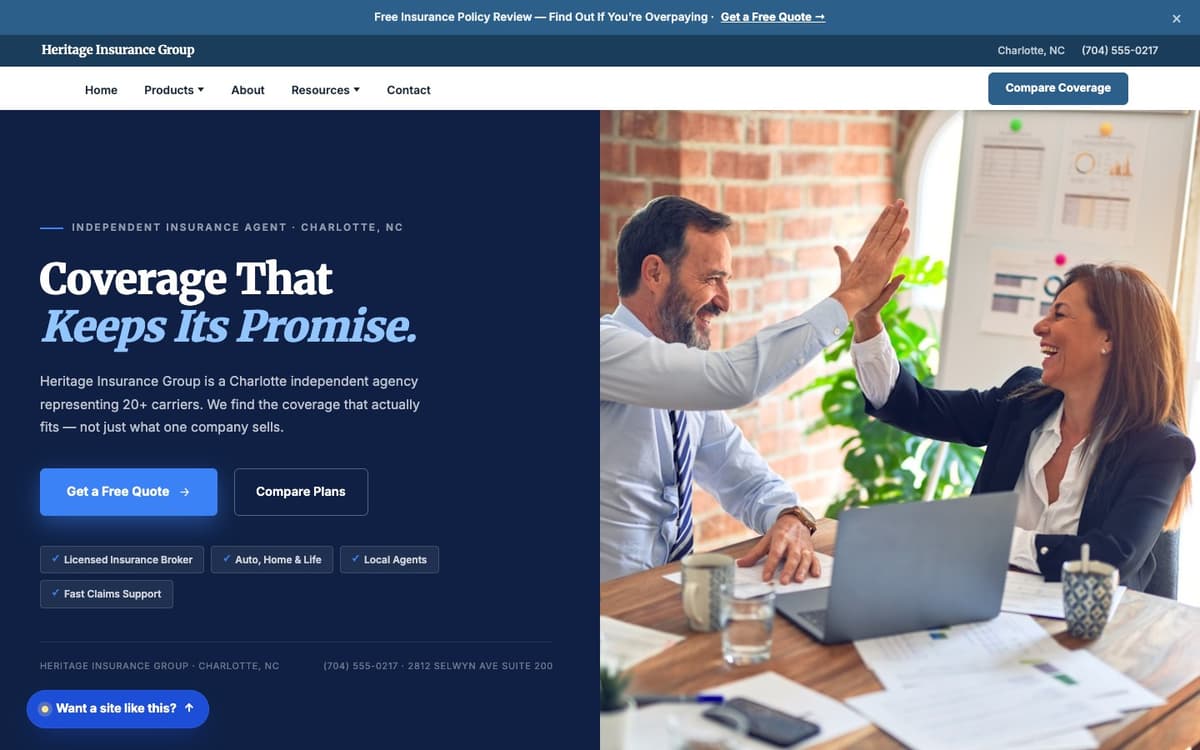
- Coverage comparison pages ranking for '[insurance type] quote [city]' queries
- Agent roster pages with credentials schema and trust signals
- Claim filing guide pages building content authority and reducing friction
- Lead capture form routing by coverage type to the right agent
- Built so AI assistants can read and cite you when buyers ask LLMs for insurance recommendations
Lighthouse
Visible in Google · ChatGPT · Claude · Perplexity
Powered by
Your Free Insurance Website Is One Call Away.
1Digital® builds your site on WorkspaceCMS.ai at no cost - AI-first, SEO-first, live in a few days to a few weeks*. Unlimited managed edits via ticket. Flat pricing. No tech skills needed.
Essentials $89 · Growth $199 · Premium $449 · Ultra $749/mo
15+ yrs · Google Partner · 4.9★ · 941+ reviews · Live in days to weeks*
* Timing depends on how quickly we receive your questionnaire answers and content.