

FOR INDEPENDENT BOUTIQUES
Boutique SEO Company: Curation, Founder Voice & Branded Search
Boutiques live and die on curation, founder voice and the branded search that Instagram and Pinterest drive back to Google. We build SEO programs that turn social discovery into compounding organic traffic - and surface your shop in AI shopping answers where Macy's and Amazon don't fit. 1Digital® has scaled independent boutiques on Shopify and Shopify Plus since 2012.
Ready to get your Boutique CMSbuilt - free?
1Digital® builds your boutique CMS front-end on WorkspaceCMS.ai at no cost - AI-first, SEO-first, live in a few days to a few weeks*. Shopping cart and checkout integration is custom-quoted. Your free build credit applies toward any package.
No setup fees · 12-month commitment · 4.9★ from 941+ reviews
* Timing depends on how quickly we receive your questionnaire answers and content.
Trusted by 400+ Brands · Certified Partners




Years in eCommerce
Of results, scale, and quality at the enterprise level.
Expert Team
Specialists across SEO, AI SEO, PPC, design, dev, and strategy.
US Core + Global Talent
US core team for clear communication; vetted global specialists for international client work.
Reputation Score
Rated 4.9/5 across 941+ verified client reviews.
Ask AI for a business like yours. Are you in the answer?
ChatGPT, Claude, and Perplexity only recommend sites they can read - and most can't read yours. Scan it free and see exactly where you stand.
Free · no signup · scores the 15 signals AI uses to find you · ~20 seconds
How Boutique SEO Captures Social-Driven Branded Demand
Boutiques operate in a different gravity well than mass retail. Discovery happens on Instagram, Pinterest and TikTok; consideration happens on Google ('[boutique name] dress,' '[founder name] new collection'); and conversion happens on-site. The SEO opportunity isn't competing with Macy's and Nordstrom on head terms - it's capturing the branded and curation-led search demand your social presence is already generating, and making sure AI shopping answers cite your taste-led collections.
1Digital® builds boutique SEO programs around three things: branded search capture (because your social is already generating it), founder-voice editorial that earns E-E-A-T signals AI engines reward, and curation-led collection pages that win style and trend queries. We work natively on Shopify and Shopify Plus, integrate Faire and Etsy where they're supplementary, and use WorkspaceCRM to track which curation queries cite your boutique vs the mass retailers.
- ›Branded search capture and entity work for the demand your social generates
- ›Founder voice and editorial that earns E-E-A-T signals AI engines reward
- ›Curation-led collection pages targeting style, trend and aesthetic queries
- ›Local SEO for brick-and-mortar boutiques with GBP and location content
- ›Faire and Etsy as supplementary channels with clean attribution and canonicals
- ›WorkspaceCRM citation tracking on curation and style queries in AI Overviews
Boutique SEO, step by step
Climb the searches your buyers make
Here is a typical boutique search playing out. Expert writers and strategists build the category and product pages that move your store up the results, and the clear answers that get it cited in Google's AI Overview above them.
- ›Pages written by people who know the search behind the sale
- ›Structure and schema that AI Overviews can read and quote
- ›Rankings tracked search by search, not as one blended average
The Boutique market
What we cover in Boutique SEO
Named sub-verticals and buyer segments inside the Boutique category that we map keyword strategy and content programs to:
Last updated: October 2026
Boutique by the numbers
$326 billion
US clothing and accessories store retail sales in 2024
Source: US Census Bureau, Monthly Retail Trade Survey 2025
Boutique SEO - buyer questions
Common questions in the Boutique vertical
How is boutique SEO different from big-box apparel SEO?
Boutique SEO competes on long-tail, style-driven queries and brand storytelling rather than head terms dominated by Macy's, Nordstrom, and Amazon.
Successful boutique strategies target queries like modest midi dresses for wedding guests or boho fall outfit ideas where intent is specific and competition is fragmented. According to NRF, specialty apparel retailers account for roughly 18% of US apparel sales, and they win through curated assortments, founder-led content, and editorial collection pages. 1Digital® builds boutique SEO around shoppable lookbooks, collection storytelling, and Pinterest/Instagram-driven content that captures style discovery traffic Google increasingly rewards.
What platform is best for boutique SEO - Shopify, BigCommerce, or WooCommerce?
Shopify powers the majority of US boutique stores (BuiltWith data shows Shopify hosts over 4.6 million live stores globally as of 2024), with BigCommerce favored by boutiques scaling past $1M in revenue that need stronger B2B and multi-storefront features.
Both platforms handle boutique SEO well when configured properly: clean URL structures, fast Core Web Vitals, structured product data, and collection-level content. WooCommerce offers flexibility but requires heavier technical maintenance. Platform choice matters less than implementing canonical tags, faceted-navigation crawl control, and image optimization - the three issues most boutique stores ship broken.
Should a boutique sell on its own site or on a marketplace like Etsy or Faire?
Most growth-stage boutiques use both: a DTC site for brand control, margin, and SEO, plus Faire (wholesale) or Etsy (handmade/vintage) for discovery and category-specific buyers.
Faire reported over 100,000 retailers on its platform in 2024 according to company disclosures, making it the dominant wholesale marketplace for independent boutiques. The DTC site captures branded search and email-driven repeat purchases, while marketplaces capture cold discovery. Each channel needs its own SEO discipline - Etsy SEO optimizes for internal search relevance, while DTC SEO targets Google product and informational queries.
How long does boutique SEO take to show results?
Boutique SEO typically shows category-level ranking movement in 90-120 days and meaningful organic revenue lift in 6-9 months, slightly faster than national apparel SEO because long-tail style queries are less saturated.
Time-to-result depends on domain age, content velocity, and product catalog depth. Boutiques publishing 2-4 styled collection pages and 1-2 buying guides per month generally outperform boutiques relying on product pages alone. Google's Helpful Content System rewards genuine expertise and original photography, which independent boutiques produce naturally - an advantage over scraped, syndicated catalog content from larger retailers.
What citations and directories matter for boutique SEO?
Boutique citations focus on industry trade outlets and style discovery platforms rather than traditional local directories.
Coverage in outlets like Boutique Magazine, Independent Retailer, The Boutique Hub, and regional gift-and-home shows (Atlanta Market, Las Vegas Market, NY NOW) builds topical authority and earns natural backlinks. Style features in editorial outlets like Who What Wear, The Everygirl, and Refinery29 drive both referral traffic and authoritative links. 1Digital® combines digital PR outreach to apparel and lifestyle press with structured-data-rich product pages so editorial mentions translate into ranking lift, not just one-off traffic spikes.
Boutique SEO - FAQ
How do small boutiques compete with Macy's, Nordstrom and Amazon?
By not competing where they can't win. Head terms like 'women's dresses' or 'designer handbags' are owned by mass retailers and aren't reachable for a boutique on any reasonable timeline. The wins are branded search (which your Instagram and Pinterest are already generating), founder-voice content that earns trust mass retailers can't fake, curation-led queries ('clean girl aesthetic outfits,' '[indie brand] alternatives'), and AI Overview citation where taste and editorial voice matter more than domain authority. We've grown boutique organic traffic significantly by focusing exclusively on what's actually winnable.
How do Instagram and Pinterest tie into SEO?
They're the discovery layer that feeds branded search. A pin or reel generates curiosity, the shopper googles the boutique or product, and Google has to surface a strong branded result or the demand leaks to a Macy's affiliate page. We treat social as the top of an SEO funnel: ensure branded SERPs are owned (homepage, key collection pages, founder bio, press, GBP if applicable), structure content for the queries social generates, and track branded-search volume as a primary KPI alongside non-branded organic.
Does founder-led storytelling actually help SEO?
Yes, particularly post-AI. E-E-A-T signals - Experience, Expertise, Authoritativeness, Trustworthiness - increasingly favor identifiable humans behind a brand. AI engines preferentially cite sources with clear authorship, founder voice, and editorial perspective; generic mass-retailer copy is genuinely disadvantaged. We build founder hub pages, author byline systems, and editorial content that surfaces personality and point of view. This matters more for boutiques than almost any other vertical and is one of the few genuine structural advantages over mass retail.
Should boutiques sell on Faire and Etsy alongside their own site?
Often yes, but with discipline. Faire (wholesale) and Etsy (retail) can supplement direct sales without cannibalizing brand. The SEO risk is duplicate content and unclear canonicals - never copy-paste PDP copy from your own site to Etsy and vice versa, and use canonical tags pointing to your owned site where the platform allows. Treat Faire and Etsy as customer acquisition, then migrate repeat buyers to your direct site through email and post-purchase flows where the LTV is yours to keep.
Is local SEO important for a brick-and-mortar boutique?
Critical if you have any physical presence. Boutique foot traffic correlates strongly with local search visibility - 'boutiques near me,' '[neighborhood] dress shop,' and branded local queries drive a meaningful share of in-store visits. We build GBP profiles, location-specific content, and review-velocity programs for every physical location. For pure-DTC boutiques without retail, we shift that budget to branded search and AI citation work instead.
Which Shopify plan fits a growing boutique?
Shopify (the standard plan) works for most boutiques under $1M in revenue; Shopify Plus makes sense above $1–2M when you need checkout customization, advanced flow logic, B2B features or multi-store consolidation. Migrating prematurely to Plus costs more than it returns. Migrating too late means living with constraints that cap growth. 1Digital® is a Shopify Plus Partner and will tell you honestly when the upgrade is justified - and when it isn't.
Get a free proposal
Talk to our Boutique marketing team
Tell us about your business and goals. A senior strategist replies within one business day with a pricing band and a draft plan. No long-term contracts.
4.9/5 from 941+ reviews
Managed Websites by 1Digital®
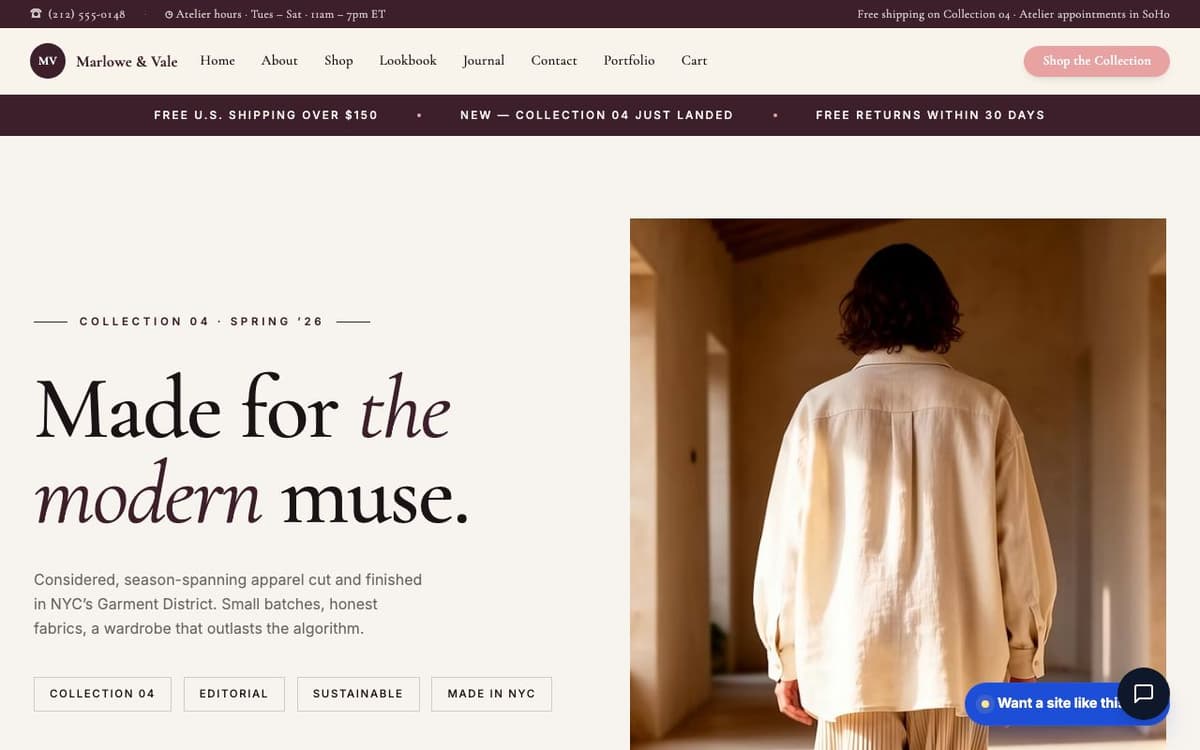
A Managed Website Built for Boutique Businesses.
- Editorial lookbook layout with atelier brand storytelling
- Shop-by-collection and quick-filter product grid
- Small-batch and limited-edition drop mechanics built in
- Garment-district or local pickup CTA wired per location
- Built so AI assistants can read and cite you when shoppers ask an LLM for fashion brands
Lighthouse
Visible in Google · ChatGPT · Claude · Perplexity
Powered by
Your Boutique CMS Is One Call Away.
1Digital® builds your boutique site’s CMS front-end on WorkspaceCMS.ai at no cost - AI-first, SEO-first, and ready for Google and every major LLM from day one. Shopping cart and checkout integration is custom-quoted. Your free build credit applies toward any custom package.
15+ yrs · Google Partner · 4.9★ · 941+ reviews · Live in days to weeks*
* Timing depends on how quickly we receive your questionnaire answers and content.